
Most VR games in 2018 are two-hour proof-of-concepts. You pay full price, you get a polished tech demo, and then you go back to waiting for someone to build an actual game in this medium. Seeking Dawn, from Chinese studio Multiverse, refuses to play by those rules. It drops you onto an alien planet with a rifle, a crafting bench, and the explicit promise of more than ten hours of survival, exploration, and combat. In a landscape starved for substance, that ambition alone makes it impossible to ignore.
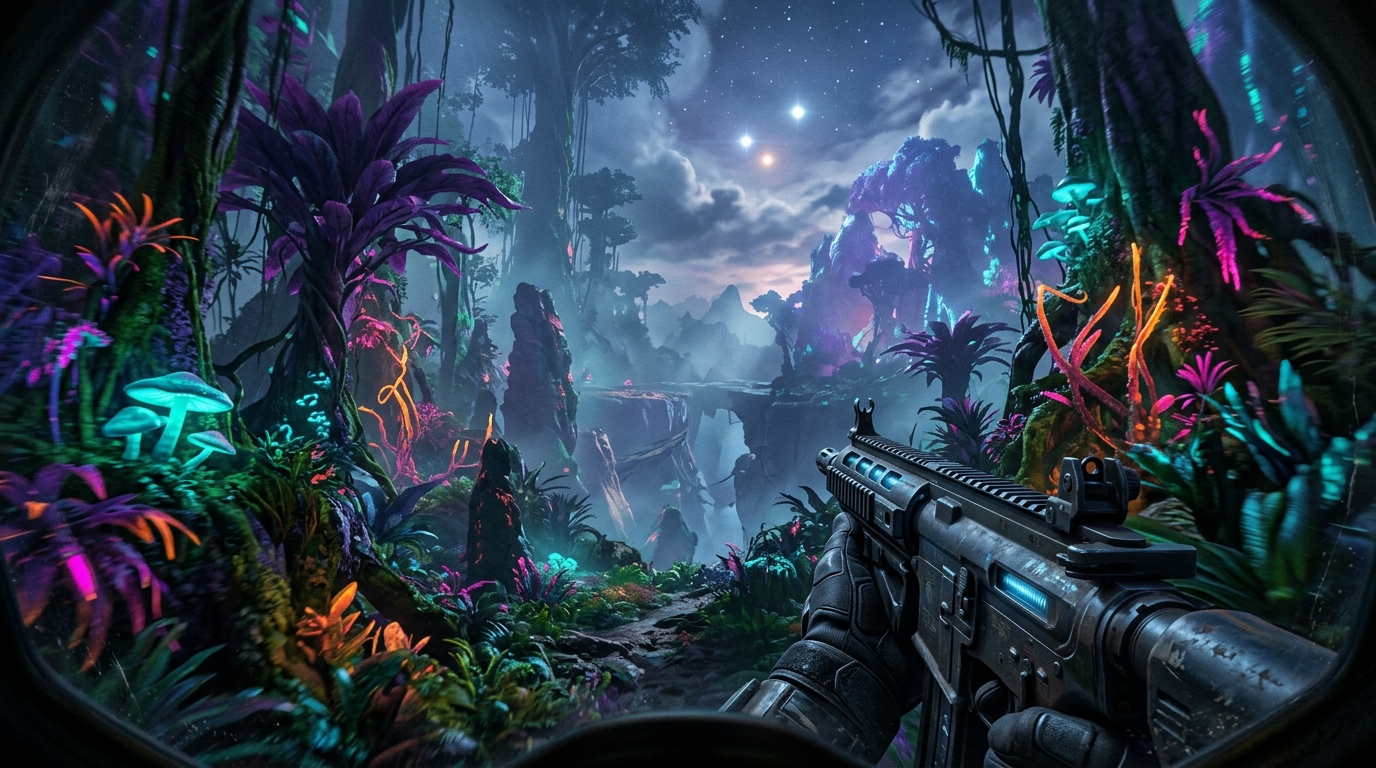
You play as a soldier dispatched to find a missing recon squad on a hostile alien world. What you find instead is a vibrant, lethal ecosystem of towering flora, aggressive wildlife, and enough mineral deposits to keep a crafting menu open for half the runtime. The narrative is standard sci-fi shooter fare — just enough context to justify moving from one biome to the next — but the world itself is the star. Seeking Dawn was, at launch, one of the most visually striking games available in VR. Alien landscapes glow with saturated color, creatures move with unexpected detail, and the sense of scale when you look up at the canopy or down a ravine genuinely delivers on the promise of “being there.” If you bought a headset for spectacle, this game pays that debt in stretches.
The combat holds up its end of the bargain, too. Weapons feel appropriately weighty in your hands, and the alien creatures you fight require genuine spatial awareness — dodging, retreating, and managing ammo in three dimensions. Boss encounters add pattern recognition and movement demands that flat-screen shooters simply cannot replicate. When the game lets you focus on shooting and exploring, it shines.
The problem is that it rarely lets you focus. Seeking Dawn wraps its shooter core in a survival blanket that feels duct-taped on rather than woven in. Hunger and thirst meters demand constant attention. Resource gathering — using tools like the Excabreaker for minerals and the Woodchucker for lumber — quickly devolves from novelty to drudgery. The crafting system lets you build weapons, armor, turrets, and ammunition, but without a meaningful tech tree or upgrade path, it functions more like a timed gate: collect enough stuff, craft the next gun, discard the old one, repeat. Base building exists in a prefabricated form that lets you place furniture and defensive structures but offers almost no creative freedom.
In VR, this busywork is amplified. Menu diving with motion controllers is slower than it should be. The constant audio reminders that you are thirsty or hungry interrupt the pacing. Several reviewers noted that the game would likely be better if the survival systems were simply toggled off — or better yet, never included. The tension between “epic sci-fi adventure” and “wood-chopping simulator” is never resolved, and the latter wins far too often.
Performance is another concern. Seeking Dawn is graphically demanding, and maintaining a steady framerate requires hardware that was, in 2018, on the higher end of the PCVR spectrum. The visual payoff is real, but players on mid-range systems reported needing to compromise on settings to keep the experience comfortable. Co-op multiplayer for up to four players is supported, though early launch reports cited connection issues and lag that undermined the feature.
Voice acting and narrative delivery also received criticism — stilted performances and animation sync issues that broke immersion during story beats. These are the kinds of rough edges you tolerate in a mod or an early-access project, but they sting more in a full-priced release promising AAA production values.
So who is this actually for? If you are a VR owner desperate for a game with real length — something you can sink a weekend into rather than an evening — Seeking Dawn is one of the few native options that delivers. The combat is genuinely good, the world is genuinely beautiful, and the scope is genuinely rare. But you have to want that scope badly enough to push through the survival-system friction. If tedious resource management is a dealbreaker, this game will test your patience within the first two hours.
For players who value polish over ambition, there are tighter VR shooters available. For players who want a survival-crafting masterpiece, the genre has better examples on flat screens. But for the narrow audience that wants both at once, in a headset, with full motion controls and a sprawling alien planet to get lost in, Seeking Dawn remains a flawed but fascinating landmark. It is the game that proved VR could sustain a ten-hour campaign. It just also proved that length, without restraint, can become its own burden.
(A planned PlayStation VR version was announced for late 2018 but was ultimately canceled due to hardware limitations.)