
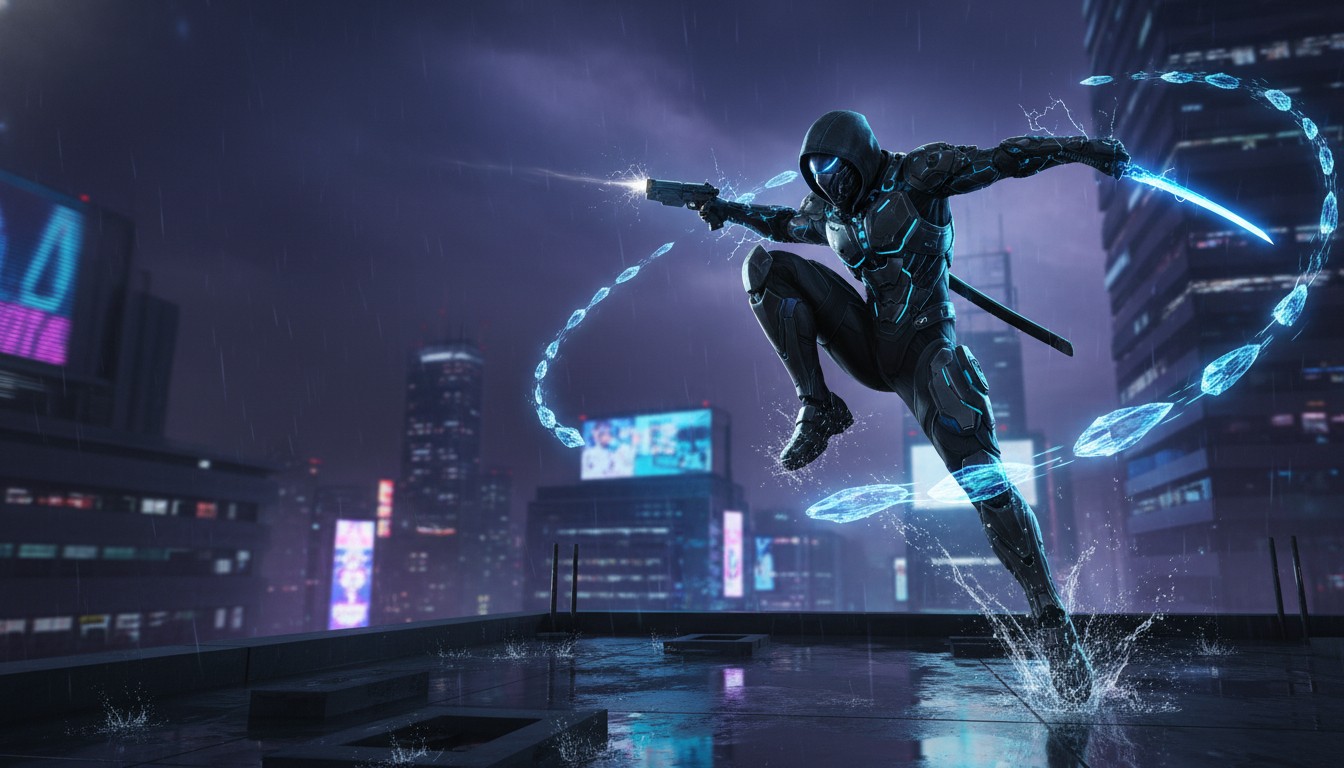
There is a moment in Sairento VR when you stop thinking about the headset and start thinking about the gap between rooftops. You sprint toward the edge, leap, slow time to a crawl, draw a pistol in one hand and a katana in the other, fire three shots into a distant drone, land in a crouch behind a shocked soldier, and spin to sever him before he turns around. Then you double-jump off his falling body toward the next platform.
That is not a scripted cutscene. That is a Tuesday afternoon in this game.
After a year in Early Access, Sairento VR has hit its full release as one of the most kinetic action games virtual reality has seen. Developed by Singapore-based Mixed Realms, it is a VR-native title with no flat-screen counterpart — a rarity even now, and a defining strength. Everything about it is built around the assumption that you are standing in a room with two motion controllers and a willingness to move.
The Mobility Is the Game
The core of Sairento is not its weapons or its missions. It is movement. The game gives you a toolkit of athletic maneuvers — wall running, triple jumps, power slides, backflips, and a bullet-time trigger that slows the world when you need a breath to aim or dodge. On paper this sounds like a recipe for nausea, and for some players it absolutely is. The locomotion is smooth, fast, and relentless. But for those with established VR legs, the payoff is extraordinary: a sense of agility that no other VR action game has matched.
The controls map physical gestures to ninja spectacle. Weapons sit on your hips and back — pistols and submachine guns at your waist, katanas and throwing glaives across your spine. Drawing them feels tactile. Aiming is true one-to-one motion control. Dual-wielding is not just supported; it is expected. The game wants you firing an Uzi in your left hand while throwing a shuriken with your right, then swapping to a bow mid-leap because you felt like it.
Combat as Physical Theater
Enemies arrive in waves, and the combat loops between shooting, slashing, and acrobatic repositioning. The slow-motion trigger, fueled by a regenerating meter, turns chaotic rooms into manageable choreography. You can deflect bullets with a well-timed katana swipe, or hang in the air above a pack of soldiers and pick them off before gravity reclaims you. The weapon variety is substantial — katanas, firearms, bows, throwing glaives, and unlockable relics — and the game encourages experimentation by letting you upgrade gear between missions.
The physicality is genuine. A session of Sairento VR is a workout. You will crouch, lunge, and spin. The game respects your real-world stamina less than your virtual ninja’s, which means longer sessions can leave you sweaty and satisfied in a way that sedentary VR shooters do not.
Where the Edge Dulls
The thrill is not infinite. In later missions, the enemy variety thins and combat can settle into repetition — another wave, another rooftop, another slow-motion volley. Melee strikes against armored foes sometimes lack the visceral feedback you want; a katana connecting with a robot torso can feel like swatting a pillow rather than cleaving steel. The story, a loose cyberpunk framework about a secretive organization in near-future Japan, is present but forgettable. It exists to move you between arenas, not to grip you.
The motion sickness question is real and unavoidable. Sairento VR is one of the most intense locomotion experiences on the market. Newcomers to VR should not start here. Even experienced players may need to ease in, tweak comfort settings, or accept shorter sessions. Mixed Realms has included comfort options, but the game’s identity is built on speed and freedom; dilute that too far and you are not really playing Sairento anymore.
Multiplayer and the Long Game
The full release adds co-op multiplayer, letting two players tackle missions together. It is a welcome addition that turns the game from a solo workout into a shared stunt show. Coordinating bullet-time takedowns with a friend adds a layer of slapstick camaraderie that the solo campaign cannot replicate.
Progression is driven by loot and upgrades. Completing missions earns currency and gear, and the inventory system gives reason to replay stages on higher difficulties. It is not a deep RPG layer, but it is enough to keep the action loop sticky beyond the initial novelty.
The Call
Sairento VR is not for everyone, and it does not try to be. If you want a narrative-driven cyberpunk epic, look elsewhere. If you are sensitive to smooth locomotion or intense motion, this will test your limits. But if you have spent months in VR wishing for a game that treats your headset like a body rather than a camera, this is the answer. It is exhausting, ridiculous, and occasionally repetitive — and for the right player, it is essential.
This is the rare VR-native action game that could not exist on a monitor. The full release is here, and the ninja have arrived.