
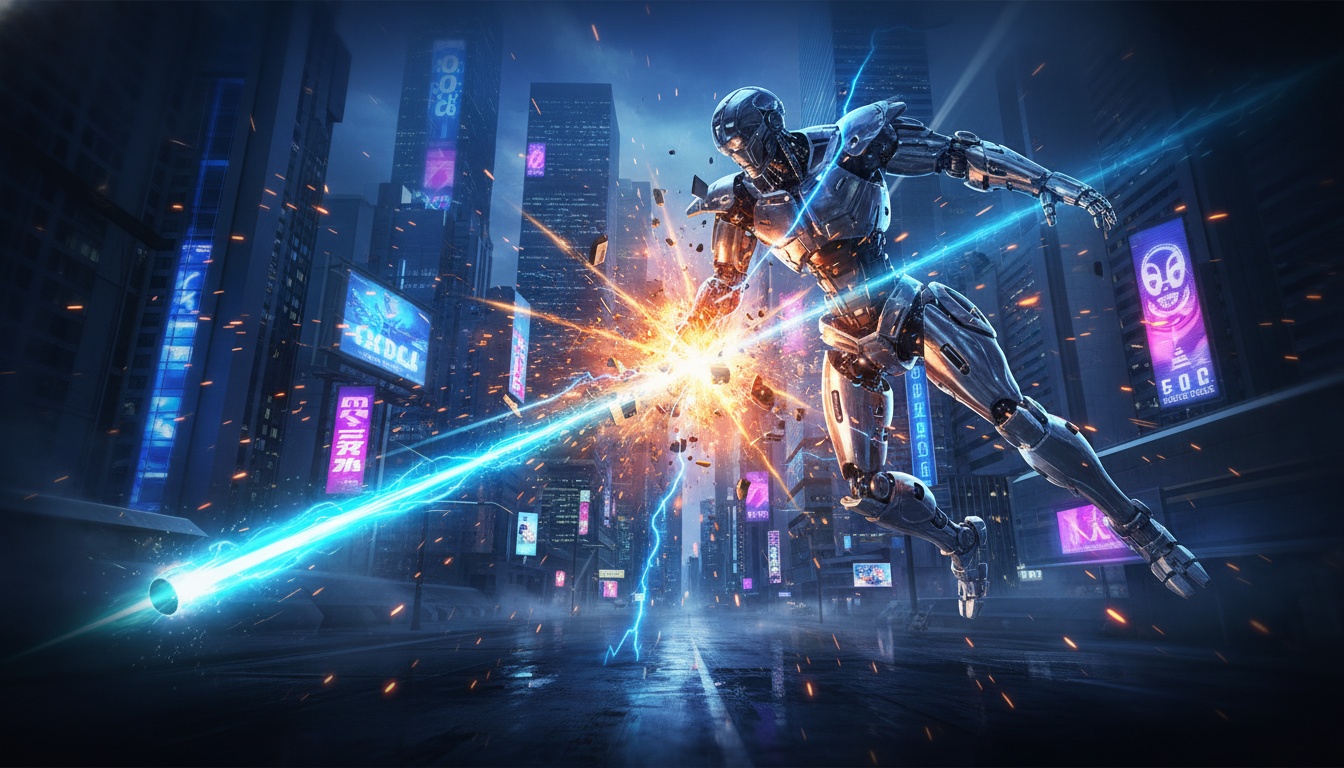
The first time you pluck a rocket out of midair and throw it back at the robot that fired it, you understand what Epic Games was going for. Robo Recall is not a tactical shooter. It is not trying to be realistic. It is a playground of escalating absurdity where you are the most dangerous thing in the room, and the robots are just waiting to be disassembled.
Released in March 2017 as an Oculus Rift exclusive bundled free with Touch controllers, Robo Recall was built from the ground up for VR. Epic Games took the core ideas from their earlier “Bullet Train” demo — grabbing bullets out of the air, slow-motion breaches, dual-wielding pistols — and expanded them into a full arcade shooter built around one question: how many ways can you destroy a robot before it stops being fun? The answer, it turns out, is quite a lot.
The Setup
You are a “Recaller,” a contractor tasked with cleaning up a city after a robot uprising. The narrative is thin wallpaper over what is essentially a wave-based score attack. Three urban maps serve as your sandbox, each broken into combat arenas where robots teleport in and you reduce them to scrap. There is a loose mission structure — kill this many, survive this wave, destroy these specific units — but the real goal is style. Every kill feeds a combo multiplier. Headshots, mid-air catches, environmental kills, and limb-ripping melee takedowns all stack toward a letter grade at the end of each stage.
Getting into the game today requires navigating some platform friction. The original PCVR version lives on the Meta store and was built for the Oculus Rift and Rift S. If you own a Quest 2, 3, or 3S, you are looking at Robo Recall: Unplugged, a standalone port released in 2019 by Drifter Entertainment that preserves the core experience with toned-down visuals. For non-Meta PCVR headsets, the community-developed RoboRevive mod and the broader Revive compatibility layer can get the original running on SteamVR hardware, though this is unofficial territory. The Quest port is the most accessible entry point now; the PCVR original is the prettier, sharper version.
Gunplay as Physical Theater
What separates Robo Recall from nearly every VR shooter that followed is how deeply its combat is rooted in your body. Weapons are not abstracted behind menus or quick-select wheels. You have a pistol on each hip, a shotgun slung over one shoulder, and a plasma rifle over the other. When a weapon runs dry, you do not reload. You drop it, reach for a holster, and pull out a fresh one. The action is so fluid, so aggressively cinematic, that it feels less like a shooter mechanic and more like choreography. Within minutes you are juggling weapons between hands, tossing empty guns at robots for bonus points, and grabbing a revolver mid-combat to finish something you started with a shotgun blast.
The Touch controller haptics sell it. Every weapon has a distinct kick, a different weight in the rumble. Shotguns thunder. Pistols crack. The plasma rifle hums before it releases a wall of energy. It is the kind of tactile feedback that makes you want to fire weapons just to feel them in your hands.
But the guns are only half the arsenal. The other half is the robots themselves.
Creative Violence
Robo Recall wants you to touch its enemies. Grab a robot and you can punch it, tear off its limbs, use its body as a shield, or throw it into its allies. The throwing mechanics are generous and weighty — grab, wind up, and hurl. Caught in a reload? Snatch the nearest drone and bowl it into a cluster of attackers. A robot fires a rocket? Reach out, catch it, and return to sender. The game slows time slightly during these catches, not as a scripted mechanic but as a natural rhythm, giving you just enough breathing room to feel like an action hero without making it effortless.
This physicality extends to movement. Robo Recall uses teleportation exclusively, which in 2017 was a comfort-driven necessity. What Epic did smartly was bake teleportation into combat rather than treating it as a concession. You can teleport behind enemies for back shots, onto rooftops for elevation, or through a group to scatter them. The thumbstick lets you choose facing direction on arrival, turning a defensive comfort feature into an offensive tool. Still, by modern standards, the lack of smooth locomotion or snap turning feels restrictive. Players who have grown accustomed to free movement in Half-Life: Alyx or Bonelab may find the teleport-only system dated and occasionally disruptive to flow.
The Modding Ecosystem
One of Robo Recall’s most impressive legacies is Epic’s direct support for modding. The company released the full mod kit alongside the game, complete with source code access, documentation, and video tutorials through Unreal Engine 4’s Blueprint system. The result was a community that built custom weapons, new maps, alternate locomotion mods, and even a native Vive compatibility layer before official support existed.
Custom levels range from medieval castles to frozen mountain outposts. Weapon mods include everything from voxel-style pistols to melee weapons borrowed from Epic’s other franchises. The RoboRevive mod remains the most practical community contribution for non-Meta PCVR users, translating the Oculus-native input into SteamVR. While mod activity has slowed as the game aged, the tools are still available and the back catalog of community content extends the already-short campaign substantially.
Where It Shows Its Age
The weaknesses are structural, not mechanical. The campaign is short — roughly three to four hours of mission content — and the three maps, while visually dense, eventually blur together. Enemy variety is limited, and by the later stages you have seen every robot type and know exactly how to dismantle it. The scoring system provides replay incentive for completionists, but players looking for narrative depth or long-form progression will bounce off quickly.
The teleportation system, innovative for its era, is the biggest barrier for modern players. In a landscape where smooth locomotion, physics-based climbing, and room-scale freedom are baseline expectations, Robo Recall’s movement feels like a design compromise from an earlier generation of VR. It is comfortable, yes, but it is also constraining.
The Call
Robo Recall is for players who want to feel powerful in VR without wading through complex systems. It is for the score-chaser who wants to perfect a stage, the tinkerer who wants to mod new weapons into the sandbox, and the newcomer who needs a comfortable, low-friction entry point that still delivers spectacle. It is not for players seeking a long campaign, deep story, or modern locomotion freedom.
If you own a Meta Quest headset, Robo Recall: Unplugged is an easy recommendation — a polished, kinetic shooter that demonstrates what makes VR combat special when it is built for your hands rather than adapted to them. If you are on PCVR with a non-Meta headset, the extra effort to get the original running through Revive or RoboRevive is worthwhile for the sharper visuals and mod support, but only if you are willing to tolerate some platform friction.
This is still one of the best arguments for motion controls in shooters. The guns feel incredible. The throwing feels better. And that moment when you catch a rocket out of the air and hurl it back — that never gets old.