
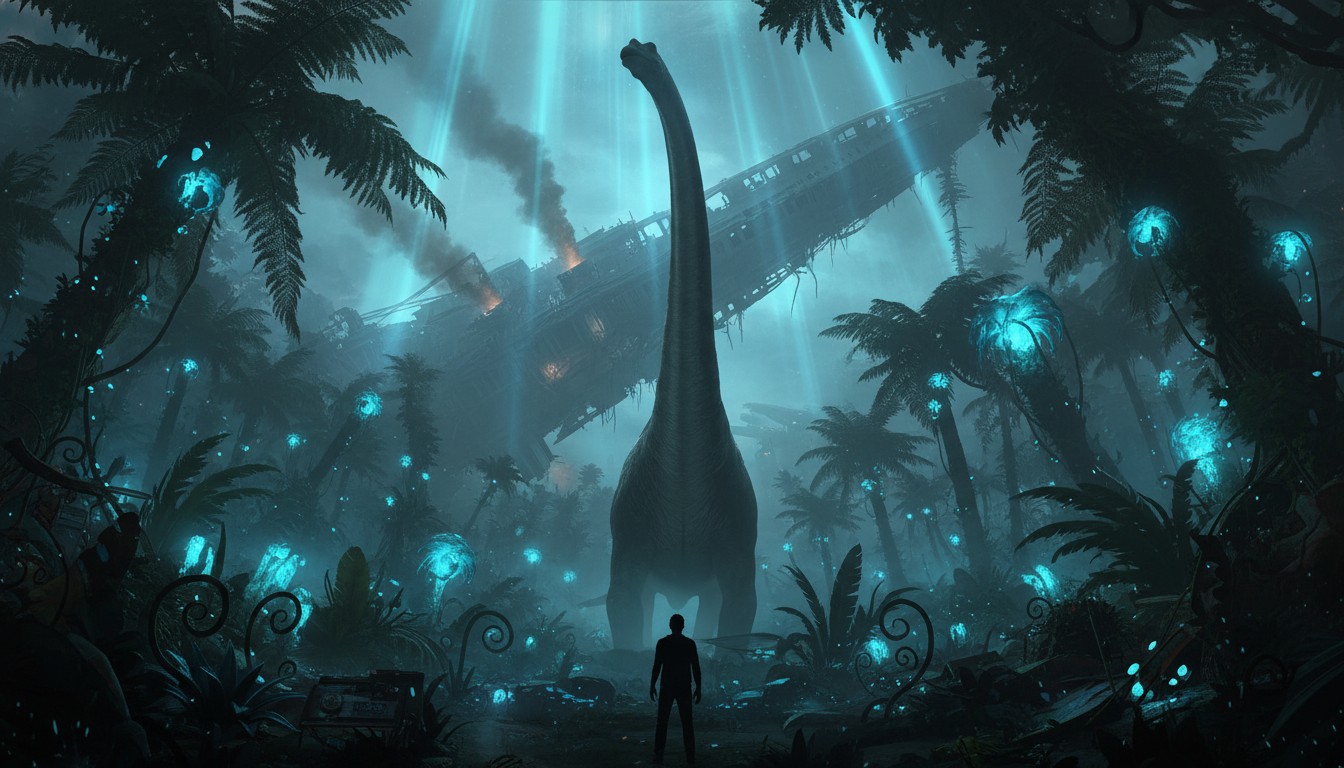
The first time a Brachiosaurus walks past you in Robinson: The Journey, you stop breathing. Not because the game told you to — because your lizard brain sees something forty feet tall and decides, correctly, that you are prey-sized. Crytek built this thing in their own engine, and it shows. Tyson III looks like someone spilled a National Geographic special into a headset. Ferns sway, water ripples, and the light filters through canopy gaps in that specific way that makes you forget you’re standing in your living room.
Then you spend twenty minutes trying to make Robin grab the right ledge, and the spell breaks a little.
Here’s the thing about Robinson: The Journey — it’s two games fighting inside one headset. One is a breathtaking dinosaur diorama that justifies the price of admission every time you round a corner and something ancient looks back at you. The other is a lightweight adventure game with climbing mechanics that sometimes work beautifully and sometimes make you want to throw your controller through a wall.
You play as Robin, a kid stranded on an alien planet after his ship crashes. Your companions are HIGS, a floating AI unit that narrates everything with the enthusiasm of a GPS, and Laika, a baby T-Rex who follows you around like a scaly golden retriever. The setup is simple: explore, scan creatures, solve environmental puzzles, climb stuff, avoid getting eaten. There’s a story about finding your missing crew, but honestly, the dinosaurs are the main event.
On PCVR with motion controllers, the experience comes alive in a way the PSVR version never quite managed. Crytek added Oculus Touch and Vive controller support after launch, and it transforms the game. Climbing feels tactile — you actually reach and grip. The multi-tool, which lets you grab and hurl objects or scan wildlife, finally makes sense as a handheld device instead of a weird appendage controlled by your face. The PSVR version launched with only DualShock 4 support, which meant aiming with your head while trying to guide Robin’s virtual hands with analog sticks. It worked, mostly, but it always felt like wearing someone else’s gloves.
That said, even on PCVR, the controls aren’t perfect. Object interaction can be finicky, and some of the environmental puzzles require precision that the physics don’t always cooperate with. You’ll know exactly what the game wants you to do and still spend five minutes wrestling the grab mechanic into compliance.
The climbing deserves its own mention because Crytek clearly learned something from The Climb. On motion controllers, pulling yourself up rocky faces is genuinely satisfying — there’s weight to it, a sense of physical effort that most VR games don’t bother with. On PSVR with a gamepad, it’s functional but awkward, requiring you to hold shoulder buttons while angling your head to guide Robin’s hands to the next hold. It works, but it never feels graceful.
Comfort is a real concern here. Robinson uses free locomotion throughout — no teleport option, no comfort vignette. You’re walking through dense jungle, climbing sheer drops, and occasionally running from things with teeth. If you’re sensitive to motion sickness, this one will test you. The swaying vegetation, uneven terrain, and first-person climbing all contribute. Some players adapt after an hour; others never do. There’s no shame in tapping out — this is a game that respects zero comfort settings.
Performance lands in that middle zone where a mid-range PC handles it fine but don’t expect to crank supersampling. CryEngine still looks gorgeous, but it’s not as demanding as you’d think for something this pretty. On PSVR it ran well enough, though the resolution drop inherent to that headset’s hardware softens the visual punch. If you have a choice, play it on PCVR — the sharper image makes the scale of the dinosaurs genuinely intimidating.
The runtime is the elephant in the room, or I guess the brachiosaurus. Most players finish the main story in about four hours. Add side exploration and collectibles and you might stretch it to six or seven. At the original launch price of around $40, that was a tough sell. At the $5-$10 it regularly hits on sale, it’s a different conversation entirely. This isn’t a game you buy at full price hoping for dozens of hours — it’s a polished, contained experience that does a few things exceptionally well and then ends.
And it does end somewhat abruptly. The final act rushes toward a conclusion that feels more like a chapter break than a finale. You get the sense Crytek had bigger plans for this universe, plans that never materialized. What you’re left with is a gorgeous fragment — technically complete, emotionally incomplete.
The support situation is worth noting. Crytek hasn’t touched this game in years. No patches, no updates, no PSVR2 compatibility. It still runs on PCVR and original PSVR, but if you bought a PS5 hoping to replay it on newer hardware, you’re out of luck. On PC, it works through SteamVR with modern headsets including Quest via Link, though some players report needing to fiddle with launch options to get controllers recognized properly. It’s not abandonware yet, but it’s definitely in maintenance-only territory.
Who’s this for? If you’ve ever wanted to stand in a jungle and have a dinosaur look at you like you’re lunch, Robinson delivers that specific fantasy better than almost anything else in VR. The sense of scale and presence is extraordinary. The companion dynamic with Laika adds genuine warmth to an otherwise cold experience. And the environmental design — dense, layered, alive with detail — proves Crytek understands how to build worlds that feel real.
Skip it if you need a meaty game loop, if motion sickness is a dealbreaker, or if you expect modern VR comfort features. This is a 2016 game in a 2016 design language, for better and worse.
At a discount, Robinson: The Journey is one of those experiences you keep around for the moments when someone new tries VR and you want to show them something that makes their jaw drop. It’s not a system seller anymore, but it’s still a hell of a demo. Just don’t expect it to keep you busy for a whole weekend.