
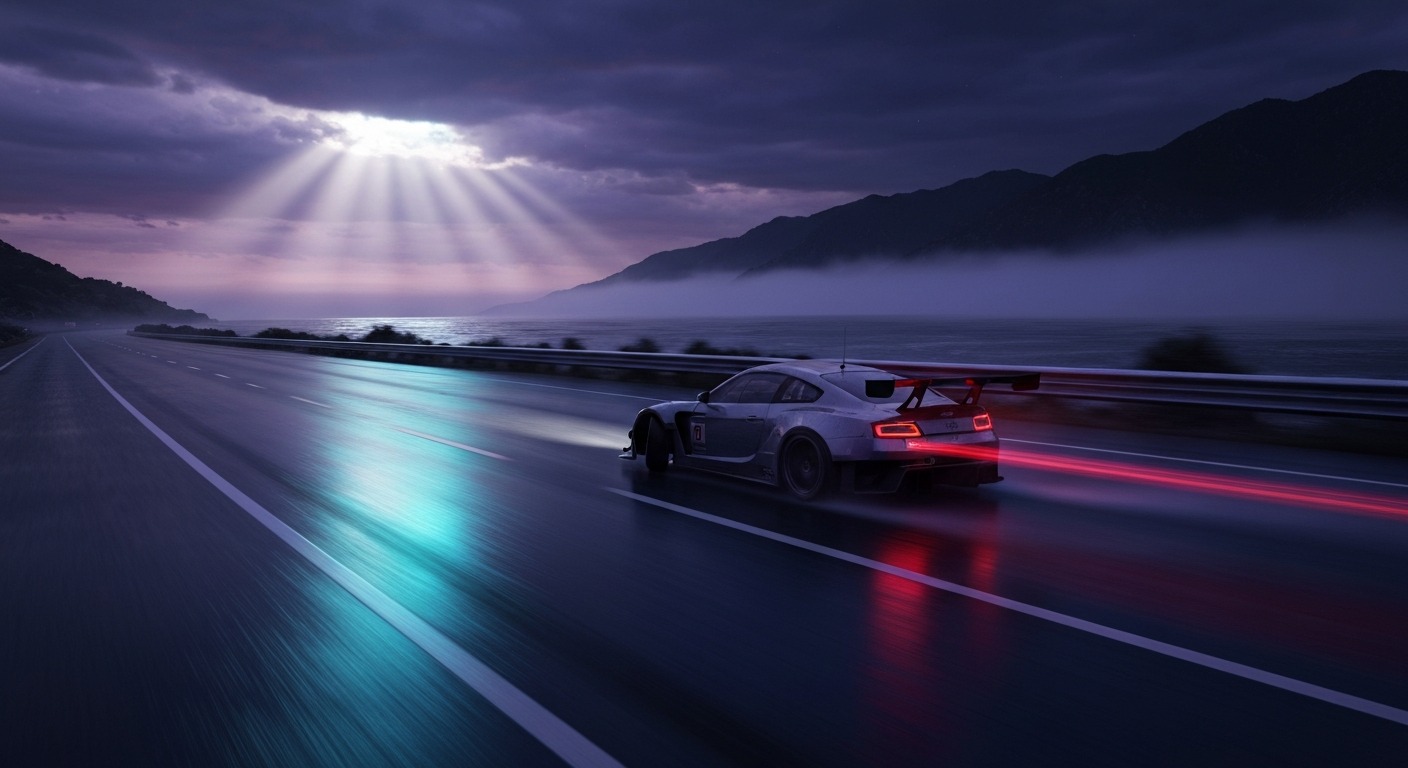
There’s a particular kind of vertigo that hits when a PSP game wraps around your entire field of view. Ridge Racer — the 2004 PSP launch title, not the 1993 arcade original — was built for a 4.3-inch screen in your hands. Playing it inside a Quest 3, with the track stretching to the horizon and the mountains receding into actual stereoscopic depth, feels like climbing inside a diorama of a game you played on the school bus.
Whether that’s a good thing depends entirely on what you’re hoping to find in there.
The Emulator Path
Ridge Racer has no official VR version. No modder has stitched together cockpit view with motion-tracked steering. Namco hasn’t touched VR in this franchise since an experimental stereoscopic arcade cabinet in 2010, and that never left Japanese game centers. The only road into VR runs through PPSSPP VR — Luboš Vonásek’s OpenXR build of the world’s best PSP emulator, sideloaded onto a Quest or PICO headset.
PPSSPP VR gives you two modes. The first is a virtual screen: Ridge Racer rendered on a flat panel floating in a dark void, upscaled to whatever size you want. It’s comfortable, it works flawlessly, and it’s basically a really big PSP. The second mode — the one that justifies the article — is 360-degree stereo rendering, where the emulator reconstructs depth from the game’s buffer and places you inside the scene with rotational head tracking.
The stereo mode is the real pitch. It’s also where things get complicated.
What Depth Looks Like in a Chase-Cam Racer
Ridge Racer is a third-person arcade racer. The camera sits behind the car, pulling wide through drifts and snapping back on exits. In stereo 3D, this camera position gives you genuine spatial depth — the car floats in front of you, the track surface recedes toward the next corner, and the background mountains separate from the foreground geometry in a way that the PSP’s original 2D rendering never communicated.
This is where PPSSPP VR works surprisingly well. Racing games with stable chase cams are among the better candidates for the emulator’s stereo reconstruction, because the camera provides consistent depth data. Ridge Racer’s relatively simple PSP-era geometry — low-poly environments, limited draw distance, clean track boundaries — actually helps. There’s less for the stereo renderer to get wrong.
Then you hit boost, and a 2D particle effect slathers itself across your field of view at the wrong depth plane. Or the HUD text splits into a doubling artifact. Or a texture pops in at the wrong distance. PPSSPP VR’s stereo rendering covers roughly half the PSP library with correct separation; the other half ranges from “low stereo effect” to “visually broken.” Ridge Racer sits somewhere in the upper middle — mostly correct, occasionally jarring. Enabling “skip buffer effects” in the emulator settings smooths out several of the worst offenders, at the cost of some visual flourishes.
The Comfort Problem
Here’s the honest part: Ridge Racer was not designed for head-mounted display, and it shows in your stomach before it shows on screen.
The chase cam whips through drift angles. The entire visible world rotates around you when you corner. In flat-screen play, this is pure arcade joy — you’re watching a screen. In stereo 3D with head tracking, your visual system reports violent motion that your vestibular system didn’t authorize. The mismatch is the textbook recipe for simulation sickness, and Ridge Racer’s entire identity is built around aggressive, slide-heavy cornering.
The virtual screen mode sidesteps this entirely, but you lose stereo 3D — which is the whole reason you’re in VR instead of playing the game on a monitor. The 360-degree mode works in short sessions, maybe 15 to 20 minutes, before most people need a break. Your tolerance will vary, but the game’s design actively fights comfortable VR play.
There’s no cockpit to anchor you. No dashboard, no steering wheel, no framed windshield. You’re floating behind a car in open space. The absence of a physical reference point makes the motion feel worse, not better.
What You’re Actually Playing
Setting aside the VR layer for a moment: this is still Ridge Racer on a PSP emulator. The game runs perfectly. PPSSPP’s compatibility database lists it as “Perfect” across all regions. On Quest hardware, the PSP’s modest computational demands barely register — you’ll hit full speed with headroom to spare, even with texture upscaling and anisotropic filtering applied. Vulkan multiview rendering keeps the stereo overhead manageable.
The controls map cleanly to Quest controllers. Throttle, brake, steering — all on thumbsticks and triggers, exactly as the PSP intended. You can pair a Bluetooth gamepad if you want something more familiar, but the default mapping is functional.
What you can’t do is steer with motion. No turning an imaginary wheel, no tilt-to-turn, no VR-native input. This is a flatscreen game running in a VR shell, and the input scheme reflects that honestly. You’re playing PSP Ridge Racer with a modern controller, inside a headset, with depth. That’s the deal.
The Audience Question
If you already own a Quest and you already own a PSP copy of Ridge Racer — or you’re comfortable with the legal gray of ROM acquisition — PPSSPP VR is free and the setup is a single SideQuest sideload plus a game load. Fifteen minutes from zero to drifting through Seaside Route 765 in stereo 3D. For series fans, that’s a legitimate experience, and the novelty of seeing Ridge Racer’s tracks in actual depth is real and genuinely cool.
But if you’re shopping for a VR racing game, this isn’t it. You’re getting a 2004 PSP launch title with all the limitations that implies: simplified physics, a small track roster, 30fps gameplay, and a progression structure designed for portable sessions. The stereo 3D doesn’t transform the game — it reveals it. You see how simple the geometry is, how compressed the draw distance was, how much of the “speed” was smoke and mirrors on a small screen. In VR, the illusion gets both deeper and thinner at the same time.
Ridge Racer in VR is a curiosity — a well-executed one, given what PPSSPP VR can do, but still a curiosity. It’s the kind of thing you show to a friend who remembers the PSP, drift through a couple of races, say “huh, that’s actually pretty cool,” and then go back to playing something designed for the headset on your face.