
Return to Castle Wolfenstein in VR: The Classic Shooter That Refuses to Age
Return to Castle Wolfenstein occupies a peculiar place in shooter history. Released in 2001 by Gray Matter Interactive and Nerve Software on the Quake III Arena engine, it arrived after Half-Life had redefined what a single-player FPS could be, yet it maintained the breakneck pace and pulp-horror sensibility of id Software’s earlier work. The result was a campaign that moved like a freight train through occult-obsessed Nazi strongholds, mixing authentic WWII weaponry with undead knights, cybernetic supersoldiers, and the kind of atmosphere that made corridor shooters feel like haunted houses.
Two decades later, the game holds up remarkably well — and it holds up even better in VR. Thanks to the prolific modding collective Team Beef, Quest owners can play a native VR port with full motion controls. PCVR users, meanwhile, have VorpX Geometry 3D support as an alternative path. Neither route is perfect, but both deliver an experience that feels surprisingly modern: fast, tense, and genuinely frightening in ways that flat-screen play never quite achieved.
What This VR Option Actually Is
Return to Castle Wolfenstein has two distinct VR implementations, and understanding the difference matters for deciding which path to take.
RTCWQuest (Quest standalone and PCVR) is a full conversion mod by Team Beef — the same group behind Quest-native ports of Doom 3, Quake, and Half-Life. This is a genuine VR rebuild: motion controller support for weapons and melee, two-handed weapon handling, smooth locomotion with snap turning, and a full 6DOF implementation of the id Tech 3 engine. The Quest version runs natively on standalone hardware. A PCVR build exists but receives less attention than the Quest port.
VorpX Geometry 3D (PCVR only) is an injection driver solution that provides stereoscopic 3D rendering and head tracking without motion controller support. It uses VorpX’s Geometry 3D mode to render distinct views for each eye, creating genuine depth perception. This is not a VR conversion — it is a 3D wrapper around the original game. You will play with a gamepad or keyboard and mouse, looking around with your head while your hands remain on traditional inputs.
Both routes require you to own the original game files. Neither is plug-and-play, though RTCWQuest’s installation process has been refined considerably since launch.
How It Plays
RTCWQuest
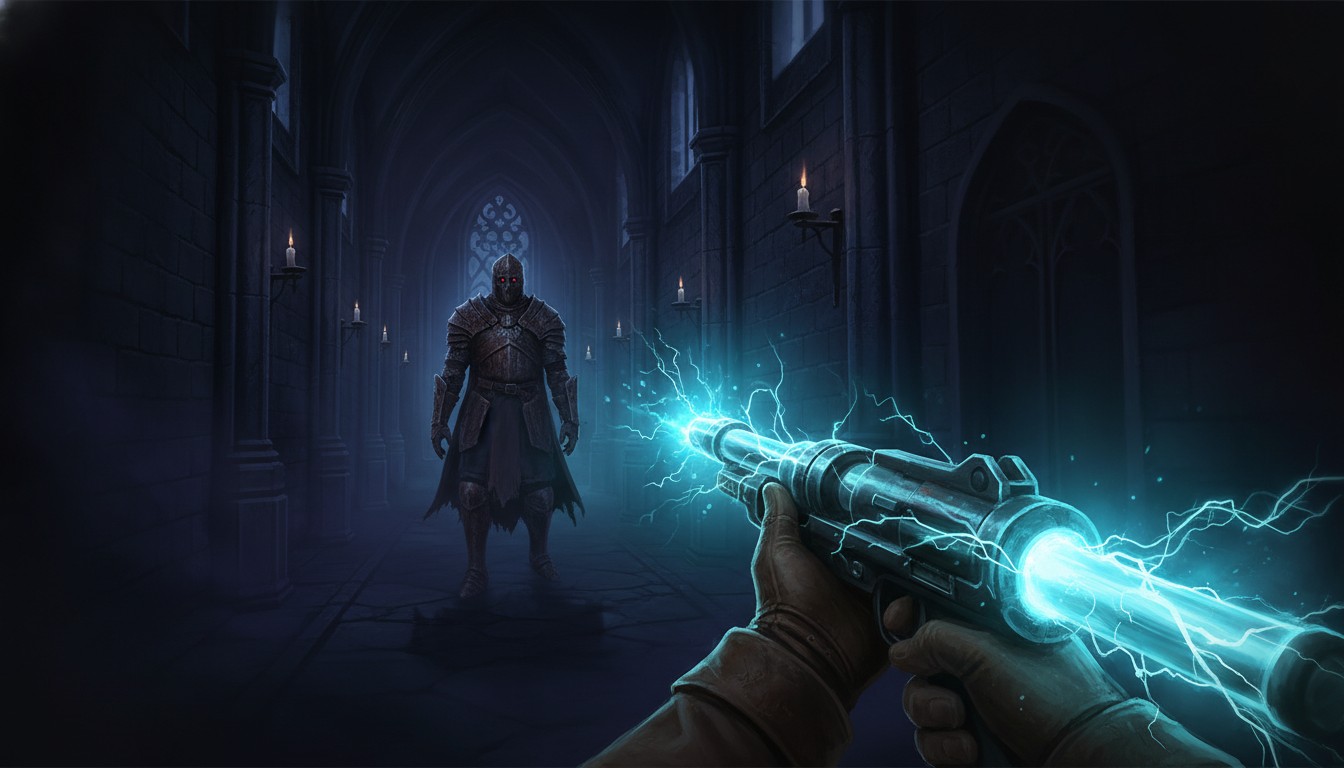
The Quest-native port feels remarkably complete. Motion controllers replace the traditional arsenal: pistols, submachine guns, rifles, and the iconic Tesla Gun all translate naturally to VR handling. Two-handed weapons like the MP40 or STG-44 can be braced with your off-hand for stability, while single-handed weapons allow free movement. Melee attacks using the knife or boot feel appropriately brutal at room scale.
Locomotion defaults to smooth stick-based movement with snap turning, though teleport options exist for those sensitive to artificial motion. The game maintains its aggressive pace — enemy soldiers flank, undead creatures rush, and the supernatural setpieces hit harder when they occupy your actual space. Standing in a candle-lit crypt while something unspeakable shambles toward you from the darkness delivers exactly the horror the developers intended, only now it happens at life scale.
Performance on Quest hardware is solid. The id Tech 3 engine was built for early 2000s PCs, and the standalone Quest headsets have more than enough headroom to maintain stable frame rates even with the VR overhead. The port includes the full single-player campaign and multiplayer components, though the latter depends on community server availability.
VorpX
The VorpX experience is fundamentally different. You are not “in” the game in the same way — you are viewing it through a stereoscopic window with head tracking. Geometry 3D produces genuine depth perception, and when properly configured, the cathedral halls and submarine pens gain a sense of spatial presence that flat-screen play cannot match.
However, the limitations are significant. You will not be aiming weapons with your hands. You will not physically duck behind cover or lean around corners with independent character movement. The VR implementation adds immersion to viewing but does not transform interaction. DirectVR automation can handle field-of-view and head tracking calibration for the Steam and GOG versions, though some users report the DirectVR scanner failing to detect certain builds, requiring manual configuration.
Performance demands are notable despite the game’s age. Geometry 3D rendering effectively doubles the GPU workload. Maintaining stable 90fps for comfort, or even locked 45fps with motion smoothing, may require reducing resolution or visual settings on mid-range hardware. Visual artifacts can appear: shadows and reflections sometimes render at incorrect depths, and HUD elements may float unnaturally in the 3D space.
What Works Well
The campaign structure translates beautifully. Return to Castle Wolfenstein was designed around discrete missions with clear objectives and varied environments — Norwegian fjords, crypts, castles, submarines, secret labs. The modular nature means natural stopping points for VR sessions, and the environmental variety prevents the visual fatigue that can set in during longer VR campaigns.
The horror elements hit harder. Jump scares work differently when they occupy your peripheral vision. The game’s late-game pivot toward occult horror — reanimated knights, dark rituals, the occult-obsessed Deathshead — benefits enormously from spatial presence. The Tesla Gun, always satisfying, feels genuinely dangerous when you are holding it.
RTCWQuest’s weapon handling is excellent. Team Beef has refined the formula across multiple id Tech ports, and the two-handed weapon implementation here is confident and responsive. The physicality of reloading, the feedback of firing, and the weight of heavier weapons all communicate clearly. This is not a janky mod — it feels like native VR design.
The multiplayer still exists. For those interested in the competitive component, RTCWQuest preserves the multiplayer functionality. Community servers remain active, and playing classic objective-based modes in VR adds a novel dimension to a familiar format.
VorpX preserves visual fidelity. For users prioritizing graphical quality over interaction, the injection driver delivers the complete original aesthetic: crisp textures, proper lighting, no compromises for mobile hardware. If your goal is to experience the game as it was designed, only in 3D, this is the technically superior path.
What Doesn’t Work
RTCWQuest has scale inconsistencies. Some players report doors and certain architectural elements appearing disproportionately large, breaking the sense of physical presence in specific areas. This is not universal — the mod generally maintains proper scale — but occasional environmental elements feel off.
Enemy hit registration can feel imprecise. RTCWQuest’s implementation sometimes requires aiming slightly above an enemy’s apparent head to register headshots, particularly at distance. The issue appears to stem from how the VR camera interacts with the original hit detection system. It is not game-breaking, but it is noticeable during precision-rewarding stealth sections.
VorpX remains VorpX. The injection driver experience is what it is: a way to view games in 3D, not a way to interact with them in VR. The lack of motion controls removes the tactical satisfaction of physical aiming and weapon handling. For a shooter, this is a substantial loss. The configuration burden and potential for visual artifacts also mean this route is only viable for users comfortable with VorpX’s idiosyncrasies.
The checkpoint system shows its age. Return to Castle Wolfenstein uses a manual save system with occasional auto-checkpoints. In VR, where sessions may be shorter and removing the headset to manage saves is awkward, the lack of modern convenience features becomes apparent. Save often, and accept that you will occasionally replay sections due to unexpected failures.
Platform Differences
Quest Standalone vs. PCVR: The Quest-native RTCWQuest is the definitive version for most users. It runs smoothly, requires no PC, and offers full motion controls. The PCVR build exists but receives less active development and lacks the optimization focus of the Quest port. Visual quality on Quest is predictably below what a PC can deliver — textures are compressed, effects simplified — but the trade-off for wireless, standalone play is worthwhile for most.
VorpX (PCVR): This is a separate category entirely. If you have a powerful PC and specifically want the highest visual fidelity with zero compromises, VorpX delivers the original graphics pipeline unaltered. However, the control scheme and interaction limitations make this a substantially different experience. Consider this path only if you prioritize graphics over gameplay transformation.
Who This Is For
Good for:
- Fans of classic shooters who want to experience them in modern VR
- Quest owners seeking a substantial campaign with full motion controls
- Players interested in FPS history — this is one of the most influential shooters of the 2000s
- Horror enthusiasts who want to experience supernatural elements at room scale
- Anyone seeking a complete, polished VR conversion of a substantial game
Not for:
- Players seeking a casual, modern shooter experience — this is deliberately retro
- Those unwilling to source original game files and complete moderate setup steps
- Users expecting VR-native multiplayer matchmaking — community servers only
- Anyone with severe motion sensitivity who cannot tolerate smooth locomotion
- Players who demand perfect 1:1 hit registration in combat
The Verdict
Tier: A
Game Quality: A Return to Castle Wolfenstein remains one of the finest single-player shooters of its era. The campaign structure is tight, the pacing is relentless, and the pulp-horror atmosphere has aged surprisingly well. This is not a historical curiosity — it is a genuinely excellent game that holds up against modern releases in the same subgenre.
VR Implementation Quality: A- RTCWQuest represents the gold standard for standalone VR conversions of classic shooters. Full motion controls, stable performance, and thoughtful adaptation of the original design make this feel like a native VR title. The minor issues with scale and hit detection prevent a perfect score, but they do not significantly diminish the experience. VorpX support is functional but inferior for gameplay purposes.
Overall Tier: A This is essential VR content. Whether you played the original in 2001 or are discovering it for the first time, Return to Castle Wolfenstein in VR delivers a campaign that feels fresh, frightening, and mechanically satisfying. The Quest-native port is the recommended path for the vast majority of users. For PCVR players, it is worth considering whether the VorpX trade-offs make sense for your priorities, though the option exists. Either way, this is a classic shooter done justice by its VR adaptation.