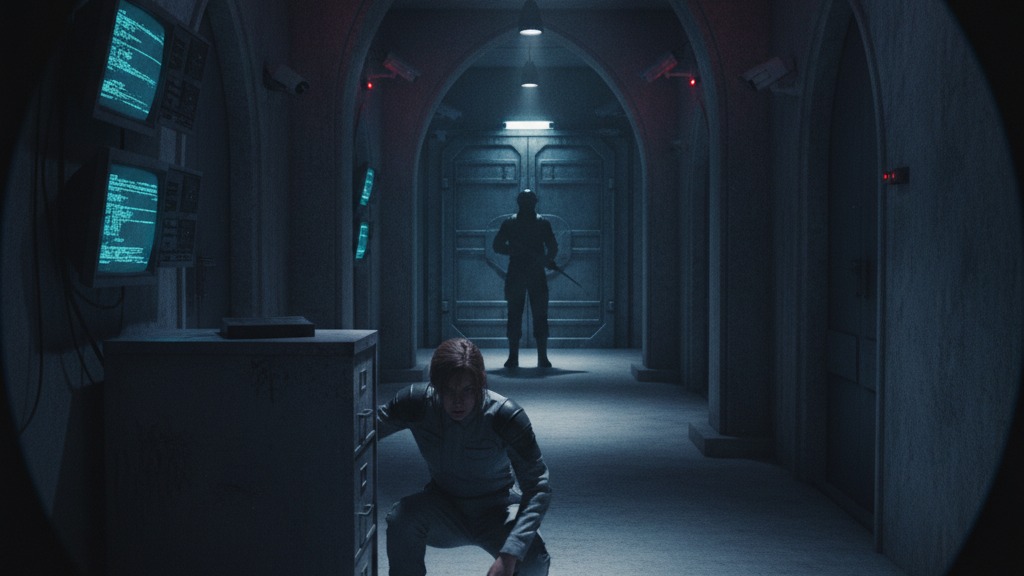
There’s a very specific feeling that happens about thirty minutes into Republique VR. You’re sitting in a chair, headset on, physically leaning forward to peer around the edge of a security camera’s view, watching a young woman named Hope crouch behind a filing cabinet while a guard patrols past. You hold your breath. She holds hers. The camera angle is tight, the audio is crisp, and for a moment you forget you’re in your living room because you are the surveillance system — the invisible eye guiding someone through a nightmare.
Republique started as an episodic mobile game in 2013, a stealth-action adventure about government surveillance developed by Camouflaj. Five episodes later, it had built a reputation for strong narrative, excellent voice acting, and a unique control scheme where you didn’t directly play the protagonist — you watched her through security cameras and guided her to safety. In 2019, the studio ported it natively to VR for Quest headsets, and in 2020 brought it to Steam for PCVR. This isn’t a mod, an injection driver, or a community hack. It’s an official, native VR version built by the original team.
And the surprising thing is how well the surveillance camera concept translates to a headset. In the flat version, you were tapping a screen to switch cameras and tapping to tell Hope where to go. In VR, your head movement controls the camera angle. You physically look left to see around a corner. You physically look up to track a guard on an upper level. When you switch cameras, the transition is disguised as a surveillance feed jump rather than a hard cut, which keeps it comfortable. The game turns you into the panopticon — an invisible observer with godlike access to an entire facility’s security network, and that power fantasy lands harder in VR than it ever did on a phone screen.
The setup is as frictionless as VR gets. Buy it on the Quest Store or Steam, install it, play it. No modding, no file copying, no command-line arguments, no wondering if your headset is supported. It runs on Quest 1 through Quest Pro, and on PCVR via SteamVR for Vive, Rift, and Index. The Quest version is a standalone, wireless experience that’s been heavily optimized — Camouflaj rebuilt scenes for efficient loading, implemented Unity’s Single-Pass Rendering to ease the CPU load, and cleaned up aliasing that would have been distracting in a headset. The PCVR version runs smoothly on modest hardware, with users reporting stable performance on GTX 1060-class cards. This is the rare VR title where the technical foundation is solid enough that you can focus entirely on the game.
Which is good, because the game is worth focusing on. Republique tells the story of Hope, a pre-cal citizen trapped in a totalitarian state called Metamorphosis, and you are a hacker who has broken into the facility’s security network to help her escape. The narrative unfolds across five episodes, each roughly two to three hours, with a total runtime of eight to fifteen hours depending on how thoroughly you explore for collectibles and lore. The voice cast includes David Hayter and Jennifer Hale — yes, Solid Snake and Commander Shepard — and the performances ground the dystopian premise in genuine human tension. The writing isn’t subtle about its surveillance-state themes, but it doesn’t need to be. The mechanics themselves make the point: you are literally watching someone through cameras, tracking their movements, accessing their private communications, and deciding when to intervene. The game makes you complicit, and that complicity feels more immediate when you’re wearing a headset.
The controls are simple and functional, if not exciting. You point with your motion controller and click to direct Hope, or use a gamepad for a more traditional feel. Some players actually prefer the gamepad — the pointing works fine for navigation, but the gamepad gives smoother direct control in tense stealth sections. Either way, this is not a motion-control showcase. You’re not physically ducking, reaching for objects, or swinging weapons. You’re a disembodied observer clicking on the world. For this specific game, that abstraction makes thematic sense. For players expecting physical VR interaction, it feels limited.
The stealth gameplay itself is relatively forgiving. You’re managing guard patrol patterns, timing movements, and using your hacking tools to unlock doors and create distractions. An “Omni View” system lets you scan items for lore and upgrade your abilities — seeing guard paths, unlocking new interaction options. The difficulty is moderate; this is a story-first experience where the stealth serves the narrative rather than challenging hardcore stealth fans. If you’re coming from VR stealth games that demand physical crouching and silent movement, Republique will feel sedate. If you’re coming from narrative adventures that happen to have sneaking, it’ll feel appropriately tense.
Comfort is the standout category here. Republique VR is a seated, stationary experience with minimal camera movement and no forced motion. You can play this for two hours straight without discomfort, which is almost unheard of in VR. The camera transitions between security feeds are disguised to avoid the jarring loading screens of the original. The perspective is inherently static — you’re watching through fixed cameras, not running through hallways. If you’ve ever wanted a VR game you could play on a plane, or during a long car ride as a passenger, or just after dinner when you don’t want to stand up — this is it. The Quest Store even lists it as “Comfortable,” which in VR terms is high praise.
The caveats are clear. First, the visuals show their mobile origins. The environments are detailed and atmospheric — gothic-totalitarian architecture with surveillance tech woven into every corridor — but the textures and models were built for 2013 smartphones and scaled up through Unity 5. In PCVR, it looks crisp and clean. In standalone Quest, it looks polished but not impressive. Second, the camera-switching mechanic, while thematically perfect, can occasionally be disorienting. Automatic camera transitions don’t always place you where you expect, and finding the right angle to guide Hope through a complex room can mean a lot of rapid feed-hopping. Third, and most significantly, this is an eight-year-old port with no meaningful updates since 2020. The game works fine, but it feels like a finished product that the studio has moved on from.
There’s also the question of replay value. Republique is a linear, episodic narrative with fixed outcomes and minimal branching. Once you’ve guided Hope through all five episodes and collected the lore items, you’ve seen what there is to see. There’s no multiplayer, no procedural content, no reason to return beyond nostalgia. At full price, that’s a consideration. But the game has been free on the Quest Store during multiple promotions, and at those prices, the value proposition becomes a no-brainer — a solid eight-to-fifteen-hour narrative experience for the cost of clicking “add to library.”
So who is this actually for? Republique VR is a recommendation with a comfortable addressable audience. If you want a story-driven VR experience that won’t make you sick, that you can play seated for long sessions, and that has something genuine to say about surveillance and complicity — this is one of the better options available. If you love stealth narratives, if you appreciate strong voice acting, or if you just want a low-intensity VR game for travel or relaxation, it delivers.
But if you’re looking for motion controls, physical interaction, first-person immersion, or a challenging stealth simulation, this isn’t your game. The abstraction of the surveillance camera works thematically but limits the VR potential. You’re an observer, not a participant. The experience is compelling but not transformative.
The honest bottom line: Republique VR is a polished, comfortable official port of a genuinely interesting stealth narrative. The surveillance-camera gimmick, which could have felt like a limitation, becomes a strength in VR because it turns you into the very system the game critiques. It’s not the most exciting VR experience you’ll have this year, but it might be the most comfortable — and for players who can’t handle intense motion, that alone makes it worth considering. Play it for the story, play it for the comfort, and play it because free is an unbeatable price when it goes on promotion. Just don’t expect it to redefine what VR stealth can be.