
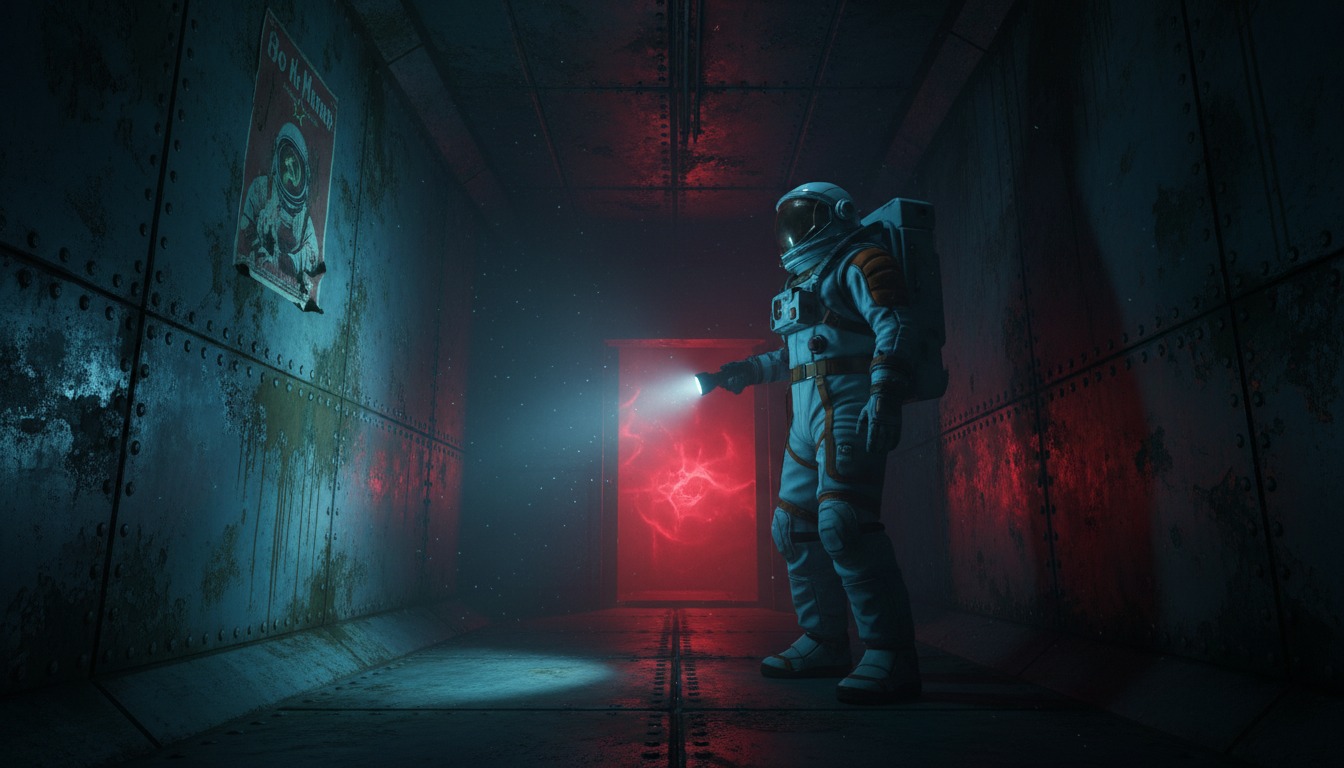
The first time your flashlight catches the riveted metal of a Soviet-era airlock, you might forget you’re wearing a headset. In May 2018, nothing in VR looked like this. Vertical Robot’s Red Matter is a science-fiction puzzle adventure built exclusively for virtual reality — no flat version, no pancake fallback — and its opening minutes make a simple argument: VR can be beautiful, and beauty in virtual space means something different than it does on a monitor.
You play as Agent Epsilon, an operative of the Atlantic Union dispatched to an abandoned research base on one of Saturn’s moons. Your mission is recovery and reconnaissance: find out what happened to the Soviet scientists who were studying a volatile substance called Red Matter, and secure any useful intelligence before the competing superpower beats you to it. The narrative unfolds through environmental details rather than exposition dumps. A discarded uniform here, a propaganda poster there, a damaged log entry you pick up and physically rotate in your hands. The worldbuilding is confident and restrained, letting the space tell its own story of scientific hubris and political paranoia.
That space is the star of the show. Red Matter was built in Unreal Engine 4, and in 2018 it was immediately obvious that Vertical Robot understood how to make materials sing in stereo. Metal looks like metal — scratched, oxidized, catching light at the edges. Concrete has grain. Painted surfaces show wear and water damage. The lighting is dramatic and purposeful, with shadows that fall naturally across claustrophobic corridors and cavernous maintenance hangars alike. This wasn’t the clean, sterile sci-fi of budget VR tech demos. It was a place that felt like people had lived, worked, and eventually abandoned it.
The interaction model matches that physicality. Puzzles revolve around environmental manipulation: picking up objects, rotating them in your hands, fitting components into machinery, aligning transmitters, decoding messages by physically handling ciphers and controls. Your tools — a scanner and a multi-purpose device — occupy your virtual hands and respond to your grip. The haptics are subtle but present, giving weight to the world in a way that mouse clicks never could. When a puzzle solution clicks into place, it clicks physically. You feel the mechanical engagement.
That tactile focus extends to the storytelling itself. Documents aren’t floating UI panels you click through. You pick them up, turn them over, examine them at different angles. Soviet and Atlantic Union propaganda is rendered as physical posters and pamphlets you can hold close to your face or pin to a nearby board for reference. It’s a small design choice, but in 2018 this level of object interactivity was genuinely rare. Most VR “adventures” were essentially static dioramas with laser-pointer interactions. Red Matter treats your hands like hands, not cursors, and the result is a world that feels inspectable rather than merely viewable.
This was also a period when PCVR was starving for content that wasn’t a wave shooter, a racing sim, or a glorified tech demo. Red Matter arrived as a fully formed adventure game with art direction, narrative cohesion, and a beginning, middle, and end. It proved that VR could sustain a single-player puzzle experience without resorting to gimmicks. The pacing is deliberate — you move through the base methodically, solving environmental challenges that escalate in complexity without ever becoming abstract. The logic is grounded in the fiction: if a door won’t open, you’re probably missing a power cell or a security override, not hunting for an arbitrary colored key.
The downside is density. A full playthrough runs roughly two to three hours, maybe four if you investigate every corner. The pacing is tight — there’s no filler, no backtracking across empty maps — but the runtime is undeniably brief for the asking price. Some puzzles spike in difficulty in ways that can stall momentum, particularly in the back half where the environmental clues grow more abstract and the solutions less intuitive. If you’re the type of player who hits a wall and checks a guide, expect to do so at least once.
Comfort is generally manageable but not universal. The game moves at a measured pace, with no high-speed sequences or frantic camera movement, but it does employ smooth locomotion in sections that can disorient players prone to VR nausea. TheSixthAxis specifically flagged this in their review, noting that motion-sensitive players should be cautious. On a high-end PCVR setup, performance is stable and the visual payoff justifies the hardware demands, though mid-range GPUs of the era often needed to compromise on settings to maintain consistent frame rates.
Who should play this? Anyone with a PCVR headset who wants proof that VR can deliver genuine atmosphere and tactile puzzle design. If you’re tired of wave shooters and glorified tech demos, Red Matter is a legitimate adventure game that happens to exist only in virtual reality. It’s ideal for players who value environmental storytelling and don’t mind a short, focused experience over a lengthy campaign.
Who should skip it? Players looking for action, combat, or extensive runtime. This is a slow, methodical experience built around observation and logic. If you get frustrated by environmental puzzles or need ten-plus hours to justify a purchase, the value proposition won’t work for you. Those prone to VR motion sickness should also approach with caution despite the generally restrained pacing.
Red Matter is one of the strongest arguments for why some games need to exist in VR and nowhere else. It’s short, occasionally stubborn, and visually demanding, but it’s also a crafted experience with real art direction and a coherent narrative — the kind of game that makes a headset feel less like a peripheral and more like a necessary window into a place you couldn’t visit any other way.