
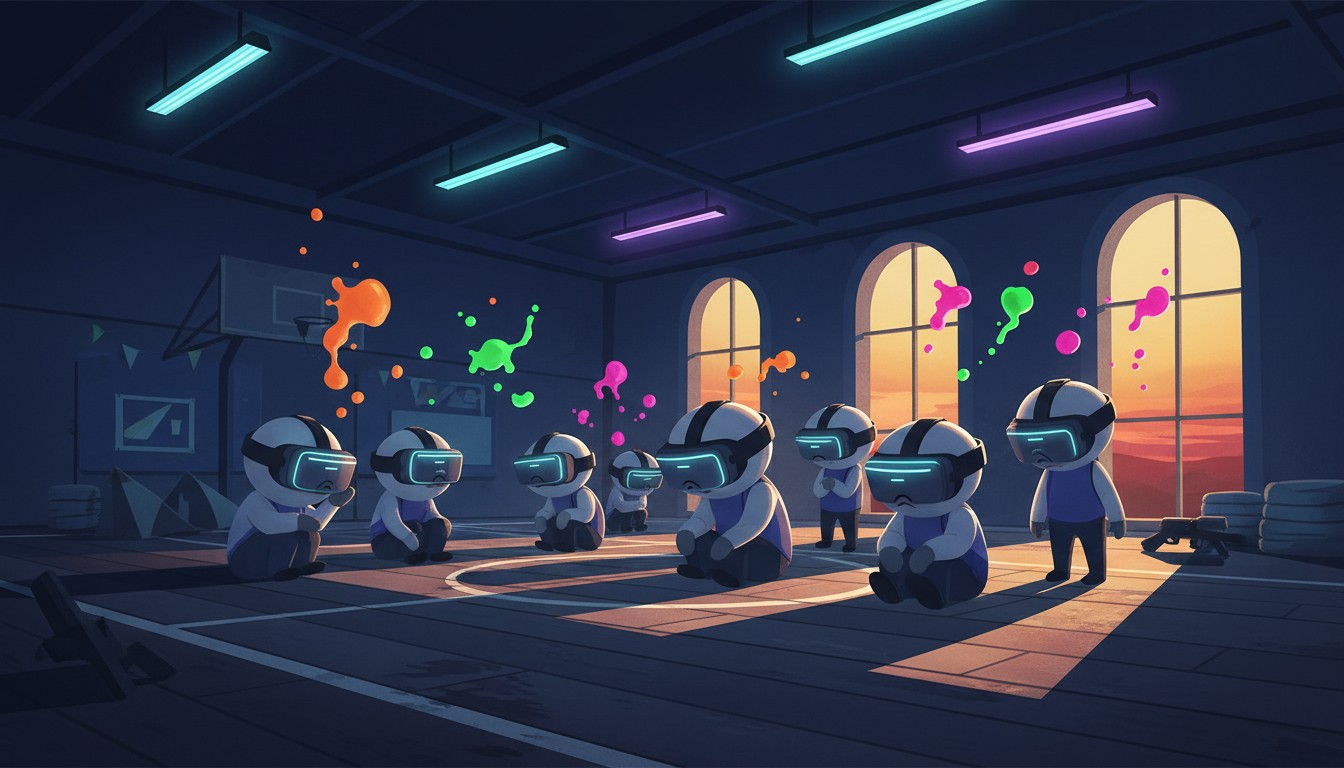
Here’s the thing about Rec Room: in three weeks, it will be gone. Not delisted, not forgotten, not updated into irrelevance — gone. Servers off. Logins rejected. The rec.net website dark. After June 1, 2026, exactly ten years to the day it launched, the virtual rec centers, paintball arenas, dodgeball courts, user-built quest dungeons, and late-night hangout rooms will all cease to exist. Half the team was laid off in August 2025. New account creation ended March 31, 2026. Some assets and talent were picked up by Snap’s XR subsidiary Specs Inc. The rest is evaporating.
So this isn’t a review you act on. This is a memorial for something that almost worked.
Rec Room launched on June 1, 2016, on HTC Vive — pure VR, no flat screen option. Six ex-Microsoft HoloLens engineers built the first version in 99 days. Nicholas Fajt, Cameron Brown, and four colleagues left Redmond when HoloLens pivoted to enterprise, convinced that consumer XR deserved a social space. What they built was deceptively simple: a virtual rec center where you could play paintball, throw dodgeballs, shoot laser tag, solve co-op quests, or just hang out with friends whose avatars actually looked at you when they talked.
The VR implementation was excellent from day one because it was never an afterthought. Full motion controls — grab, throw, point, wave. Room-scale movement. Voice chat that felt spatial, not broadcast. The avatars were deliberately cartoonish, abstracted humanoids with expressive hand gestures and body language, avoiding the uncanny valley that killed so many early VR social experiments. The art style was bright, clean, and readable even on 2016-era headsets with their screen-door panels and limited resolution. Rec Room understood something a lot of VR developers didn’t: clarity and performance matter more than graphical ambition when your brain is already working overtime processing depth and scale.
The paintball mode was where it first clicked. Two teams, a handful of maps, simple rules. You grabbed a paintball gun with your dominant hand, pumped it with the other, aimed by actually aiming, and fired. The haptics gave each shot a satisfying mechanical crunch. Reloading meant physically reaching to your hip and grabbing a new ball. It wasn’t simulated — your hands did the work. The dodgeball mode was even purer: throw, catch, dodge. No button-mashing. Your actual arm motion determined velocity and arc. When you caught a ball mid-air, the controller rumble and the sudden weightless pause in your hand felt like a genuine athletic moment.
The game expanded. User-generated content became the engine: custom rooms, quest-style adventure maps, escape rooms, murder mysteries, hangout spaces, concerts, comedy shows. The 2018 flat-screen mode opened the doors to players without headsets, and cross-play meant VR and flat users shared the same spaces — sometimes seamlessly, sometimes with the awkwardness of two different input paradigms trying to coexist. The platform grew to 150 million lifetime players. In March 2021, Rec Room Inc. hit a $1.25 billion valuation, making it the first VR-native “unicorn.” The HoloLens team of six had built something that the entire industry took seriously.
And then the math stopped working.
The shutdown announcement was blunt: costs consistently outweighed revenue. The VR market hadn’t grown fast enough. The flat expansion diluted the VR-native identity without replacing the revenue. User-generated content was the platform’s soul, but monetizing creator economies at scale — especially in a free-to-play model — turned out to be harder than building the tech. By August 2025, half the team was gone. The remaining staff announced the sunset: no new accounts after March 31, 2026, everything offline June 1, 2026.
What’s left now is a ghost town with the lights still on. If you have an existing account, you can log in, play your last paintball match, walk through your favorite custom room, say goodbye to friends you’ve never met in person. The VR experience itself still works — the controls are still responsive, the physics are still satisfying, the social magic still flickers when you find someone else online. But the population is thin. The creative pipeline is frozen. The knowledge that the server timer is counting down changes everything. You’re not building memories for the future. You’re attending a wake.
For VR historians, Rec Room matters because it proved a point: native VR social spaces could work. Not as tech demos. Not as novelty experiences. As actual places where people spent actual time, made actual friends, and built actual communities. The UGC ecosystem was genuinely impressive — players built quests, games, and experiences that rivaled official content in ambition if not always in polish. The cross-play experiment was messy but forward-looking. The business model just couldn’t sustain it.
If you already have an account and a headset, these next few weeks are your last chance to see what social VR looked like when it had momentum. Play a round of paintball. Visit a custom room. Wave at a stranger. Then log out knowing you witnessed the end of an era.
If you never played it, you missed something. Not the best game ever made, not the most innovative platform, not the most polished experience. But one of the most honest attempts to build a shared virtual world that actually felt social — built by people who believed in the medium, executed with skill, and ultimately defeated by economics rather than design.
The verdict is complicated. Rec Room the VR experience was excellent. The paintball felt great. The dodgeball felt great. The quests were fun. The community was real. Rec Room the business was unsustainable. The shutdown is final. The Snap acquisition of select assets and talent suggests some of the DNA might resurface in AR glasses somewhere down the line, but Rec Room itself — the rec center, the rooms, the friendships, the content — disappears on June 1.
Tier it as you will. The VR implementation was first-rate. The game was genuinely fun. The recommendation for new players is impossible — the door is already closed. For existing players, it’s a farewell tour. For everyone else, it’s a lesson in how close VR social gaming came to sticking the landing, and how fragile those successes turned out to be.