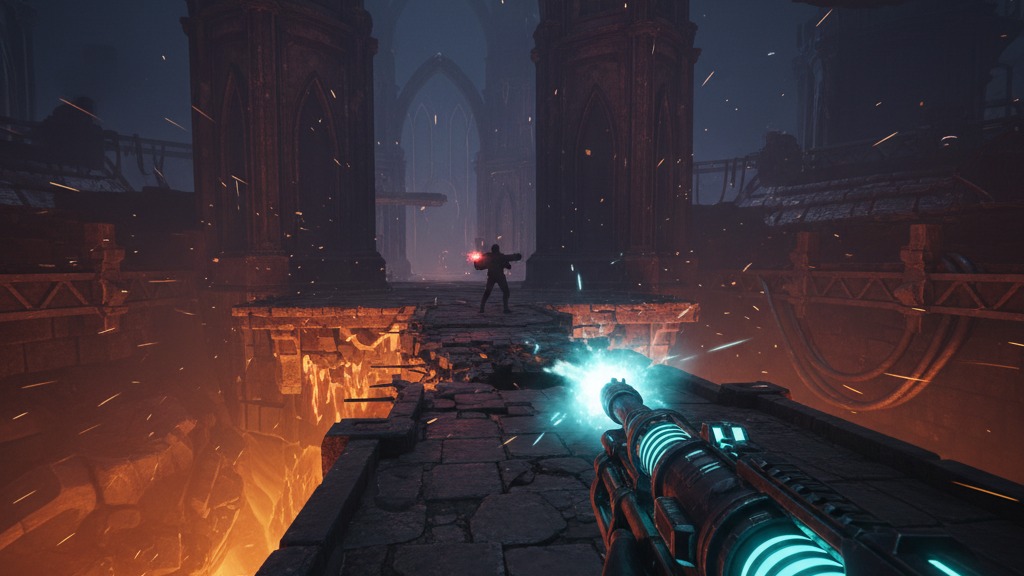
There’s a moment in Quake III Arena when everything clicks — you’re strafe-jumping across a bridge, your railgun hums with charge, and you see an opponent silhouetted against a lava pit three hundred yards away. You flick your crosshair, fire, and the kill registers before your feet touch the ground. That moment, in VR, is something else entirely. The bridge is no longer a texture — it’s a physical structure you feel yourself racing across. The opponent isn’t a dot on a monitor — they’re a figure standing in genuine 3D space. And when the rail connects, the controller vibration makes the weapon feel like it actually kicked in your hand.
Quake III Arena in VR is not a theoretical possibility anymore. It’s real, it’s playable from start to finish, and it’s available through two separate free community ports: Quake3Quest for standalone Meta Quest headsets, and Quake 3 VR (q3vr) for PCVR on Windows and Linux. Both are built on the open-source ioquake3 engine, both include full 6DoF motion tracking, and both let you play the complete game — bot tournaments, online multiplayer, Capture the Flag, Team Deathmatch, the whole catalog. They even support crossplay between Quest and PCVR players. This is not a tech demo. This is the full competitive arena shooter, twenty-five years old, now inside your headset.
The way you get there depends on your platform, and neither route is what I’d call effortless. On Quest, you need to enable developer mode, sideload the Quake3Quest APK through SideQuest, and manually copy the pak files from a legally owned PC copy of the game into the right folder on your headset. The first launch will probably crash — that’s normal, it’s creating directories. Then you copy files over USB, handle a CD key if the game asks for one, and restart. On PCVR, you download q3vr from GitHub, place pak0.pk3 in the baseq3 folder if you own the full game, make sure SteamVR is running, and launch the executable. Both ports include the demo version out of the box, so you can try before committing to the full file shuffle.
Here’s the thing: once it’s running, the experience is immediate and overwhelming in the best possible way. Quake III Arena was already one of the fastest first-person shooters ever made. In VR, that speed becomes physical. Strafe-jumping — the technique of zigzagging at high velocity by angling your jumps — now involves actually leaning into turns. Rocket-jumping — propelling yourself skyward with explosive force — sends you looking straight up as your avatar launches into the air. The railgun, Quake’s iconic hitscan weapon, benefits enormously from motion-controlled aiming. Tracking a fast-moving target with your actual hand and arm, rather than a mouse, changes the rhythm of duels. It feels less like pixel-perfect twitch and more like physical sport.
The weapon selection wheel is one of the better VR UI decisions I’ve seen in a mod. Instead of fumbling for number keys, you hold a button and rotate your wrist to cycle through the arsenal — machine gun, shotgun, plasma gun, rocket launcher, railgun, lightning gun, BFG. The selected weapon appears in your tracked hand. Switching mid-fight becomes a deliberate, physical action. In a game where weapon choice matters as much as aim, this matters a lot.
Performance is solid across both platforms. On Quest, you can select 72, 80, or 90 Hz refresh rates depending on the map complexity. Most arena maps run well at 80 Hz, and simpler layouts can push 90. The game was built for 1999 hardware, so even a modern standalone headset has headroom. On PCVR, frame rates are locked and high on anything resembling a contemporary VR-capable PC. The caveat is that HD texture mods and AI upscales, popular in the flat Quake modding scene, will tank performance on Quest. Stick to the original textures if you want consistent smoothness.
Comfort is where the caveats become unavoidable. Quake III Arena is built on speed, rapid direction changes, aggressive verticality, and constant motion. Every arena is a gymnastics course — you’re never standing still for more than a second. In VR, that translates to frequent acceleration, sudden 180-degree turns, and the stomach-dropping sensation of looking down while rocket-jumping over a pit. The ports include comfort options: adjustable vignette, tunnel vision, height adjustment, virtual screen mode. But these are mitigation, not transformation. The core game remains one of the most motion-intense experiences you can have in a headset. Team Beef reported that most beta testers experienced minimal sickness, but the general consensus from the community is clear: you need solid VR legs for this. If your first VR shooter was Half-Life: Alyx, Quake III is a significant step up in intensity.
The visual package is the other thing that keeps this from a higher tier. Quake III Arena looked stunning in 1999. In 2026, the low-poly character models, simple textures, and flat gothic lighting show their age. The stereoscopic depth adds spatial presence that the flat game never had — arena architecture becomes genuinely navigable in 3D, and weapon models in your hands feel substantial — but this is still a twenty-five-year-old game running on a twenty-five-year-old renderer. The gameplay transcends the visuals completely, but someone coming from modern VR shooters will notice the polygon count immediately.
What saves it, and what makes this a genuine recommendation despite the caveats, is the underlying game quality. Quake III Arena is arguably the best competitive arena shooter ever made. The map design by id Software is still unmatched — tight layouts that reward map knowledge, verticality that rewards movement skill, item placement that creates constant tension over armor and quad damage spawns. The bot AI was advanced for its era and remains competent, providing a full single-player tournament ladder that scales from beginner to nightmare. The weapon balance is textbook: each gun has a distinct role, range, and skill curve. The rocket launcher requires prediction. The railgun demands precision. The plasma gun excels at close-mid range tracking. No other VR shooter has this kind of competitive depth, this kind of skill expression, this kind of timeless map design.
The multiplayer is the real prize. Crossplay between Quest and PCVR means the player base isn’t fragmented by platform. Community servers are active, and the ports support simpler mods. Playing Capture the Flag in VR, with actual spatial awareness of where the flag is in 3D space, with teammates you can hear through voice chat while physically looking around for enemies — this is what competitive VR shooters should feel like. It’s raw, it’s fast, and it’s genuinely thrilling in a way that cover-based VR shooters rarely achieve.
So who is this actually for? Quake III Arena in VR is a recommendation with a very specific audience. If you have any history with arena shooters, if you remember the rhythm of strafe-jumping and rail duels, if you have the VR tolerance to handle rapid motion — this is essential. It’s the most competitive, deepest, and most skill-expressive shooter in VR right now, and it’s completely free to try via the included demo. The weapon wheel, the tracked aiming, the crossplay, and the sheer velocity of the gameplay make this feel like a native VR competitive experience, even though the menus are flat and the polygons are old.
But if you’re new to VR, if you’re prone to motion sickness, if you want a polished visual package with modern graphics, or if you can’t stomach sideloading APKs and manually copying pak files between folders — this will frustrate you before it thrills you. The setup is real work. The comfort demands are real. And the dated visuals are what they are.
The honest bottom line: Quake III Arena in VR is a competitive miracle wrapped in a twenty-five-year-old shell. The community ports deliver everything that matters — motion controls, 6DoF tracking, full multiplayer, crossplay — and the underlying game remains the gold standard for arena shooter design. It’s not comfortable, it’s not pretty by modern standards, and it’s not effortless to set up. But if you’ve ever wanted to feel what it’s like to rail someone across a bridge while physically leaning into a strafe-jump, there is nothing else like it in VR.