
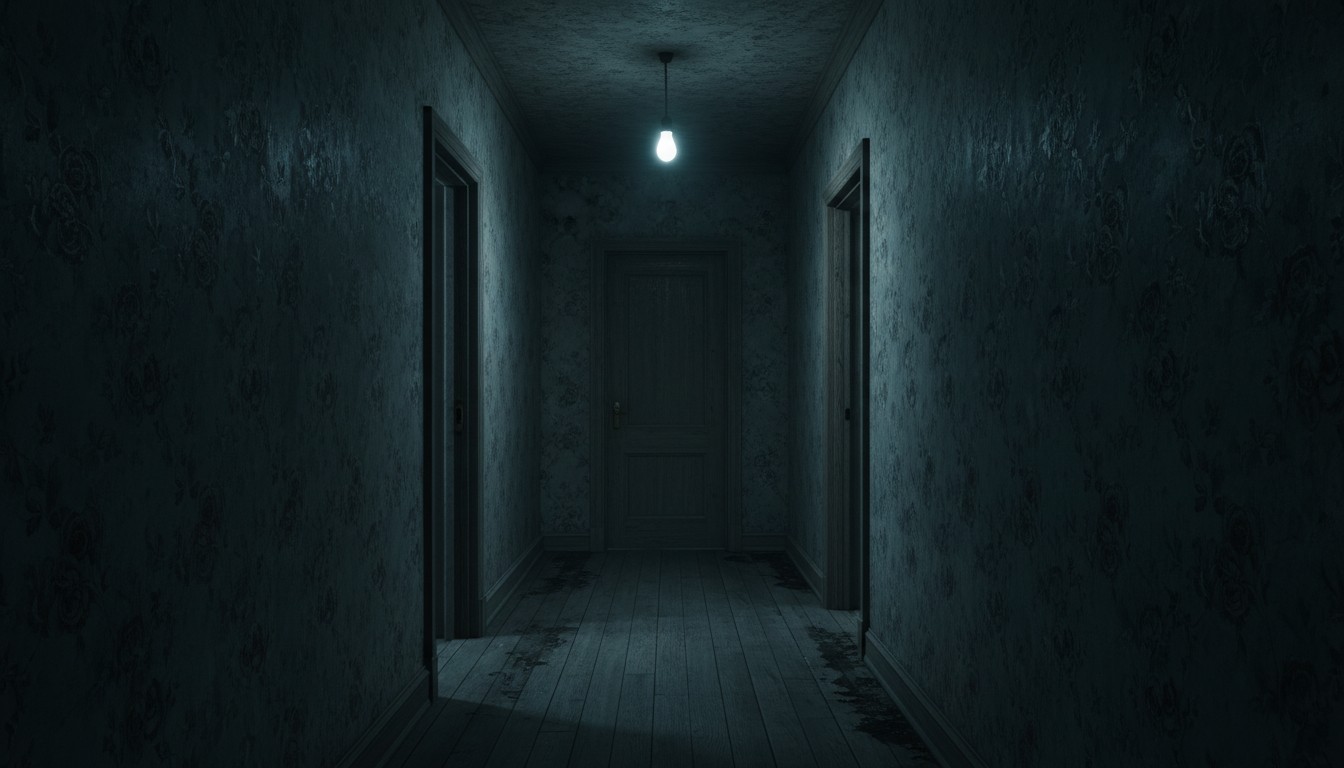
I almost took the headset off three times. Not because of motion sickness — because my brain decided that standing in a looping suburban hallway where the walls breathe was not something I should be doing voluntarily.
P.T. was never supposed to exist in VR. The 2014 PlayStation 4 demo — a “playable teaser” for the canceled Silent Hills collaboration between Hideo Kojima and Guillermo del Toro — was delisted from the PlayStation Store in 2015 and never resurfaced. Konami has spent the last decade pretending it never happened. The demo itself is a single, self-contained experience: maybe thirty minutes to an hour of walking the same L-shaped hallway over and over, watching it get progressively wrong. There are no enemies to fight, no inventory to manage, no health bar. Just a corridor, a bathroom, a phone, and the growing certainty that you are not alone.
The fact that you can now play it in a headset at all is a small miracle of fan persistence. And the fact that it’s genuinely one of the most horrifying things I’ve ever encountered in VR is the part that surprised me.
How This Actually Exists
The primary way to experience P.T. in VR is Unreal P.T., a full recreation of the demo built from scratch in Unreal Engine 4 by a solo developer working under the name Radius Gordello. Released around 2019, it took nine months of work — models, textures, animations, code — all rebuilt from memory and reference footage. The result is reportedly nearly identical to the PS4 original, with one critical addition: native VR support for PC headsets.
The VR mode works, but it’s worth being honest about what it provides. Head tracking is fully functional, and the stereoscopic presentation turns the claustrophobic hallway into something you physically occupy. Motion controllers are detected but their role is limited — the core interaction is still gaze-based, staring at objects to trigger events, just like the original. You won’t be reaching out to open doors with your hands. For a more robust motion control experience, some community members have had success pairing a separate fan remake (often referred to as PT Emulation) with Praydog’s UEVR injection framework, which can add 6DOF head tracking and expanded controller integration. That’s a more technical path, but it’s an option for tinkerers who want deeper VR integration.
On Quest, there’s a different animal entirely: Silent Hill VR Gallery, available through SideQuest. This isn’t the full P.T. experience — it’s an explorable recreation of the hallway and bathroom with no puzzles, no progression, no ghost. You can walk the space and soak in the atmosphere, which is genuinely impressive as a virtual environment, but if you’re looking for the looping, escalating horror of the original, this won’t deliver it.
What It Feels Like to Stand There
Here’s the thing about P.T. in VR that flat-screen play doesn’t prepare you for: the hallway has a physical presence now. On a monitor, the looping corridor is a clever design trick. In a headset, it becomes a trap you are actually inside.
The scale shifts. The ceiling feels lower. The bathroom door at the end of the hall is a real door you’re walking toward, and when it doesn’t lead where it should, your spatial reasoning rebels. The original demo’s genius was in making the mundane feel threatening — a phone ringing, a clock ticking, a baby crying behind a locked door. In VR, those sounds have location and distance. The baby isn’t just “in the game.” It’s behind that door, six feet to your left, and you cannot open it.
The ghost, Lisa, is where most people stop. In the original, seeing her standing on the balcony or appearing in the bathroom mirror is a jolt. In VR, it’s a genuine physiological threat response. Community reports consistently describe the experience as “extremely unnerving,” “traumatic,” and far more intense than flat-screen play. This isn’t hyperbole — it’s the difference between watching a horror film and standing inside it with no ability to look away without physically removing the headset.
The pacing works differently in VR, too. The original demo’s slow burn — walking the same hallway, noticing small changes — becomes meditative and then unbearable when the space surrounds you. By the third or fourth loop, you’re scrutinizing every texture for changes, and the headset’s isolation means there’s no peripheral view of your real room to anchor you. It’s just the hallway. Forever.
The Caveats Are Real
I need to be straight with you about the problems, because they’re significant.
First: this is a fan remake of a delisted demo, and Konami has a documented history of shutting down fan P.T. projects. The legal gray area here is not theoretical — it’s active, ongoing risk. The project could disappear overnight. If you’re the type of person who needs a stable, supported product with a clear future, this fails that test completely.
Second: the motion controller support in Unreal P.T.’s native VR mode is limited. You can look around freely, but your hands are not deeply integrated into the experience. For a 2026 VR audience accustomed to full hand presence and physics interactions, this feels dated. The UEVR injection path improves this substantially, but that adds setup complexity and requires comfort with third-party injection tools.
Third: it’s short. Thirty to sixty minutes, depending on how quickly you solve the obtuse final puzzle. That was appropriate for a free PS4 demo in 2014. For a VR experience you have to hunt down, download, and configure in 2026, some players will feel cheated by the runtime. I don’t — the density of the experience justifies the length — but your mileage will vary.
Fourth: comfort features are essentially nonexistent. No teleport movement, no snap turning, no vignetting during intense moments. You’re walking through a dark hallway with smooth locomotion while psychological horror dismantles your composure. If you have VR sensitivity, this is a worst-case scenario.
The Silent Hill 2 Remake Alternative
If you’re looking for a full Silent Hill experience in VR with modern production values, the community has built a robust VR mod for the Silent Hill 2 Remake using Praydog’s UEVR framework. That project offers full motion controls, first-person perspective, roomscale movement, and immersive melee combat — it’s a genuine full-game VR conversion of a current commercial release. It’s a different thing entirely: a ten-hour survival horror game versus a one-hour concentrated nightmare. Both have merit, but they serve different appetites. P.T. is the amuse-bouche of horror VR — small, intense, unforgettable. Silent Hill 2 Remake in VR is the full meal.
Who Should Walk This Hallway
Play this if you want to understand why people talk about P.T. with the reverence usually reserved for lost albums. Play this if you’re a horror enthusiast who has grown numb to jump scares and wants something that genuinely frightens you on a primal level. Play this if you’re curious about how a single corridor, stripped of almost all traditional game mechanics, can become one of the most memorable experiences in the medium.
Skip this if you need official support, ongoing updates, or guaranteed availability. Skip this if limited motion controls break your immersion. Skip this if you’re VR-sensitive or prone to anxiety in enclosed virtual spaces — this will not be a fun challenge, it will be genuinely unpleasant in ways you may not want.
P.T. in VR shouldn’t work as well as it does. It’s a fan recreation of a canceled demo, built by one person, existing on the internet only through the tolerance of a rights holder who has every incentive to erase it. The motion controls are thin, the legal status is precarious, and the experience lasts less time than most films.
But when you’re standing in that hallway, and the lights flicker, and you hear something behind you that wasn’t there before, none of that matters. What matters is that you are somewhere you should not be, and the headset won’t let you forget it.