The First Lap: Project CARS and the Birth of Racing VR
There’s a moment every sim-racer knows. You’re sitting in the cockpit, hands gripping the wheel, and you instinctively glance left to check your mirror. In a flat-screen game, you’re pressing a button to swing the camera. In VR, you just… look.
Project CARS was among the first games to make that feel real. Not perfect. Not polished. But real in a way that made you understand, somewhere around your second lap at Spa-Francorchamps, why people were willing to tolerate VR’s early-era friction.
What This Is
Released in May 2015 by Slightly Mad Studios, Project CARS entered a racing simulation landscape dominated by established names like Assetto Corsa and iRacing. What set it apart wasn’t just the crowd-funded development model or the ambitious feature set—it was VR support that arrived as one of the Oculus Rift’s launch titles in early 2016.
This wasn’t a hack. This wasn’t a Vorpx injection or a third-party VR wrapper. Slightly Mad Studios built native VR support directly into their game engine, making Project CARS one of the first AAA racing simulations to offer official VR support. For context, this was the era of the Oculus DK2 and CV1. The HTC Vive was just launching. VR was still finding its feet, and here was a serious racing sim saying: we believe in this.
That belief mattered. It signaled to the industry that racing simulation and virtual reality were natural partners—that the cockpit view sim-racers had been using for years was one headset away from genuine presence.
The Experience
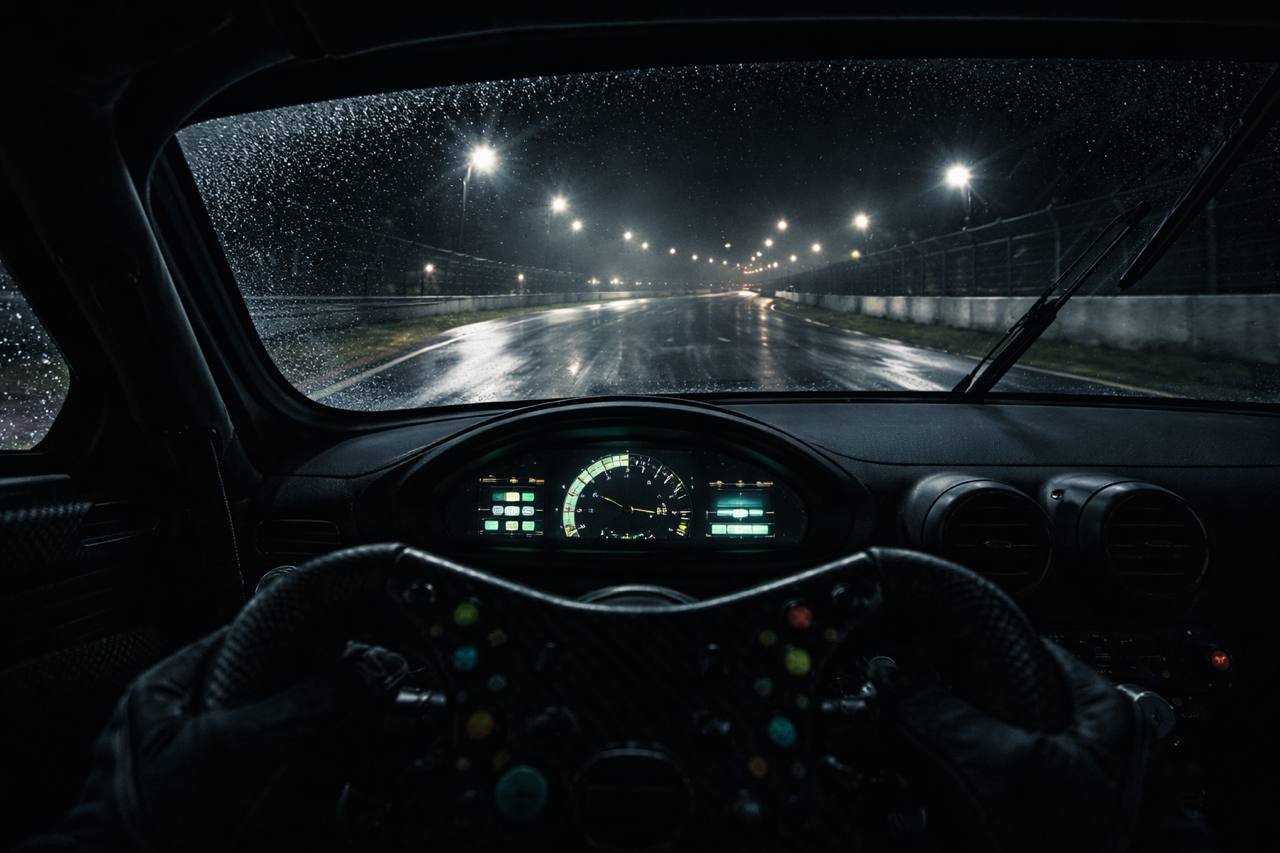
Once you’re in the car, Project CARS VR delivers something that’s hard to overstate: the sense of actually being there.
The cockpit surrounds you. You can lean forward to see past the A-pillar at tight corners. Glance down at your mirrors without breaking immersion. Feel the scale of the track, the distance to that braking zone, the way elevation changes at the Nordschleife that flat screens never quite convey.
The visual fidelity holds up remarkably well. Dynamic time of day, weather systems, rain—these weren’t stripped down for VR. You’re getting the full simulation with all 110+ track layouts and 120+ cars. The physics model that made Project CARS respected in sim-racing circles remains intact. Tire wear, temperature, atmospheric conditions—they all still matter.
Multiplayer in VR is where the experience peaks. Racing against others while feeling the genuine spatial awareness of your car’s position relative to theirs adds a dimension that flat-screen racing never achieved. When you’re side-by-side through Eau Rouge, you feel the proximity.
The comfort considerations are real. This is rated “intense” for a reason. Banking, sudden stops, elevation changes—all the things that trigger motion sickness in VR are present here. The cockpit helps by providing a stable reference frame, but this isn’t a gentle introduction to VR. It demands your tolerance for sensory disconnect.
The Split
Here’s where the experience fractures: VR support in Project CARS is incomplete.
Menus exist on your monitor. Setup screens, car selection, track configuration—all of it happens outside the headset. You boot the game, navigate menus on a flat screen, and only once you’ve loaded into a session does VR activate. Need to change something between sessions? You’re either removing your headset or fumbling blind.
This isn’t unique to Project CARS—early VR titles often struggled with interface design—but it’s a persistent friction point. The game was built for monitors, with VR grafted onto the racing engine. The result is a split experience: one game for preparation, another for driving.
Steam’s launch options hint at this bifurcation. You choose between “Play in VR Mode with HTC Vive” or “Play in Other Mode with Oculus Rift”—distinct launch paths for what should be a unified experience. The game handles it, but the seams show.
The Friction
Beyond the menu split, Project CARS VR carries the expected baggage of early-era support.
Performance demands are significant. Maintaining 90 frames per second in a racing simulation with dynamic weather, multiple cars, and detailed tracks requires substantial GPU headroom. The game automatically lowers resolution settings when VR mode activates—a necessary compromise that leaves the image softer than enthusiasts prefer. For players with mid-range hardware, the choice becomes stark: visual fidelity or smooth performance.
Platform fragmentation complicates things. The Oculus Store version and Steam version don’t communicate. Want to race with a friend who bought elsewhere? One of you is repurchasing. The VR landscape was still sorting out its platform wars, and Project CARS sat in the crossfire.
Various graphical quirks require attention. Shadow rendering could cause visual artifacts in VR—a problem many players solved by simply disabling shadows. Not ideal, but functional. The game also limits to 240Hz maximum refresh, which causes issues with modern high-refresh displays that can’t be selected in-game.
Control support favors simulation. This is a racing simulation first. Project CARS expects you to have a wheel or at minimum a gamepad. The mouse doesn’t work in VR menus. This is fine for the target audience but worth noting for VR enthusiasts coming from other genres.
Historical Context
It’s easy to criticize Project CARS VR from the perspective of modern standards. The sequels—Project CARS 2 and 3—refined VR support considerably, with full VR menus, better performance optimization, and fewer compromises. Assetto Corsa evolved. iRacing added VR. The bar moved.
But in 2015 and 2016, Project CARS was the VR racing option for anyone seeking a serious simulation. Not an arcade experience, not a tech demo—a full racing simulation with career mode, extensive content, and the physics depth that sim-racers expect.
Slightly Mad Studios took a bet on VR when the ecosystem was nascent. The implementation wasn’t perfect, but it proved something important: racing simulation and virtual reality were natural partners. The cockpit view that sim-racers had been using for years was genuinely one headset away from presence.
That proof-of-concept mattered. It paved the way for the refined experiences that followed.
Where It Stands Now
Project CARS 1 has been delisted. Licensing agreements expired, and Electronic Arts—acquirer of Slightly Mad Studios—removed both Project CARS and Project CARS 2 from sale. If you own it, it still works. If you don’t, acquiring it requires third-party key resellers or hoping for a re-release.
For VR enthusiasts with access to a copy, the question becomes whether it’s worth installing. The honest answer: it depends on what you’re seeking.
If you want the most polished VR racing experience, you’re better served by Project CARS 2 (while it lasts), Assetto Corsa with its VR support, or more recent titles. The gap between Project CARS 1 and its successors is meaningful.
If you’re curious about racing VR’s origins—if you want to experience what early adopters felt in 2016 when strapping on a CV1 and finally seeing a serious simulation take VR seriously—Project CARS remains playable. The core racing in VR still works. The immersion still lands. The rough edges are historically accurate.
The Verdict
Tier: C
Game quality carries weight here. Project CARS is a solid racing simulation with substantial content and genuine physics depth. The VR experience, when it works, delivers the presence that defines racing VR’s appeal.
But the incomplete implementation—the menu split, the platform confusion, the performance compromises, the workarounds—keeps it from feeling finished. This isn’t a VR-native game. It’s a flat-screen racing simulation with VR grafted onto its driving engine.
For historical significance, Project CARS VR earns respect. It was early, it was ambitious, and it proved that racing simulation belonged in VR. For actual recommendation? The sequels exist. Other options exist. Play those instead.
Historically important, genuinely immersive once racing, but incomplete VR implementation and modern alternatives make this a curiosity rather than a recommendation.
Quick Reference
Status: DELISTED — Licensing expired. Playable for existing owners only.
Platform: PC (Steam, Oculus Store versions don’t cross-play)
Input: Steering wheel strongly recommended. Gamepad supported. No motion controls.
Comfort: Intense. Motion sickness risk for sensitive users. Cockpit frame provides some reference.
Performance: Demanding. 90fps target requires substantial GPU. Resolution compromises in VR mode.
Content: 110+ track layouts, 120+ cars. Full career mode.
Historical Note: One of the first AAA racing simulations with native VR support. Paved the way for Project CARS 2 and other VR racing titles.
Alternatives: Project CARS 2 (superior VR implementation), Assetto Corsa, iRacing, more recent racing titles.
Last updated: March 2026