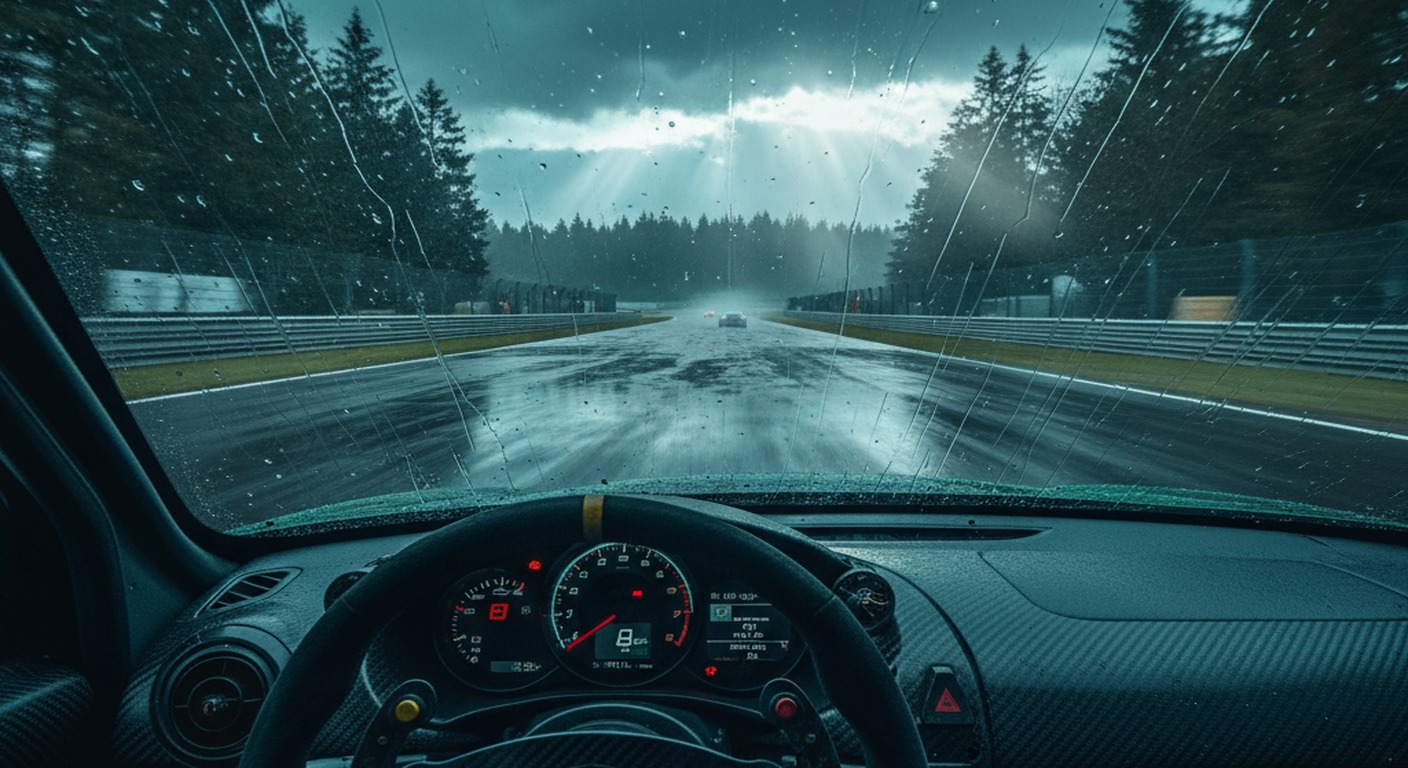
There is a specific moment in Project CARS 2 that sells the whole thing. You’re three laps into a GT3 race at Spa, the sky has opened up, and a river is forming across the apex at La Source. In a flat-screen racing game, you’d see the puddle as a texture change and adjust your line from memory. In VR, you see the depth of it. You see how it catches the light differently from the dry asphalt around it. You feel the car get light as the tires hydroplane, and you correct not because a meter told you to, but because your inner ear demanded it.
That is what Slightly Mad Studios got right in 2017. Project CARS 2 is not a VR-native game — it is a serious flat-screen racing simulation with official VR support bolted into its core — but the bolt is tighter, cleaner, and more intentional than it was in the first game. Where Project CARS 1 treated VR like a promising experiment, the sequel treats it like a platform worth respecting.
The improvements are immediate once you’re in the car. Head tracking is smooth and responsive, without the micro-stutters and delayed updates that made the original occasionally nauseating. Cockpit detail is sharp enough that you can read individual gauge needles without leaning uncomfortably close. The scale feels correct — not the dollhouse effect that plagues poorly implemented driving VR, not the looming-claustrophobia of some cockpit sims. Just a car, in a space, at speed.
The content roster is where Project CARS 2 makes its case. Over 180 licensed cars spanning IndyCar, Rallycross, GT3, Le Mans prototypes, and vintage racing. More than 60 venues with over 130 track layouts. No other VR racing package at the time offered this breadth. You can spend a morning lapping a 125cc shifter kart at a purpose-built karting circuit, an afternoon wrestling a Group C prototype around the Nordschleife in the wet, and an evening sliding a Rallycross car through a snow-dusted hairpin. The variety is the point. Other sims might go deeper on a single discipline; Project CARS 2 wants to be the garage that has everything.
The LiveTrack weather system is the standout feature, and it is genuinely terrifying in VR. Rain does not simply lower grip — it forms puddles dynamically, changing the racing line lap by lap. Snow and ice racing on the frozen Swedish lake circuits creates whiteout conditions that genuinely disorient you inside the headset. The transition from dry to wet is not a preset script; it is a physical system you have to read and react to in real time. No other racing sim in 2017 made weather feel this consequential, and in VR the effect is amplified because you are not watching the conditions — you are sitting inside them.
But the experience is not seamless, and the seams matter. The menus are still flat virtual screens floating in front of you, navigated with a mouse, keyboard, or gamepad. There is no VR-native interface. Want to tweak your brake bias between sessions? You’re either removing your headset or fumbling blind at a virtual screen that was clearly designed for a monitor two feet from your face. The game asks you to choose between OpenVR or Oculus drivers at launch, which adds a layer of platform awareness that breaks the illusion every time you start the application. It is a split personality: preparation happens on a flat screen, racing happens in three dimensions.
Performance is the other reality check. Project CARS 2 is a graphically demanding simulation, and VR compounds that demand significantly. Maintaining a stable 90 frames per second requires real GPU headroom, and the visual tradeoffs to get there are meaningful. Shader quality, shadow detail, particle density — these are the levers you pull, and pulling them down dulls some of the visual spectacle that makes the VR version special. The game does benefit from Oculus Asynchronous Space Warp to maintain playability at lower framerates, but the handling fidelity suffers when reprojection kicks in. For smoother, more responsive driving, the settings stay high and the hardware better match.
Control expectations are worth stating plainly. This is a simulation, and it wants a wheel. A gamepad works, but the analog stick lacks the fine control that the physics model demands, especially when tire temperatures and track surfaces are changing beneath you. There is no motion controller support — no reaching out to flip switches or adjust dials with your hands. The In-Car Management menu is functional but traditional, mapped to buttons rather than gestures. For pure immersion, this is a missed opportunity. For pure racing, it is standard.
Comfort is intense, by nature and by design. This is a racing sim with full six-degrees-of-freedom cockpit presence, elevation changes, high-speed cornering forces, and no comfort vignetting by default. The cockpit frame helps anchor you, but a wet lap at Brands Hatch will still test your tolerance for sensory disconnect. Experienced VR users will find this exhilarating. Newcomers should expect a learning curve, both for their stomach and for their driving — the physics are more forgiving than hardcore alternatives like iRacing, but a Formula car on cold tires still bites.
Who is this for? The sim-curious enthusiast who wants one package that covers multiple motorsport disciplines without the setup complexity of a deep mod ecosystem. The weather and track variety are genuine differentiators, and the VR cockpit presence is strong enough to justify the headset on its own. It is not for the hardcore purist who wants laser-focused physics at a single discipline — Assetto Corsa and iRacing exist for that. It is also not for the VR newcomer looking for a gentle introduction; the intensity and performance demands are real.
Project CARS 2 arrived at a moment when VR racing was still proving itself. It does not revolutionize the format, but it refines it substantially over its predecessor. The cockpit feels like a place you belong, the weather feels like a system you must respect, and the breadth of content means you are unlikely to exhaust it before your hardware begs for mercy. The flat menus and performance overhead keep it from excellence, but when the visor is down and the lights go green, those compromises fade into the background — replaced by the simple, overwhelming fact of speed.