
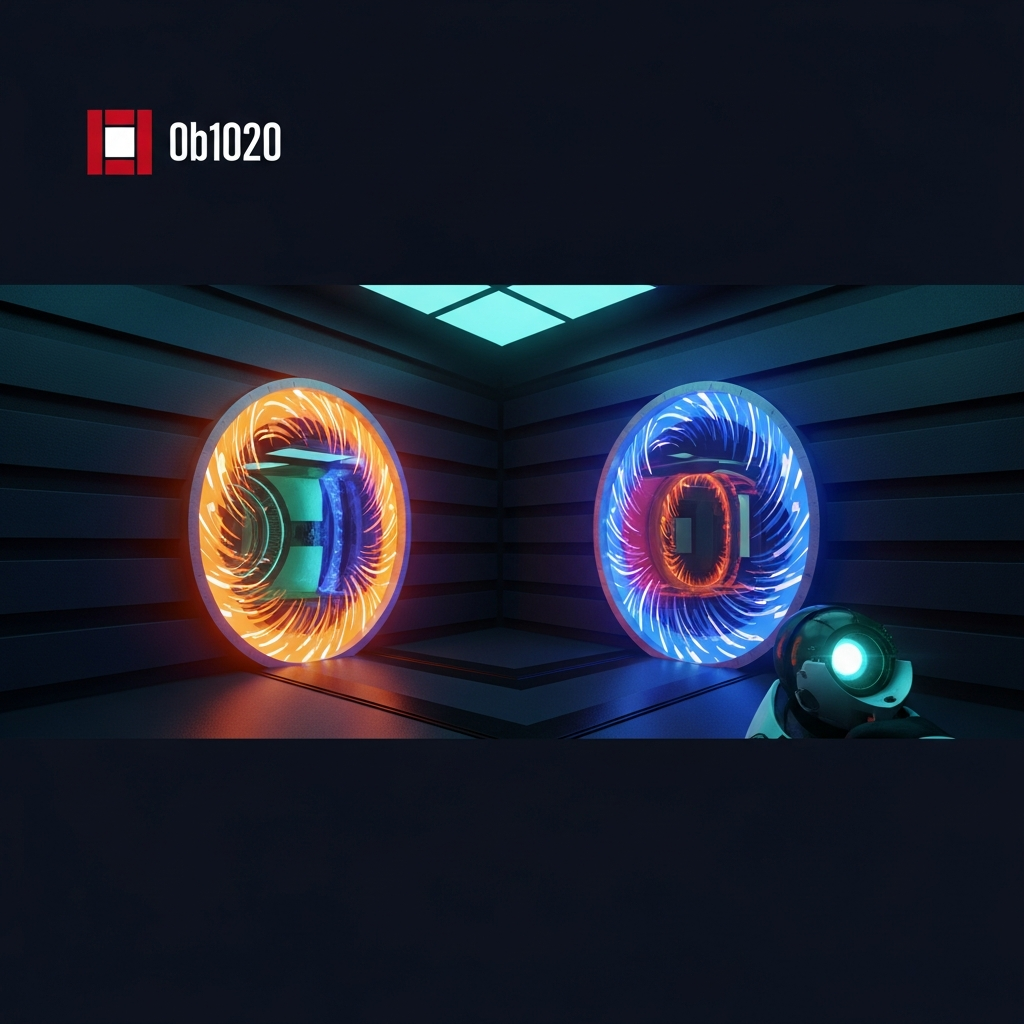
Portal in VR: The Original Test Chambers Reimagined
Portal remains one of the most perfectly designed games ever created. Its spatial puzzles, darkly comic writing, and revolutionary mechanics created something unforgettable in 2007. The prospect of experiencing those test chambers in virtual reality — actually standing inside Aperture Science, physically holding the portal gun, seeing the spatial relationships that make the puzzles work — is tantalizing.
Here’s the reality: there is no dedicated Portal 1 VR mod. But through an elegant community workaround, the entire original game is fully playable in VR.
The VR Path: Portal 2’s Mod + Portal 1 Remastered
Portal (2007) runs in VR through the Portal 2 VR Mod (by Gistix) combined with Portal 1 Remastered — a workshop collection that recreates the original game’s test chambers within Portal 2’s engine.
This is not emulation or approximation. These are faithful recreations of Portal’s test chambers, built using Portal 2’s assets and mechanics, running through a purpose-built VR implementation. The result is the complete original Portal experience, from waking up in the relaxation vault to the final confrontation with GLaDOS, playable start-to-finish in 6DOF VR with motion controls.
What Actually Works
The Full Campaign
Portal 1 Remastered includes all 19 test chambers from the original game, plus the escape sequence and final battle. This is not a tech demo or sampler — it’s the complete experience. The pacing, the escalation, the moments of revelation as the test chambers open up into larger spaces — all preserved.
Motion-Controlled Portal Gun
The portal gun becomes a physical object in your hand. Pointing, shooting, and watching portals open on surfaces feels natural and satisfying. The haptic feedback from the controller vibrates when you fire, reinforcing the sense of holding Aperture’s signature device.
Grabbable objects — cubes, turrets, the weighted companion cube — can be picked up and manipulated naturally. The physics interactions that Portal depends on translate well to VR’s direct manipulation.
Spatial Puzzle Solving
Portal was always a game about understanding three-dimensional space. In VR, that understanding becomes visceral. Looking through portals, judging distances, and visualizing momentum conservation all feel more intuitive when you’re physically present in the space. Flinging yourself through a portal to build momentum — the game’s signature mechanic — gains a physical thrill in VR.
Workshop Integration
The Portal 2 VR mod supports Steam Workshop content. This means that once you’ve played through Portal 1 Remastered, thousands of community-made test chambers are available. The puzzle potential is effectively endless.
The Setup Process
Getting Portal running in VR requires several steps:
-
Own Portal 2 — The VR mod requires Portal 2 as its base (Portal 1 ownership is recommended but not strictly required for the remastered content)
-
Install Portal 2 VR Mod — Download the latest release from GitHub and extract files to your Portal 2 directory
-
Subscribe to Portal 1 Remastered — Find the workshop collection on Steam and subscribe to all chapters
-
Configure Launch Options — Add specific command-line parameters to Portal 2’s launch options
-
Launch and Play — Start Portal 2 with SteamVR active, navigate to Community Test Chambers, and begin
The process is documented and community-supported, but it’s not plug-and-play. Expect to spend 15-30 minutes on initial setup and troubleshooting.
Known Limitations
UI and Menus
The in-game UI and pause menu are partially broken in the VR mod. Navigation works with the left thumbstick and right controller buttons, but some elements may require SteamVR Desktop interface or a physical mouse to access. This is a known issue listed by the mod developer.
Roomscale Positioning
The player’s in-game position is locked to the center of the playspace rather than tracking actual roomscale movement. You can look around freely, but physically walking in your play space won’t translate to character movement. This limits immersion slightly but doesn’t affect gameplay.
Some Camera-Dependent Elements
Certain game elements still use the HMD camera position rather than controller position. Laser redirection cubes, for example, rotate based on where you’re looking rather than controller orientation. The built-in aim assist also references HMD position, which can actually be helpful for puzzle solutions.
Cutscenes
Pre-rendered cutscenes don’t display correctly in the headset. The Portal 1 Remastered content largely avoids this issue since it uses in-engine sequences, but some transitions may require removing the headset or using the SteamVR desktop view.
How It Plays
Controls: Full motion controls with the portal gun mapped to the dominant hand. Movement uses standard smooth locomotion with snap or smooth turning. Left stick recenters the camera height when pressed.
Comfort: Moderate. Portal’s gameplay involves sudden movement and perspective shifts that can challenge VR comfort. The flinging mechanic — where momentum carries through portals — creates intense motion. Players sensitive to artificial movement should take breaks and build tolerance gradually.
Performance: Runs on the Source Engine, which is undemanding by modern standards. Most PCVR-capable systems will handle it smoothly, though the mod notes CPU underutilization as a current limitation.
Visual Quality: Portal 2’s cleaner aesthetic replaces Portal’s grittier industrial look in the remastered content. The tradeoff is acceptable — chambers are recognizable and atmospheric, just slightly more polished than the 2007 original.
What Works Exceptionally Well
Portal Mechanics in VR — The core loop of placing portals, moving through them, and manipulating physics objects feels designed for VR. It’s one of those cases where the flat-to-VR conversion reveals why the mechanics were brilliant in the first place.
Scale and Presence — Test chambers that felt claustrophobic on a monitor feel appropriately sized in VR. The moments when walls retract to reveal larger spaces carry more impact. GLaDOS’s eye cameras and turrets have physical presence that adds to their menace.
Puzzle Clarity — Spatial relationships that required mental rotation in flat mode become immediately obvious in VR. Understanding how portals connect spaces, judging distances for flings, and tracking object trajectories all benefit from stereoscopic vision.
The Writing — Portal’s sharp, dark comedy translates perfectly. GLaOS’s narration surrounds you. The companion cube moment lands differently when you’ve physically held the object.
What Doesn’t Work
No Native Portal 1 Mod — The need to use Portal 2 as a base, subscribe to workshop content, and navigate an indirect path to the original campaign adds friction. A dedicated Portal 1 VR mod would simplify this significantly.
Setup Complexity — Multiple installation steps, launch options, and potential troubleshooting place this in “moderate setup” territory. This isn’t a download-and-play experience.
UI Limitations — Broken menus and the need for workarounds to access certain functions remind you this is a mod, not an official release.
Roomscale Limitations — The locked player position means you can’t physically lean around corners or step closer to examine details. You’re anchored to a virtual center point.
Comparison: Portal Stories: VR
Worth noting: there’s an official VR title called Portal Stories: VR — a short, standalone experience built for VR from the ground up. However, it was designed for the HTC Vive’s launch in 2016 and is essentially a brief tech demo. It offers only a handful of test chambers and lacks the narrative and mechanical depth of the main games.
The Portal 1 via Portal 2 VR mod experience is far more substantial and ultimately more satisfying for anyone wanting actual Portal in VR.
Who This Is For
Recommended for:
- Portal fans who want to revisit the original in a new format
- Puzzle game enthusiasts curious about VR spatial mechanics
- Players comfortable with moderate technical setup
- Anyone who wants a complete, content-rich flat-to-VR experience
Not recommended for:
- Players seeking instant, plug-and-play VR experiences
- Those highly sensitive to artificial motion or momentum-based movement
- Users unwilling to troubleshoot mod installations
- Anyone expecting native roomscale movement
The Verdict
Tier: B
Game Quality: A+ Portal is a masterpiece of game design — concise, inventive, funny, and mechanically revolutionary. Its influence on puzzle games and first-person design cannot be overstated. The writing remains sharp, the puzzles remain satisfying, and the experience remains memorable nearly two decades later.
VR Implementation Quality: B The Portal 2 VR mod is a remarkable technical achievement. Motion controls feel natural, the 6DOF implementation is solid, and the game is genuinely completable in VR. The indirect path to Portal 1 content, UI limitations, and roomscale restrictions prevent a higher grade, but this is among the more complete flat-to-VR conversions available.
Overall Tier: B
Portal in VR delivers something rare: a complete, beloved single-player campaign fully playable with motion controls. The spatial puzzles that defined the original gain new dimension when experienced in actual space. The portal gun feels right in your hand. The writing still lands.
The B-tier rating reflects the friction of setup and the workaround nature of the implementation, not the quality of the experience itself. Once configured, this is one of the best arguments for flat-to-VR modding — it preserves and enhances a genuine classic.
For players willing to spend twenty minutes on installation and configuration, Portal in VR offers hours of exceptional puzzle gameplay. The original test chambers, experienced at scale with motion controls, remain as engaging as they were in 2007 — perhaps more so.