
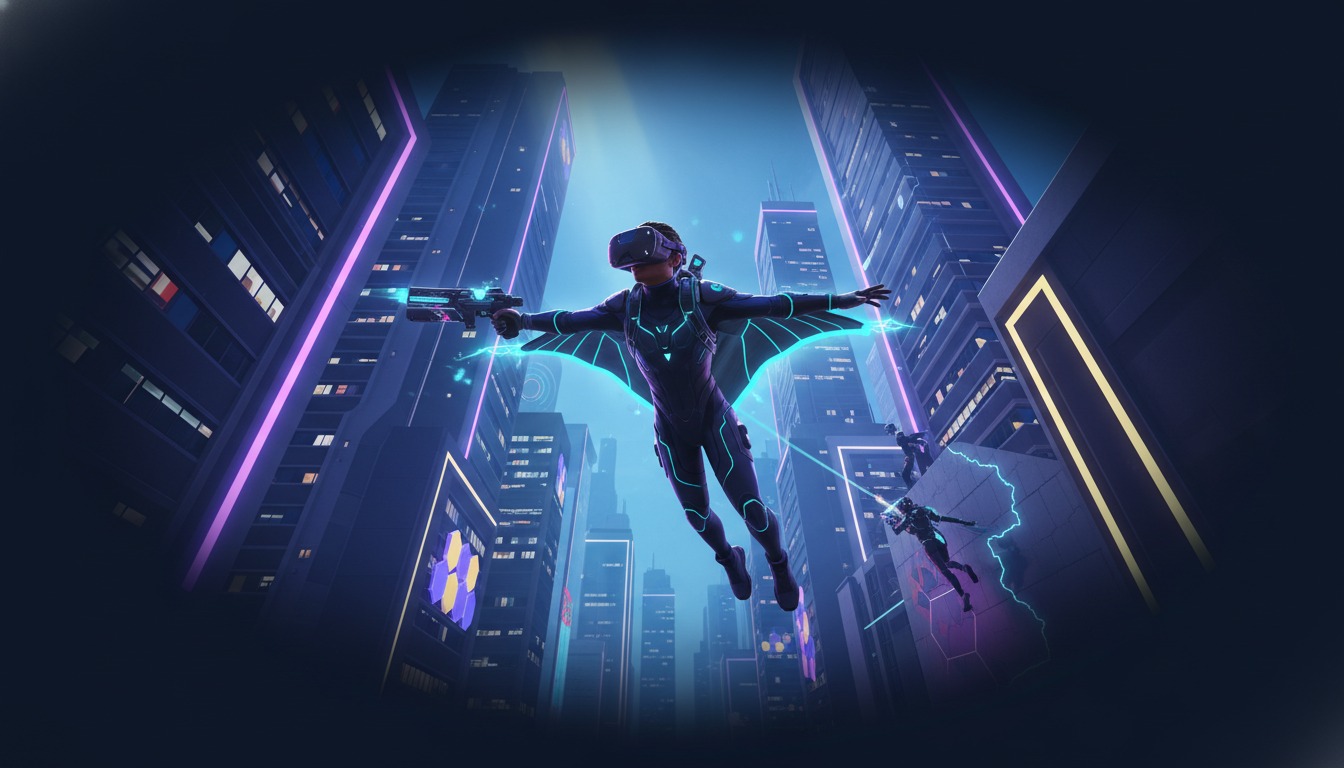
You are halfway up a concrete tower, one hand gripping a window ledge while the other squeezes off suppressing fire at a gliding target below. Your teammate shouts a direction. You release, fall, spread your arms like a wingsuit, and bank hard toward the next rooftop where the final squad is holed up. This is not a mod. This is not a flat game with head tracking bolted on. Population: One is a battle royale built from the ground up to make VR’s physicality central to combat—and for a while, it was the best argument that competitive shooters could actually work inside a headset.
Built for the Headset
Developed by BigBox VR and acquired by Meta, Population: One is a native VR battle royale that launched in late 2020. It remains one of the few competitive shooters designed exclusively for headsets rather than adapted from a flatscreen foundation. The game is free-to-play on Meta Quest headsets and carries a price tag on PCVR platforms—a split that exists partly as an anti-cheat measure on PC. Cross-play between Quest and PCVR keeps the player pools connected, which matters because the pool itself has been shrinking.
The control scheme maps physical actions to in-game movement with rare intuition. Grip buttons grab any surface for climbing, letting you scale buildings while keeping one hand free to reload or shoot. Spread your arms while falling and you glide, steering with body and controller positioning. Building cover walls requires putting your weapon away and pulling a trigger—simple, but tactically crucial when crossing open terrain. Manual reloading adds physical engagement without becoming fiddly. On Quest hardware, the game maintains playable frame rates with scaled-back visuals. Newer Quest headsets deliver a notable resolution and performance bump over older standalone models. PCVR unlocks sharper distant targets and higher refresh rates, though the gap is not drastic enough to make the paid PC version essential if you already own the Quest release.
Combat benefits enormously from this vertical freedom. Sniping from rooftops, ambushing from above, or escaping by leaping off a cliff all feel like genuine spatial decisions rather than button presses. The gunplay itself is straightforward—this is not a military sim—but the movement layer transforms encounters into something no flatscreen battle royale can replicate. The Phoenix Royale update overhauled the core loop with a redeploy mechanic, rotating zones, and character classes, streamlining the experience but also narrowing some of the sandbox freedom that early players loved.
Running on Reserves
The live service model carries uncertainty. Following Meta’s broader studio restructuring, BigBox VR has shifted to a maintenance-focused approach, with major content updates slowing to a crawl. The player base has thinned, leading to longer queue times and less populated matches. Cheating has become a recurring frustration, particularly on PCVR, where the paid price point does not insulate you from the problem. What was once a vibrant, regularly evolving shooter now feels like a game operating on borrowed time—servers still humming, but the creative pipeline reduced to cosmetics and minor patches.
The free-to-play model on Quest removes the financial barrier to entry, which is genuinely generous for a game of this scope. But it also means the experience lives or dies by matchmaking health, and the health is declining. Solo queue players feel it most. Squad players with regular teammates still find matches, but the days of instant drop-in lobbies are fading.
If you own a Quest headset and want a competitive shooter that actually uses VR’s strengths, Population: One is an easy download. The vertical combat is genuinely special, and the price of entry is zero. VR veterans looking for a battle royale that does not feel like a flat game with a camera strapped to their face will find the most to like. But players with low tolerance for live service uncertainty should be cautious. The shrinking population and maintenance-mode status mean the game’s future is unclear. If you primarily play solo or prefer methodical, tactical shooters, the fast-paced arcade nature and chaotic redeploy mechanics may grate. PCVR buyers specifically face a tougher sell at a paid price point when the free Quest version offers nearly identical gameplay.
Population: One remains one of the most mechanically distinctive VR shooters available. Its climbing, gliding, and building systems are not gimmicks—they fundamentally reshape how a battle royale functions in three dimensions. But the game is living on server uptime and community goodwill now. Download it on Quest while the lobbies still fill. Paying for the PCVR version is a harder recommendation to stand behind.