
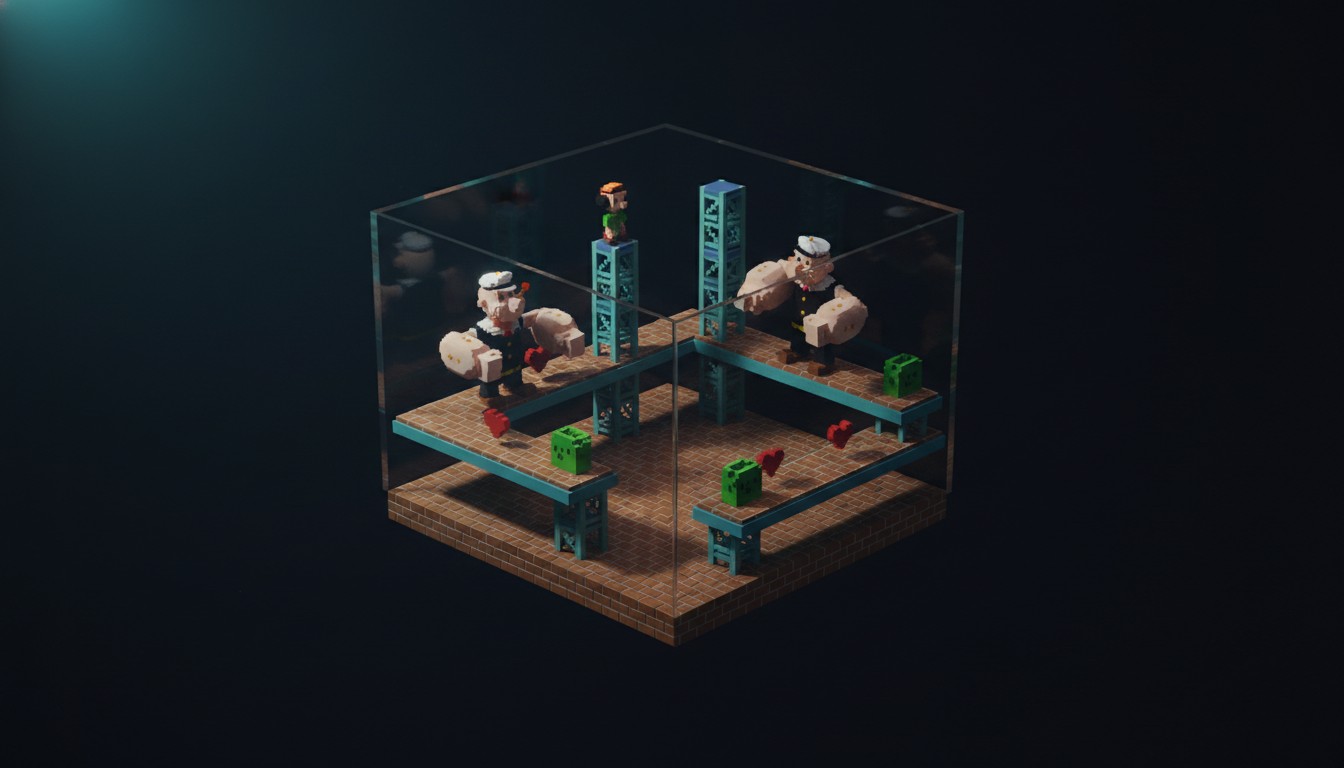
There is a very particular joy in watching an 8-bit sprite gain depth. Popeye in 3dSen VR does not transform the 1982 arcade classic into something it never was. It does something stranger and more specific: it turns a flat platformer into a physical object you can walk around, a voxel diorama floating in space where Popeye catches hearts while Brutus stomps across platforms that now actually have sides.
This is not a mod, not an injection driver, and certainly not an official VR port. It is a profile inside 3dSen VR, a commercial NES emulator that has spent over a decade learning how to reinterpret 2D sprites as three-dimensional voxel scenes. The Popeye [V3] profile arrived in March 2026, and it does exactly what the tech promises. The spinach cans have volume. The platforms cast tiny shadows. Olive Oyl’s falling letters tumble through space instead of sliding down a flat plane. It is genuinely charming the first time you see it.
Getting it running is straightforward if you already own 3dSen VR. You buy the emulator through Steam or itch.io, supply your own legally obtained NES ROM, load it, and select the Popeye profile. The emulator handles the rest. Compared to the config-file nightmares and dependency chains I have wrestled with for other VR retro experiences, this is almost polite. There is no VorpX to tweak, no ReShade fix to hunt down, no FOV console command to memorize. You load a ROM and you are standing inside a Nintendo game from 1983.
The problem is what you do once you are there. Popeye is an extremely simple arcade platformer. You catch hearts, musical notes, or letters that Olive Oyl drops from above while Brutus wanders the platforms trying to punch you. A Sea Hag throws bottles. You eat spinach for temporary invincibility. That is the entire game. The NES port has three short levels that loop with increasing speed. In VR, with 6DoF head tracking, you can lean in and examine the voxel geometry, orbit the scene with your head, and appreciate the craftsmanship of the conversion. But the gameplay itself is unchanged. You are still timing jumps on a gamepad to catch falling objects. The depth adds visual interest but does not add mechanical depth.
Comfort is not an issue. This is a fixed-screen platformer reinterpreted as a diorama. There is no continuous locomotion, no sprinting, no camera shake. You observe the action from a comfortable vantage point while your thumbs control the sprite. It is one of the most comfortable retro VR experiences I have encountered, and I would recommend it to anyone showing VR to a newcomer — except for the part where the game itself is over in about ten minutes.
Performance is a non-concern. NES emulation is trivial for modern hardware, and even the 3D voxel conversion runs smoothly on mid-range systems. 3dSen VR’s minimum spec is a GTX 960, which tells you everything about how lightweight this is. The Mixed Reality mode on Meta Quest is a fun bonus — you can place the Popeye diorama on your actual coffee table — but it requires the PC VR setup, not standalone Quest.
The real question is value. 3dSen VR costs $24.99, and the Popeye profile is just one of over a hundred supported titles. If you already own the emulator for Super Mario Bros. or Punch-Out!! or The Legend of Zelda, then Popeye is a free bonus curio, a fun ten-minute nostalgia hit. But if you are buying 3dSen VR specifically for Popeye, you are spending twenty-five dollars plus ROM sourcing effort for a game that was designed to eat quarters in 1982 and is not much deeper than that.
That said, what 3dSen VR does is technically remarkable. The developer has spent ten years building a tool that turns sprite data into believable 3D spaces, and the results are sometimes magical. Popeye is not the showcase title — the depth does not transform the simple catch-and-dodge loop the way it transforms the exploration of Zelda or the platforming of Mario — but it is a solid example of what the tech can do with even the most straightforward arcade conversions.
So who is this for? If you collect NES ROMs, already own 3dSen VR, and want to see every supported title, Popeye is a charming fifteen-minute diversion. If you are looking for a substantial VR platformer with modern depth and mechanics, this is emphatically not that. And if you are trying to decide whether 3dSen VR is worth the purchase, judge it on Mario or Zelda or Metroid, not on a three-level arcade port that was shallow when it was new.
The voxel Popeye is a delightful curiosity. The original game remains what it always was: a simple, charming, aggressively slight arcade experience that happens to look very cool in three dimensions. Eat your spinach, catch the hearts, and do not expect to stay long.