
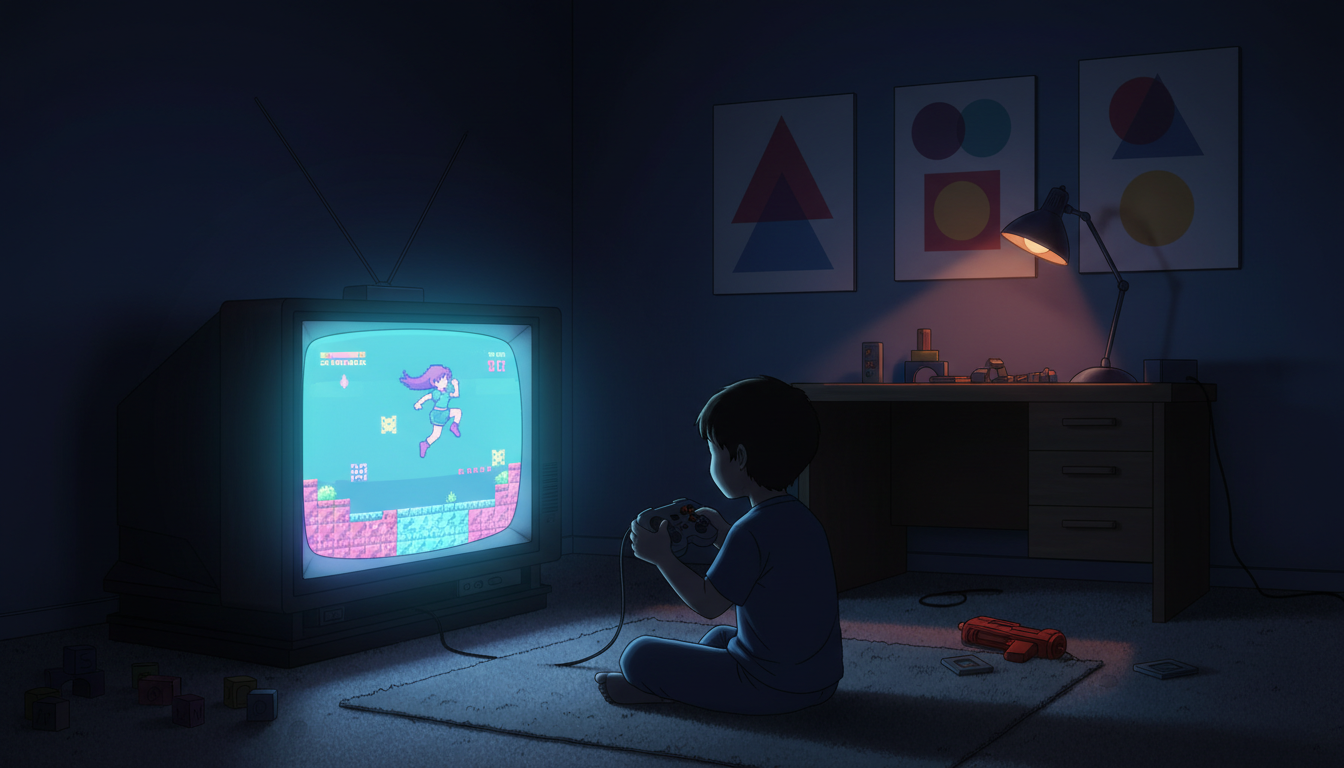
There is a moment in Pixel Ripped 1995 that captures everything it gets right. You are nine-year-old David, hunched on a carpeted bedroom floor in front of a chunky CRT television, gripping a virtual gamepad in your hands. On the screen, Dot — a purple-haired platforming heroine — is battling through a side-scrolling level. Then your mother walks in. She wants you to clean your room. To keep playing, you have to look away from the TV, grab a toy dart gun from the floor, and shoot a target to distract her. Then it is back to the game before she notices you have not moved.
That is Pixel Ripped 1995 in miniature: a nostalgic action-adventure built around the premise that you are a kid in 1995 pretending your homework does not exist while games secretly bleed into the real world. Developed by ARVORE Immersive Experiences and released as a native VR title, it is not a retrofit or a mod. It was designed for headsets from the ground up, and that intention shows in nearly every interaction.
The story follows David and Dot as they fight the Cyblin Lord, a villain trying to merge digital and physical worlds. The narrative matters less than the structure. You spend most of your time playing retro-inspired games on David’s television — platformers, beat-‘em-ups, space shooters, action RPGs, even a racing segment — while periodically breaking the fourth wall to manipulate the bedroom around you. Grab a flashlight to illuminate a dark corner. Throw a basketball at a switch. Tilt the TV to see a hidden path. The game treats your headset not as a viewport but as a physical presence in a child’s room.
Controls vary by platform, but the intended input is motion controllers on PCVR and Quest, where your hands become David’s hands. You grip the virtual gamepad with both hands to control Dot, then release one hand with a trigger press to interact with objects around the room. On the original PSVR, the game used the DualShock 4 controller, which was tracked in 3D space and functioned similarly. The PSVR2 version upgrades this further with adaptive triggers, headset rumble, and 120fps rendering — a free patch for existing owners that makes the game run smoother than it ever has.
What makes the VR version work is restraint. There is no artificial locomotion, no teleportation, no snap-turning anxiety. You are seated in a virtual room, and the only movement is your own head turning and your hands reaching. That makes it one of the most comfortable VR experiences available, even for players sensitive to motion sickness. The tradeoff is limited interactivity outside the television screen. You cannot walk around David’s house or explore beyond the boundaries of each scene. The game is a series of meticulously crafted dioramas, and once the script moves you to the next room, the previous one is gone.
Those dioramas are packed with charm. The pixel-art games on the CRT are faithful love letters to the 16-bit and early 32-bit era — Sonic, Zelda, Final Fantasy, and Street Fighter filtered through a playful, slightly irreverent lens. The boss battles are where the concept shines brightest, merging television action with real-world distractions in ways that feel genuinely inventive. In one fight, you might need to catch popcorn falling from the ceiling to feed an audience that boos if you miss. In another, the game itself glitches out, forcing you to physically repair the console while dodging attacks on screen.
But the variety that fuels the first half becomes a weakness in the second. Individual genres do not get enough time to develop depth. The beat-‘em-up segment is button-mashy. The RPG section is thin. The racing level is brief. None are bad exactly, but they feel like appetizers instead of meals. The game is over in roughly three to five hours, and while a free “Ultimate Challenge” update added hardcore modes, alternate routes, and hidden collectibles, the core campaign is a one-and-done experience for most players. There are golden cartridges to hunt down and costumes to unlock, but the linear design means little reason to return once the nostalgia fades.
Performance is solid across all platforms. The Quest version hits a stable 90fps with visuals that hold up well against PCVR, and the PSVR2 patch pushes that to 120fps with sharper textures. The art direction helps: the real world is rendered in a soft, stylized look that hides technical limitations, while the in-game games commit fully to chunky pixels and chiptune soundtracks. It is not a demanding title, and that efficiency is part of why it plays so smoothly.
Who should play this? Anyone who grew up with a Super Nintendo or Sega Genesis will find something to grin at. The humor lands, the references are sharp without being obnoxious, and the VR framing elevates what could have been a simple retro anthology into something with genuine personality. But if you are looking for a lengthy adventure or deep mechanical systems, this is not it. Pixel Ripped 1995 is a carefully curated experience with a beginning, middle, and end, and it does not pretend to be anything else.
The game sits in an odd place in the VR landscape. It is not a blockbuster and it is not experimental tech. It is a polished, creative, slightly slight action-adventure that uses VR as a storytelling device rather than a gimmick. For players who want a comfortable, low-stress introduction to what native VR design can do — or for anyone who once got yelled at for playing video games past bedtime — it is an easy recommendation. Just know you will finish it in a weekend, and you might wish there was more.