
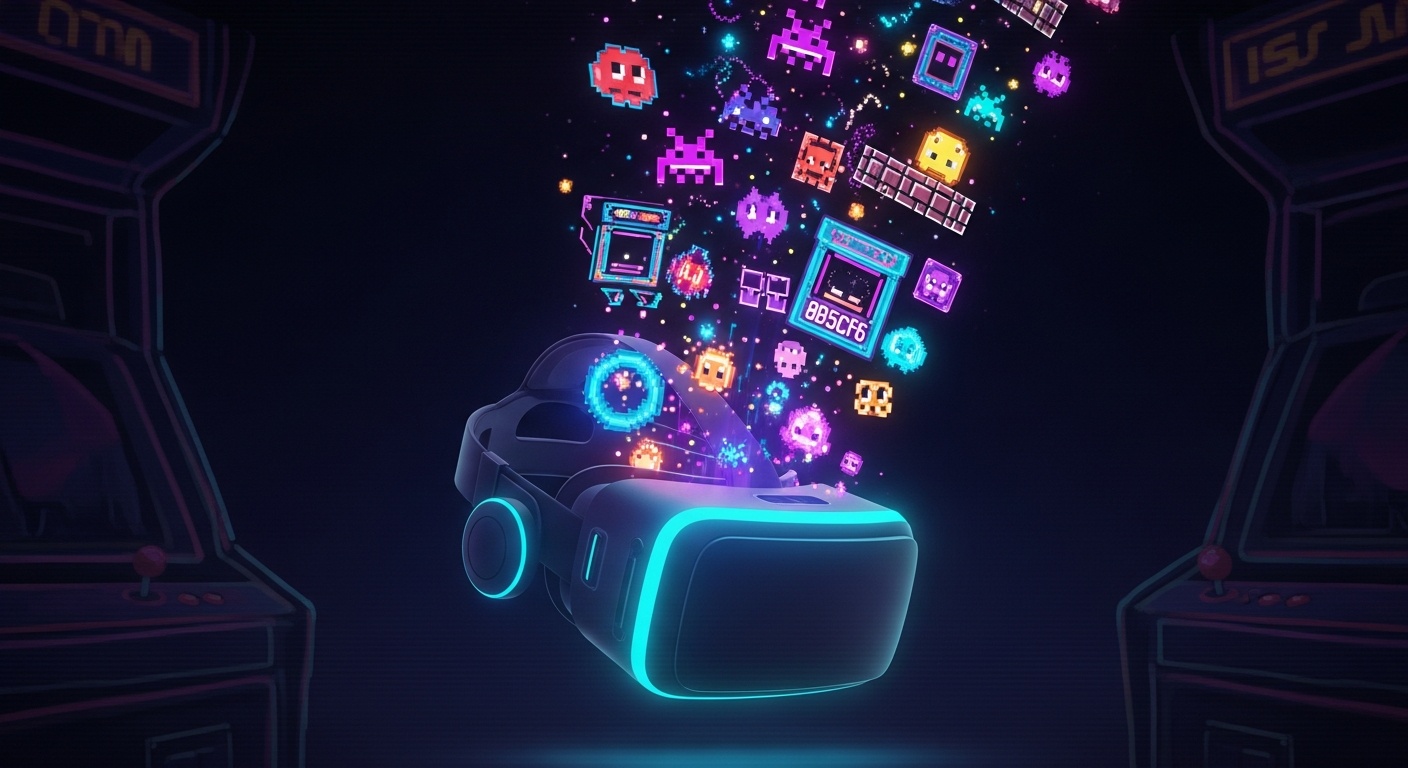
Pixel Ripped 1989: When Nostalgia Meets VR’s Unique Possibilities
Most VR games port flat experiences into virtual reality. Pixel Ripped 1989 does something far more interesting — it creates an experience that only works because you’re in VR. Released in 2018 by Brazilian studio ARVORE Immersive Games, this isn’t a flat-to-VR conversion. It’s a native VR title that understands the medium’s potential for spatial storytelling and layered reality in ways few games have matched.
The premise sounds simple: you’re Nicola, a second-grade student in 1989, secretly playing a Game Boy-like handheld called the “Gearkid” during class. Inside that handheld lives Dot, an 8-bit Mega Man-inspired heroine battling the villainous Cyblin Lord. But the game’s genius lies in how these two realities — Nicola’s 3D classroom and Dot’s 2D platformer world — begin to bleed into each other.
How It Actually Plays
The Core Loop: Most of the game has you holding the Gearkid in one hand while using the other to interact with Nicola’s surroundings. You’re playing a fully functional 2D platformer on the handheld screen — complete with jumping, shooting, and boss battles — while simultaneously managing distractions in the “real” world.
Classroom Management: Your teacher patrols the classroom, and getting caught playing means game over. You’ll use spitballs, erasers, and other classroom items to create diversions. This isn’t just background flavor; it’s active gameplay that requires spatial awareness and quick thinking. You’re managing two attention spans simultaneously — yours on the game, and the teacher’s on you.
Reality Collapse: As the story progresses, the barrier between worlds breaks down. The Cyblin Lord escapes the handheld screen into Nicola’s world, transforming your Gearkid into a window that reveals 8-bit versions of the 3D space around you. You’ll point the handheld at flying enemies and shoot them like a wave shooter, or watch as pixelated effects overlay your physical environment.
Genre Shifts: Just when you think you’ve mastered the rhythm of platforming-plus-distraction, the game throws new mechanics at you. A motorbike chase sequence. A section where you’re physically moving through Nicola’s world while the handheld displays a different perspective entirely. The variety keeps the ~3-4 hour runtime feeling fresh.
What Works Brilliantly
The Dual-Reality Concept: This isn’t “game-within-a-game” as narrative device — it’s the entire mechanical foundation. The way your attention must split between the handheld screen and the 3D classroom creates genuine tension that flat games can’t replicate. When you’re deep into a Dot boss battle and hear the teacher approaching, the panic is real.
Nostalgia Done Right: If you grew up with Game Boys, NES cartridges, or sneaking gaming sessions in class, Pixel Ripped triggers something deeper than simple reference humor. The Gearkid’s green-tinted screen, the sound effects, the Mega Man-inspired gameplay — it all feels authentic rather than parodic.
Comfort-First Design: Despite the layered realities, Pixel Ripped is remarkably comfortable. Most gameplay happens at fixed distances. There’s no smooth locomotion to induce motion sickness. The camera work is deliberate and careful. This is a game you can show VR newcomers without worrying about nausea.
Performance Headroom: Running on modest hardware requirements (GTX 960 minimum), this isn’t pushing any technical boundaries. It doesn’t need to. The visual style is clean, readable, and purposefully stylized. Frame rates stay locked, and you’ll never hit reprojection artifacts.
Cross-Platform Availability: Available on PSVR, PCVR (Steam), and Quest, with the Quest version releasing later as DLC for Pixel Ripped 1995 owners. The game translates well across headsets — there’s no complex control scheme that demands specific controller layouts.
Where It Falls Short
Length: At 3-4 hours, this is a short experience. That’s not inherently a problem — the game doesn’t overstay its welcome — but for the $24.99 MSRP (often discounted to ~$7.50), some players may hesitate. Consider it a premium short film rather than a feature-length epic.
Difficulty Spikes: The 2D platforming sections can get unexpectedly tough, particularly some boss encounters. Since you’re also managing classroom distractions, frustration compounds when you die repeatedly to a boss pattern while trying to monitor your teacher’s patrol route.
Limited Replayability: Once you’ve experienced the reality-bending moments, they lose some impact. This is a story-first game with a clear beginning, middle, and end. There’s no procedural content or multiplayer to extend the experience.
Sequel Dependency: The Quest version requires owning Pixel Ripped 1995 to access it as DLC, which frustrates players who want to experience the series chronologically. It’s a business decision that creates unnecessary friction.
Platform Comparison
PCVR (Steam): The original release and the most flexible option. Works with any SteamVR-compatible headset. Visuals are crisp, and the controller tracking for holding the Gearkid feels natural.
PSVR: Solid port that doesn’t sacrifice the core experience. The tracking limitations of PSVR’s single camera setup can occasionally cause issues when reaching for classroom objects while holding the handheld at certain angles, but it’s rarely problematic.
Quest: Released later as DLC for Pixel Ripped 1995, this is the standalone version many Quest owners will encounter. Wireless freedom is nice, though the DLC requirement is an odd structure. Performance is solid on Quest 2 and newer hardware.
Who This Is For
Retro Gaming Enthusiasts: If you have fond memories of Game Boys, Mega Man, or the 8-bit/16-bit era, this is practically mandatory. The nostalgia runs deep and genuine.
VR Advocates: This is a “see what VR can do that flat screens can’t” showcase piece. When someone asks why VR matters beyond novelty, Pixel Ripped is an answer.
Short Session Players: The chapter-based structure and 3-4 hour runtime make this perfect for players who can’t commit to 40-hour RPGs. It’s completable in a weekend.
Comfort-Sensitive Users: No artificial locomotion, no nausea-inducing camera work. This is accessible VR at its best.
Not For: Those seeking multiplayer, procedural content, or gameplay-focused experiences divorced from narrative. This is a crafted journey, not a sandbox.
The Verdict
Tier: A
Game Quality: A Pixel Ripped 1989 knows exactly what it wants to be and executes with confidence. The platforming feels good, the meta-narrative is clever without being pretentious, and the pacing keeps surprising you. ARVORE understood that VR’s strength isn’t just immersion — it’s the ability to create impossible spaces that blend multiple realities.
VR Implementation Quality: A This is native VR done right. Every mechanic serves the medium. The way you physically hold the Gearkid, the spatial awareness required for classroom management, the reality-melting moments that only work because you’re wearing a headset — it’s all built for VR from the ground up.
Overall Tier: A
Pixel Ripped 1989 represents VR at its most conceptually interesting. It doesn’t need room-scale environments or complex physics interactions to prove the medium’s worth. Instead, it uses VR’s unique capacity for layered reality to tell a story about gaming itself — about the magic of screens-within-screens and the way virtual worlds capture our imagination.
For a flat-to-VR site, covering native titles like this serves an important purpose: it establishes the baseline of what proper VR design looks like. When we evaluate flat-to-VR mods, we’re implicitly asking whether they approach this level of integration. Pixel Ripped 1989 is the standard — a reminder that when VR is built correctly from the ground up, the results can be genuinely special.
The sequels (Pixel Ripped 1995 and Pixel Ripped 1978) expand the concept across different eras of gaming history, but this 2018 original remains the essential starting point. For anyone with a VR headset and nostalgia for the 8-bit generation, this belongs in your library.