
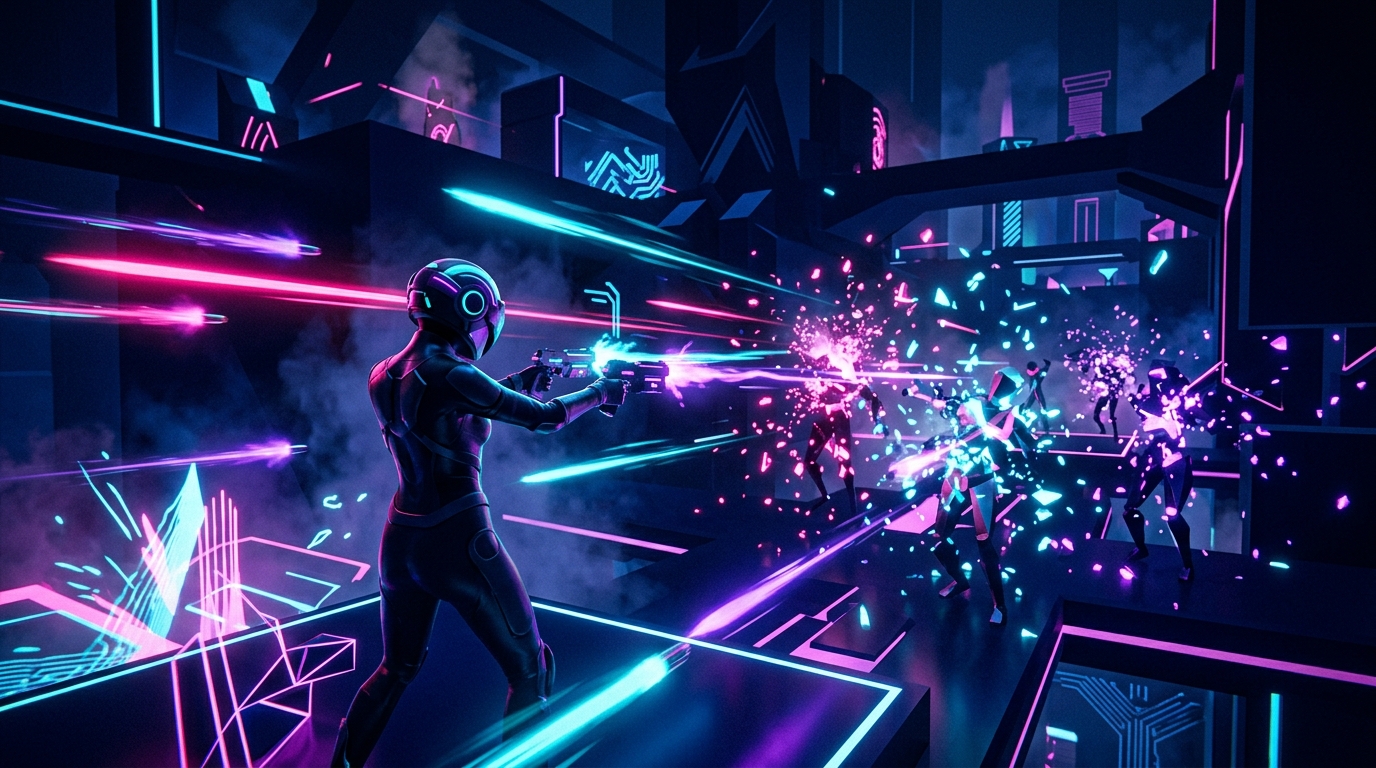
The first time the bass drops in Pistol Whip and you instinctively duck under a neon bullet trail, you realize Cloudhead Games has built something that flat screens simply cannot replicate. This is not a shooter with VR support bolted on. It is a shooter that only makes sense inside a headset — a rhythm-action gauntlet where your body becomes the instrument and the gun is just the percussion.
Cloudhead, the Vancouver studio behind The Gallery series, has traded the slow-burn puzzle exploration of its earlier work for something far more immediate. Released this month for PCVR and Oculus Quest, Pistol Whip drops you onto an automatic conveyor belt of stylized violence. Faceless, glitching enemies pop into existence around abstract architectural sets bathed in pulsing color. You shoot them. You dodge their return fire. You reload by pointing your pistol at the floor or ceiling, and if someone gets too close, you smack them with the weapon itself — the eponymous pistol whip — which also restores precious ammunition.
The comparisons to Beat Saber and Superhot are inevitable, but reductive. Where Beat Saber asks you to slice blocks with precision and Superhot freezes time until you move, Pistol Whip is about flow state. The game auto-pushes you forward through each scene, and generous auto-aim means you are rarely fighting the controls to land a shot. The challenge is not marksmanship. It is choreography. Can you keep your shots timed to the electronic soundtrack’s beat while simultaneously leaning around a pillar, ducking under a horizontal volley, and reloading before the next wave materializes?
The soundtrack is not background dressing. It is the spine of the experience. Levels are built around individual EDM tracks from artists like Black Tiger Sex Machine and Apashe, and the geometry itself seems to breathe with the music. Shoot an enemy on the beat and you earn score multipliers. Fall out of rhythm and you are still playing a shooter, but you are not playing Pistol Whip — not the way it wants to be played. The visual design leans hard into abstraction: hot pinks, electric blues, and geometric foes that shatter into particles when hit. It reads like a nightclub hallucination directed by John Wick’s stunt coordinator.
What gives the game surprising depth is its Styles system — a suite of modifiers that let you calibrate the experience to your mood and physical tolerance. Want a relaxed rhythm session? Keep auto-aim on, disable enemy return fire, and glide through the levels like a tourist. Want to suffer? Turn on Deadeye to disable auto-aim, enable Vengeance so every enemy immediately shoots back, and dual-wield pistols while the Scavenger modifier forces you to melee foes to regain ammo. The difference between the easiest and hardest configurations is the difference between a light dance and a boxing match. I have seen people finish a session drenched in sweat, legs burning from repeated squats, grinning like fools.
From a comfort perspective, the on-rails design is a gift. There is no smooth locomotion, no teleportation, no artificial camera movement to trigger discomfort. You stand in place while the world glides past you. The only motion sickness risk is the one your own body creates by ducking and weaving with too much enthusiasm. For newcomers to VR who want intensity without nausea, this is one of the safer bets on the market right now.
That said, the design has edges. The lack of player-directed movement means agency is limited to where you look and when you shoot. You cannot choose your path through a level or retreat from a bad situation. For some, this will feel liberating — a focus on pure reaction and rhythm. For others, it may feel like a fancy shooting gallery with delusions of grandeur, especially once the initial novelty of each scene wears off and the underlying structure reveals itself: enter, shoot, dodge, exit, repeat. There is no narrative to speak of, no characters to invest in, no world to uncover beyond the aesthetic. If the EDM genre leaves you cold, the entire package becomes harder to love.
The gunplay itself is satisfying in a theatrical way rather than a simulationist one. Guns bark, enemies collapse, and the reload gesture feels tactile enough to sell the fantasy. But do not come here for ballistics realism or tactical depth. This is a rhythm game wearing a shooter’s clothes, and it is at its best when you stop thinking about aiming and start feeling the beat in your shoulders.
Between the simultaneous PCVR and Quest launch, the polished presentation, and the genuinely smart modifier system, Pistol Whip arrives as one of the most confident VR-native releases of the year. It does not ask you to adapt to VR’s quirks. It was built from the ground up to exploit what VR does well: physical presence, spatial awareness, and the simple primal joy of pointing at something and making it disappear in a burst of color and bass.
If you own a headset and you have any tolerance for electronic music, this is close to essential. If you are looking for a story-driven campaign or a realistic tactical shooter, look elsewhere. But if you want to spend twenty minutes feeling like the most dangerous person in a neon-soaked nightmare, Pistol Whip delivers that sensation better than almost anything else available today.