
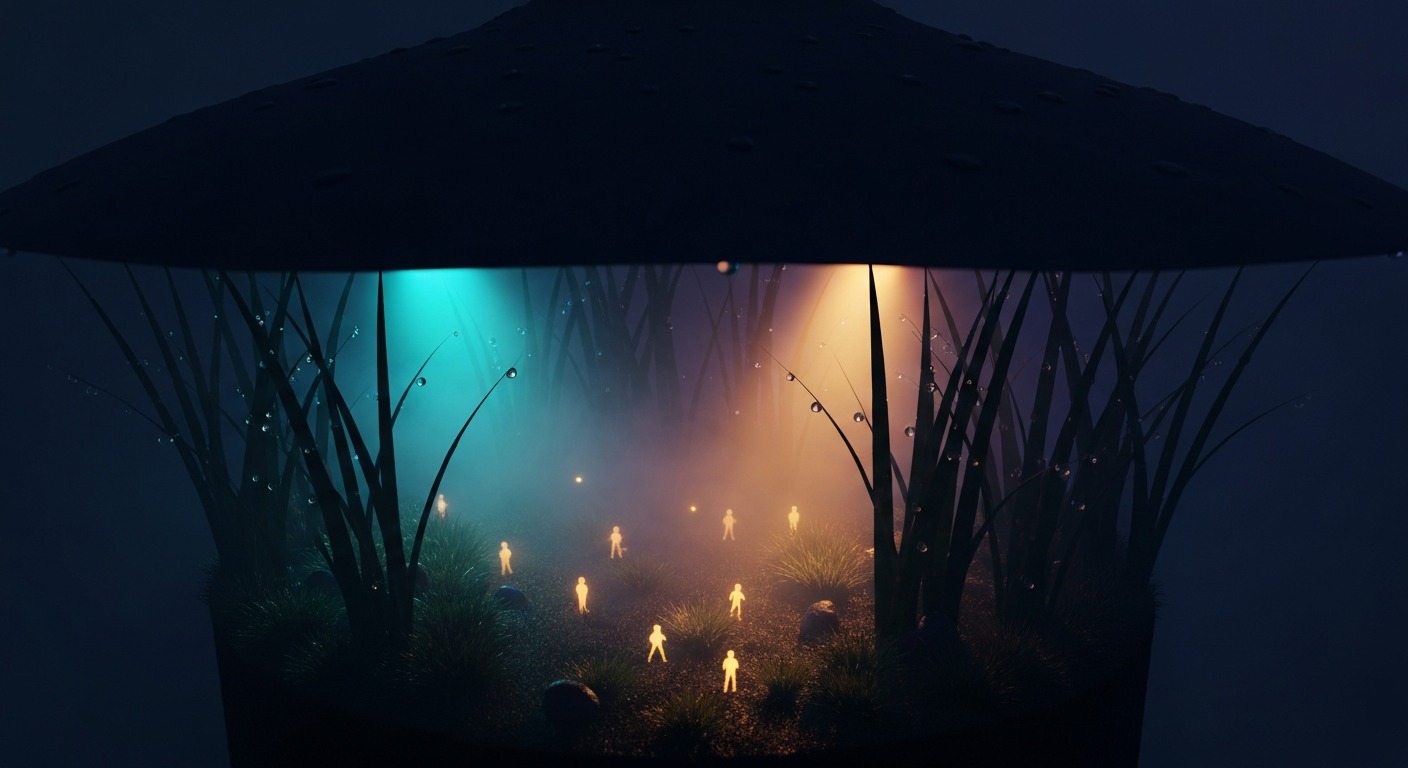
Here’s the thing about Pikmin in VR: it should be incredible. You’re commanding a swarm of two-inch tall plant-creatures through a backyard that might as well be a jungle. Scale is the whole point. In theory, strapping on a headset and looking down at a living diorama of tiny soldiers hauling fruit and fighting bugs sounds like exactly what VR was made for.
In practice? You’re digging up a fossil.
The only way to play any Pikmin game in VR is through Dolphin VR, an unofficial fork of the GameCube/Wii emulator that bolted stereoscopic 3D and head tracking onto Nintendo’s 2001 original. That fork got its last update in July 2016. It is, by every reasonable definition, abandoned software.
The Diorama You Can’t Quite Touch
Dolphin VR does deliver on the core fantasy, at least visually. The original Pikmin’s simple geometry and saturated colors actually hold up surprisingly well in stereoscopic 3D. When it works, you’re hovering over a living terrarium — Olimar and his Pikmin look appropriately minuscule, the environmental details pop with depth, and the sense that you’re peering into a tiny, bustling ecosystem is genuinely affecting. VR Bites tested this back in the DK2 era and called it “one of the best games we’ve played in the Oculus so far” despite the frame rate being “terrible” and the experience “buggy as hell.”
That tension — genuine charm under genuine jank — is the whole story.
The camera is still the game’s original overhead strategy view. You’re not in the garden; you’re a god hovering above it. Head tracking lets you lean around and examine the miniature world from different angles, which is neat for about twenty minutes. But there’s no hand presence, no motion controls, no ability to physically point at Pikmin and direct them. You’re playing with a gamepad (or Wiimote/Nunchuk if you’re really committed to the bit) while your headset displays a pretty 3D view. It’s a stereoscopic diorama viewer with controller input, not a VR-native strategy game.
The Setup Reality
Getting this running in 2016 required: a GameCube or Wii ISO dumped from your own disc, the Dolphin VR 5.0-250 build, an Oculus Rift CV1 or DK2 or HTC Vive, and patience for emulator configuration, VR runtime wrangling, and per-game tweaking. Some games needed AR cheat codes and “Hide Object Codes” to render correctly in VR.
Getting this running now? You’re trying to launch 2016 SDK code on modern hardware. The Dolphin VR fork is frozen in time, dozens of major Dolphin releases behind the mainline emulator. Modern headsets, modern Windows versions, and modern GPU drivers were not part of the design brief. You may be able to brute-force compatibility through SteamVR’s legacy runtime support or OpenComposite wrappers, but you’re in undocumented territory. The community knowledge from 2016 has decayed. Forum threads are stale. GitHub issues sit open unanswered.
This is not “moderate setup.” This is emulator archaeology.
What Works and What Doesn’t
The stereoscopic 3D is real when the emulator hooks correctly. The world scale feels correct — Pikmin are appropriately tiny, Bulborbs are appropriately intimidating, and the spatial relationships between units and obstacles are easier to read with actual depth perception. For a strategy game about precise positioning and hazard avoidance, that’s not nothing.
But performance is all over the place. The VR Bites review noted frame rate issues even on hardware of the era. On modern systems, you’re running an unoptimized, abandoned emulator branch with none of the performance improvements that mainline Dolphin has accumulated over nine years. Stutter, judder, and frame time inconsistency are likely. For a game that requires no fast head movement, comfort stays manageable — there’s no artificial locomotion, no forced camera spins, no vehicle sequences. You’re just staring at a miniature world. But inconsistent frame pacing can still break presence.
Stability is the bigger concern. Crashes, rendering errors, games starting in non-VR mode, audio routing to wrong outputs — these were documented bugs in 2016, and nobody’s fixed them since.
What You’re Actually Playing
Worth clarifying: this route only covers the original Pikmin (2001) and Pikmin 2 (2004), plus their Wii “New Play Control!” re-releases. The modern Switch remasters? No VR pathway. Pikmin 3 Deluxe? No Labo VR support. Pikmin 4? No VR at all. Hey! Pikmin on 3DS? Technically you could run it through CitraVR on Quest, but that’s a 2D side-scrolling spin-off with none of the overhead strategy DNA. If you want the actual Pikmin experience — commanding swarms, managing daylight timers, exploring sprawling environments — you’re limited to two decades-old GameCube games through a frozen emulator.
Who Should Bother
Honestly? Almost nobody.
If you’re an emulator preservationist with a soft spot for early VR experiments and a dusty Rift CV1 in a closet, Dolphin VR is a fascinating time capsule. The diorama effect is real, and it’s easy to imagine what a proper VR-native Pikmin could feel like. There’s genuine inspiration here.
If you’re a regular VR owner looking for a new experience to justify your headset? Skip this entirely. The setup friction is extreme, the software is unsupported, the performance is unpredictable, and the actual gameplay hasn’t been adapted for VR in any meaningful way. You’re playing a 2001 strategy game with a gamepad while wearing a headset that displays it in 3D. That’s it.
For Pikmin fans specifically, the Switch remasters are the definitive way to play the originals. Pikmin 4 is the best entry point for newcomers. Neither has VR. Neither needs it. The franchise’s top-down strategy DNA doesn’t naturally map to immersive first-person VR without a ground-up redesign — something no mod or emulator can provide.
The Honest Bottom Line
Dolphin VR was a cool experiment in 2016. In the current landscape, it’s a dead end. The Pikmin franchise deserves a thoughtful VR adaptation — imagine physically pointing to direct your swarm, crouching down to examine a discovered treasure, or feeling the scale difference between your tiny captain and the massive creatures stalking the garden. That game does not exist. What exists is an abandoned emulator fork that renders two GameCube games in stereoscopic 3D with substantial friction and no ongoing support.
The diorama charm is real. The recommendation is not.