
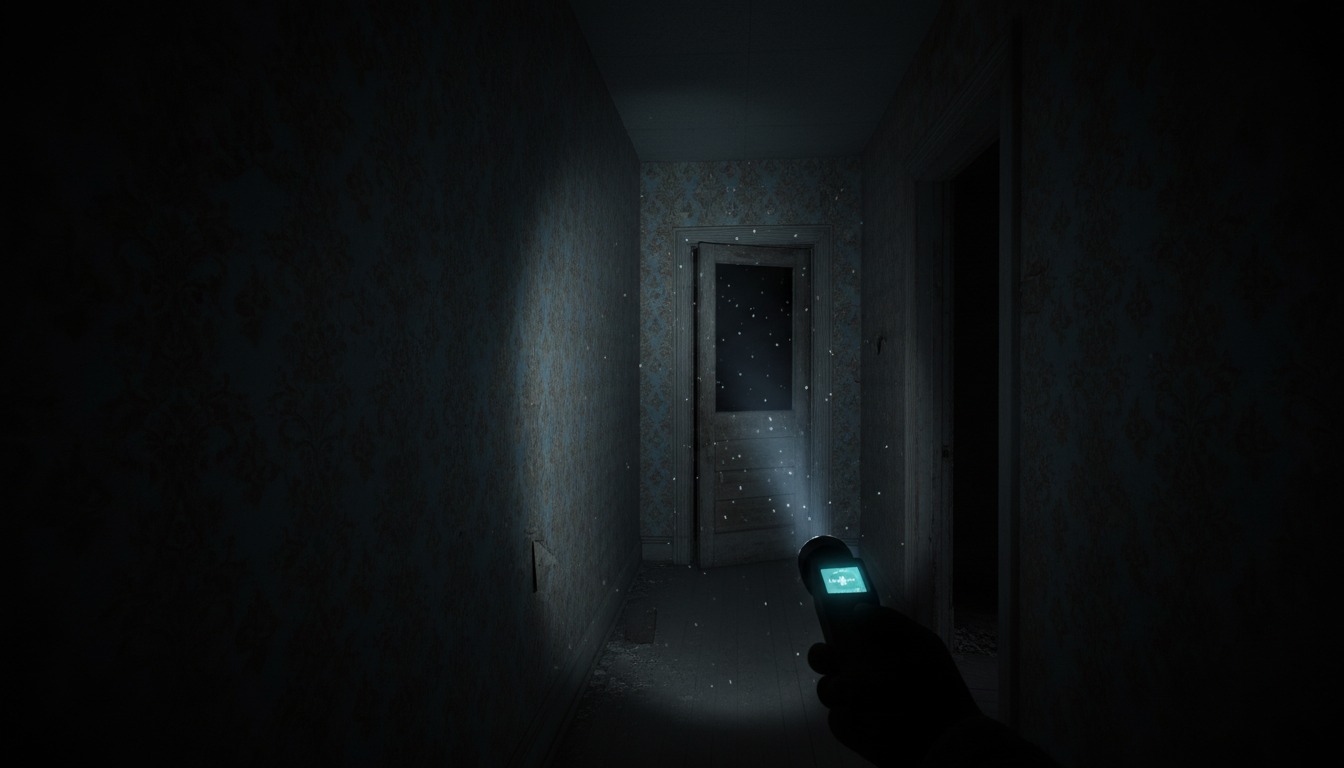
The first time a door slams shut behind you in Phasmophobia’s VR mode, you don’t just hear it — you feel the air move. You’re standing in a dark farmhouse hallway, flashlight beam trembling against peeling wallpaper, and the realization hits that you are no longer watching a horror movie. You are inside it.
Phasmophobia is a four-player co-operative ghost investigation game where you and your crew enter haunted locations to identify spirits using a grab-bag of paranormal equipment: EMF readers, spirit boxes, UV lights, cameras, crucifixes, and salt. The ghost responds to your voice, hunts you down if provoked, and each mission becomes a tense balancing act between gathering evidence and getting out alive.
The VR option is native official support that launched alongside the game’s early access debut, not a bolted-on afterthought. On PCVR it runs through SteamVR with full motion controller support. The PSVR2 version arrived in October 2024 with cross-platform play intact, meaning VR and flat players can hunt together without friction.
The Ghost in the Room
VR transforms Phasmophobia from a scary video game into something closer to a haunted house attraction. Proximity chat means your teammates’ voices fade as you split up to cover different floors. You find yourself whispering into a spirit box, actually speaking the words “Where are you?” and waiting in the dark for something to answer. When the ghost finally hunts — lights flicker, your flashlight strobes, and the door locks — the panic is physical. You aren’t pressing a key to run. You’re physically turning, fumbling for the door handle, your real voice probably betraying you with actual terror.
This is where Phasmophobia in VR earns its keep. No other co-op horror game leverages voice interaction this effectively, and being inside the headset makes every creak, every breath, every distant footstep land harder. Playing solo in VR is genuinely unnerving in a way that flatscreen can’t replicate.
The equipment interaction has moments of brilliance too. Physically holding the EMF reader, watching the needle spike as you approach a cold spot, or snapping a photo of fingerprints with a handheld camera — these actions feel natural and grounded in a way that mouse clicks never could.
The Jank That Haunts the Haunting
But Phasmophobia’s VR implementation has a ghost of its own, and it’s been rattling around since early access began. Object interaction is the biggest culprit. Doors stick and clip. Items on your equipment belt behave unpredictably — or don’t behave at all. The physics engine has a habit of launching objects across rooms for no discernible reason. Grab angles feel off. Your VR hands regularly phase through geometry. These aren’t occasional quirks; they’re persistent enough that most VR players learn to work around them rather than expect a fix.
On PCVR, performance takes a hit on the larger maps. Frame rate dips are common enough that players with mid-range hardware report needing to drop settings to maintain comfort. The PSVR2 version runs at 60fps with 120Hz reprojection and uses foveated rendering, but even there, larger locations like the prison map push the hardware. The visual presentation is serviceable rather than striking — low-resolution textures and jaggy edges remind you this is an indie early access title, not a polished AAA production.
The PSVR2 port in particular launched without several of the headset’s signature features. No haptic feedback. No adaptive triggers. The Sense controllers work as standard VR controllers, but Sony’s hardware capabilities go untapped. Voice recognition for the spirit box and Ouija board — a core mechanic on PC — was initially absent on PSVR2, though a February 2025 update finally brought parity. That delay speaks to a broader truth: VR has never been Phasmophobia’s primary development focus. The game is built flat-first, and the VR mode receives attention when schedules allow.
Comfort settings are present and appreciated: smooth locomotion with adjustable turning speed, snap turning at 15/45/90 degree increments, seated mode, height calibration, and a crouch toggle for players who don’t want to physically duck. The 180-degree snap-turn on joystick down is hard-mapped and can’t be disabled, which some players find disruptive during tense moments.
Early Access Forever
It’s worth stating plainly: Phasmophobia has been in early access since September 2020. That is not a footnote. The game receives regular updates — a 2025 roadmap promised new evidence types, map reworks, and a progression overhaul — but the underlying foundation still has the looseness of a game that hasn’t shipped. This matters in VR more than on flatscreen. A physics bug that makes a door awkward on a monitor can make it nauseating when you’re standing inside it.
The developer, Kinetic Games, has a small team and an ambitious roadmap extending into 2026. Updates come, but VR-specific polish has historically lagged behind flatscreen features. The community has been asking for a proper VR overhaul for years. What exists now is functional and fun, but it’s far from the refined experience the game’s popularity deserves.
Who Should Hunt, and Who Should Wait
Play Phasmophobia in VR if you have a crew of friends who own it and you want the most atmospheric co-op horror experience available. The voice-driven ghost interaction, the physical presence of being inside the location, and the social panic of proximity chat make this a genuinely unique VR offering. It doesn’t require setup tinkering — launch it from SteamVR or the PSVR2 dashboard and you’re in — which removes a major barrier that stops a lot of flat-to-VR experiments.
Skip it if technical jank ruins your immersion, if you demand polished VR interactions, or if you primarily play solo and want a refined single-player horror campaign. This is a social game first, and the VR mode’s rough edges are easier to laugh off with friends than to tolerate alone.
Phasmophobia in VR is a haunted house you build with friends, not a polished theme park ride. The scares are real, the tension is unmatched, and the voice-driven ghost interaction remains one of the best uses of VR’s unique capabilities in multiplayer gaming. But the object-interaction bugs, performance inconsistencies on larger maps, and the lingering early-access roughness mean you’ll spend as much time wrestling the controls as you do wrestling your nerves. For patient players with a tolerance for jank, it’s absolutely worth the haunting. For everyone else, waiting for the promised polish — or playing flat — may be the smarter call.