
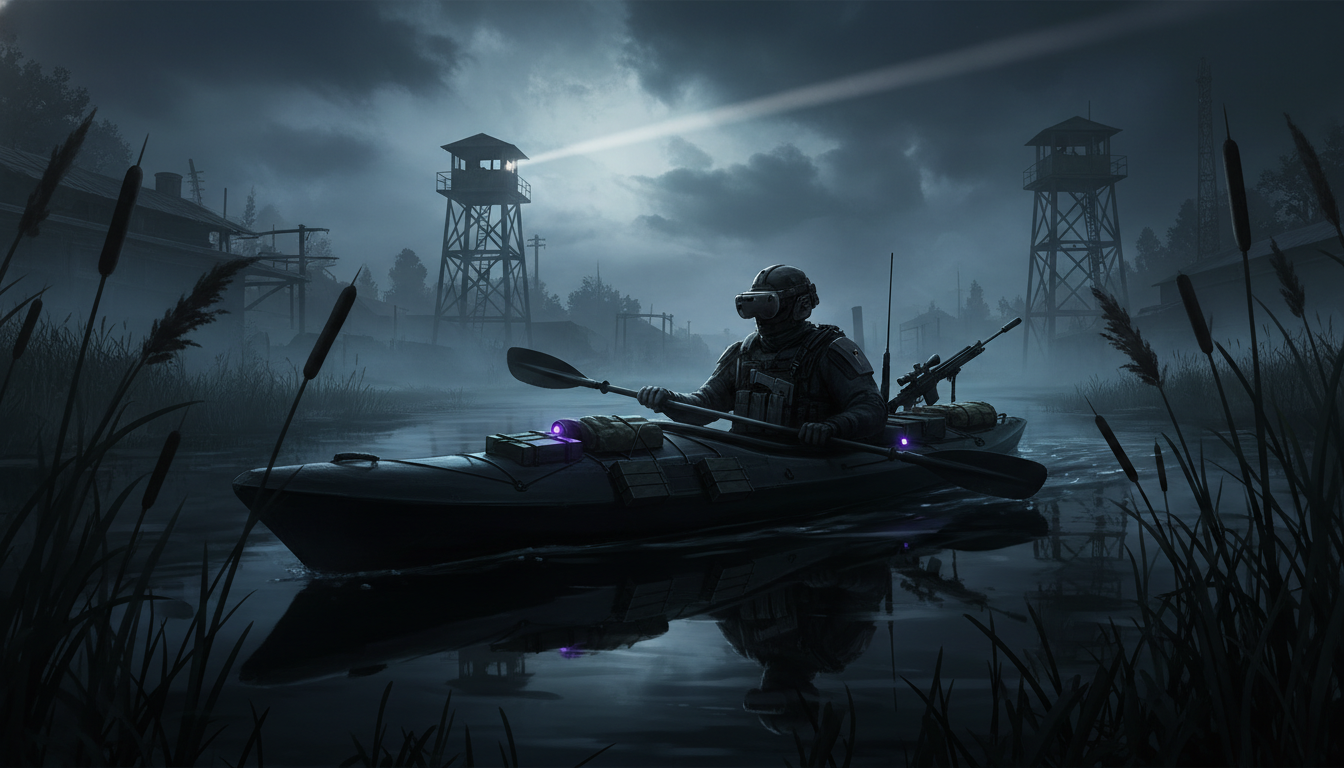
There is a moment in Phantom: Covert Ops when you paddle hard to the left, kill your momentum, and drift silently under a rotting dock while a guard’s flashlight beam cuts through the reeds inches above your head. Your silenced pistol is strapped to your chest. Your night vision goggles hang from the kayak’s frame. You are, objectively, a grown adult sitting in an office chair pretending to paddle a boat through a flooded Cold War military base. And for a few seconds, it is the most convincing stealth game in VR.
That is the essential tension of nDreams’ 2020 release: a genuinely brilliant locomotion concept wrapped around a stealth shooter that is, in most other respects, perfectly ordinary.
The Kayak Is the Game
Phantom: Covert Ops is a native VR title built from the ground up around one idea—you play from a seated position inside a tactical kayak. There is no standing, no room-scale dodging, no artificial teleportation. You paddle with your motion controllers, pulling water on the left to turn right, accelerating with strong strokes, braking by reversing. The physics are convincing enough that you develop a feel for momentum. You learn to glide, to spin in place, to reverse-paddle into cover. It is the rare VR locomotion system that feels like a skill worth mastering rather than a compromise forced by the hardware.
Your weapons and gadgets are physically mounted on the kayak and your virtual body. The pistol sits on your chest rig. The sniper rifle clips to the hull. Night vision goggles flip down from your forehead. C4 charges, silenced SMGs, and grenades occupy specific hardpoints you learn to reach for without looking. It is an inventory system that only works in VR, and it works beautifully. Grabbing your sidearm, firing a suppressed round into a searchlight, and holstering it without breaking paddling rhythm feels like the game nailing its core fantasy.
The campaign sends you through seven missions of flooded industrial complexes, dockyards, and ruined installations. The level design understands the kayak’s constraints—narrow channels, open water under bridges, reeds to hide in, current that pushes you where you do not want to go. You mark guards with night vision, shoot out lights, detonate environmental hazards as distractions, and slip past patrols. The pacing is methodical by design. Rushing gets you spotted. The kayak forces deliberation.
Where the Illusion Cracks
The problem is what happens when you stop paddling and start looking at the world around you. The enemy AI in Phantom: Covert Ops is not merely dated by current standards—it was questionable at launch. Guards follow rigid patrol routes with all the environmental awareness of animatronics at a theme park. You can drift directly beneath a walkway while a soldier stares at the water, invisible to him because the detection cone is drawn from the waist up. You can brazenly paddle past reeds in full view if your speed stays low enough. The stealth is less about outsmarting adaptive opponents and more about memorizing where the blind spots are.
This turns the game into a puzzle box rather than a dynamic tactical experience. For some players, that is fine—methodical pattern recognition has its own satisfaction. But anyone hoping for Metal Gear Solid tension or Splinter Cell systemic depth will find the AI too simple to sustain interest across repeated playthroughs.
The campaign compounds this by being short. Most players finish the seven missions in four to five hours. nDreams did release three free challenge packs post-launch—new scenarios with modifiers like invisible enemies, ice physics, and infinite explosives—but the final pack arrived in December 2020, and the studio confirmed in 2022 that no sequel is in development. Active support ended years ago. What exists is complete, but it is not expanding.
Platform Realities and Technical Baggage
On PCVR, Phantom looks noticeably sharper. Dynamic vegetation, water reflections, and lighting effects hold up on a mid-range setup, though some textures reveal their age up close. The Quest version is perfectly playable but cuts foliage density, water shaders, and draw distance behind aggressive fog. Weapons and kayak models remain detailed on both platforms, and the core experience is identical. Cross-buy and cross-save between Oculus ecosystems are supported, though community reports suggest cloud sync has occasionally failed to transfer progress reliably.
More concerning are the technical issues that have emerged as hardware has moved on. Players on Quest 3 have reported a persistent save bug where progress fails to stick, forcing them to replay missions from the start. A workaround exists—deleting app data without uninstalling the game—but it is the kind of friction that sours a short campaign. On PC, users with newer Intel processors have experienced crashes attributed to an outdated OpenSSL dependency in the game’s build. These are not universal problems, but they are real enough that buying into Phantom now carries a small but measurable risk of needing to troubleshoot a five-year-old title.
Comfort is generally strong. The seated design eliminates most VR fatigue, and the arm-based paddling gives players a physical anchor that helps with motion sickness. Smooth turning is the default, though snap-turn is available. Fast reverse strokes or sharp spins can momentarily disorient sensitive users, but the game is broadly accessible.
Who Should Paddle In
Phantom: Covert Ops is a B-tier VR experience because its best idea is genuinely excellent and its worst problems are genuinely limiting. The kayak locomotion is not a gimmick—it is the reason to play the game. The weapon mounting, the paddling rhythm, the feel of drifting through a darkened marsh with a silenced rifle on your chest: these are moments that only work in VR, and nDreams executed them with real care.
But the AI is too simple, the campaign too brief, and the technical support too quiet to call this essential. It is worth playing if you want a unique seated VR experience that does something no other stealth game attempts. It is worth skipping if you need deep systemic stealth, a lengthy campaign, or guaranteed stability on modern hardware without workarounds.
Buy it for the kayak. Stay for the four hours of competent, occasionally thrilling stealth. Forgive it the guards who cannot see a boat floating under their noses. Go in with calibrated expectations, and you will find one of the most inventive locomotion systems VR has produced—wrapped around a game that is merely good enough to justify the trip.