
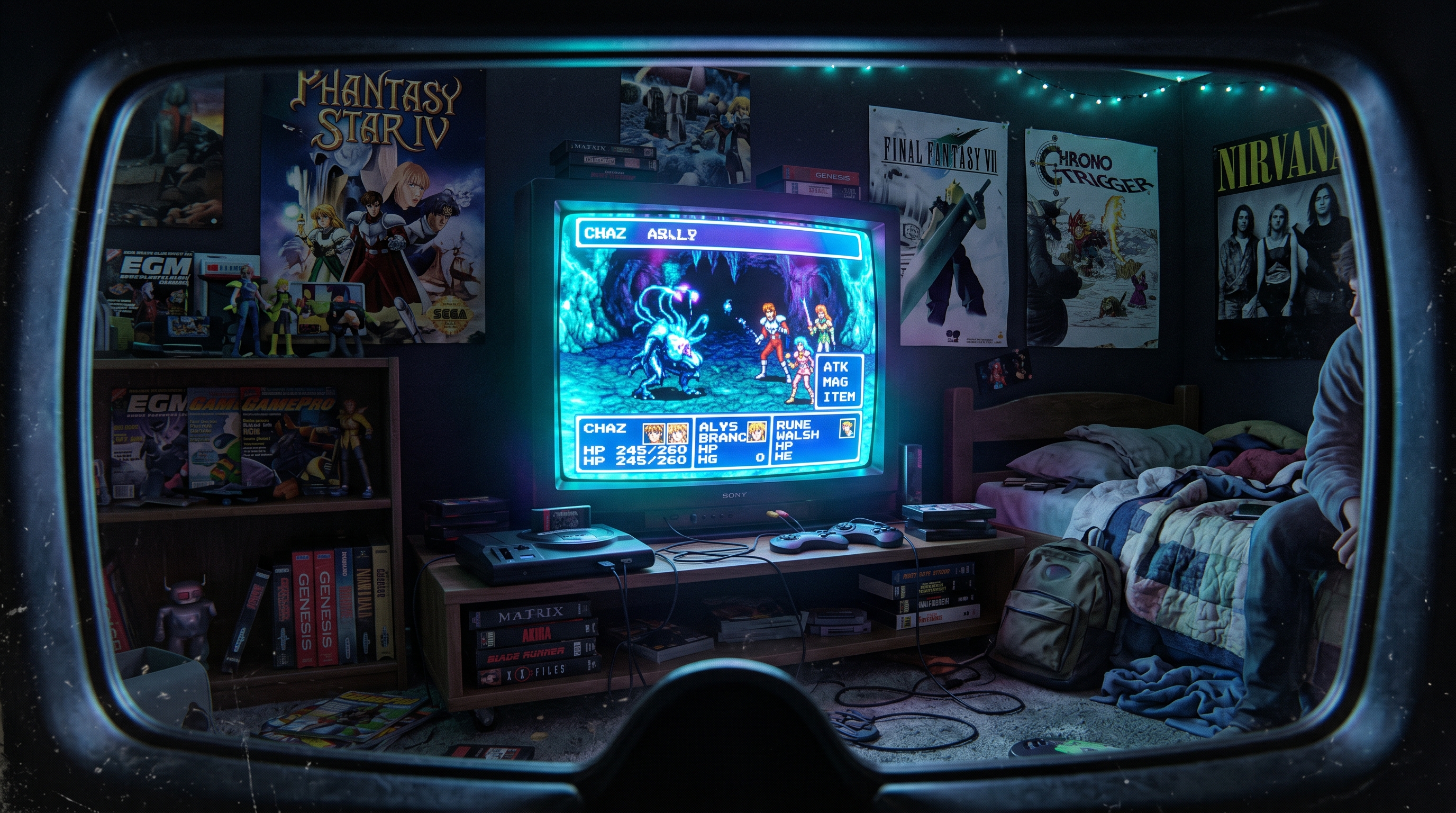
You snap the cartridge into the slot. The Genesis logo flickers to life on a curved CRT screen. Sonic posters watch from the walls. A stack of VHS tapes sits on the shelf. You’re not in your living room — you’re in VR, standing in a meticulously recreated 90s bedroom, about to play one of the finest 16-bit RPGs ever made.
That’s the pitch of Phantasy Star IV: The End of the Millennium in VR. And for existing owners of the now-delisted Sega Genesis Classics collection, it’s a surprisingly effective nostalgia machine — even if the “VR” part never touches the actual game.
This isn’t a VR remake or a native VR port. It’s an officially licensed emulation wrapper. The Sega Genesis Classics collection on Steam — delisted in December 2024, but still playable for owners — includes a VR hub mode that drops you into a virtual bedroom. You pick games from a shelf, “plug” them into a virtual Genesis console, and play them on a virtual CRT television. The hub is compatible with PCVR headsets including Oculus Rift and HTC Vive. You launch in “Steam VR Mode,” select the game hub, and find yourself sitting on a virtual couch in a room decorated with period-accurate posters, magazines, and console paraphernalia.
Phantasy Star IV doesn’t need VR to justify itself. Released in Japan in December 1993 and in North America in early 1995, it’s the final chapter of Sega’s original Phantasy Star saga — a turn-based RPG that spans planets, generations, and roughly 20–25 hours of play. You follow Chaz, a young hunter, and his mentor Alys through a story that weaves ecological disaster, ancient evil, and cosmic stakes into something genuinely moving.
The combat is classic turn-based fare with a smart twist: combination attacks let party members merge techniques into devastating team moves. A macro system lets you automate battle commands. The pacing is tight, the difficulty well-tuned, and the presentation — including manga-style cutscene panels that push the Genesis hardware to its absolute limit — remains impressive three decades later. The music, the sprite work, the dungeon design, the narrative arc: this is A-tier 16-bit gaming by any standard.
So what does adding VR actually do? It puts you in a room. A good room, honestly. The Genesis Classics hub is lovingly detailed. The CRT television can be configured with scanlines, curvature, and bezel options. You can scoot closer to the screen or settle back on the couch. There’s a certain magic to selecting Phantasy Star IV from the shelf, watching the virtual cartridge slide into the slot, and hearing the familiar Sega jingle echo from a virtual TV set.
But that’s where the VR integration ends. You’re still playing a 2D, turn-based RPG on a flat screen inside a 3D environment. There’s no motion control support for gameplay — a gamepad is strongly recommended, and some users have reported that VR controllers don’t even work for menu navigation. The experience is seated by design. Stand up, and the perspective feels wrong.
The virtual screen itself can feel small depending on your positioning, though moving closer helps. More concerning is performance: the VR hub has been reported to cause slowdown and audio stuttering that bleeds into the emulated games, making them nearly unplayable in some configurations. The emulator runs fine outside the hub, but inside VR, the extra rendering overhead of the bedroom environment can tax systems that should be more than capable.
This is a nostalgia delivery system, not a VR transformation. The bedroom hub is charming — genuinely so — but it doesn’t make Phantasy Star IV a better RPG. It frames it. For someone who grew up with a Genesis in their actual bedroom, the VR hub hits with surprising emotional force. The posters, the clutter, the glow of a CRT in a dark room — it’s a time machine. But if you don’t have that personal connection, you’re essentially looking at a themed virtual theater mode around a game you could play on any emulator.
The delisting complicates everything. As of December 2024, new players can’t buy the Sega Genesis Classics collection at all. The only people who can experience Phantasy Star IV this way are those who already owned it. That makes this less of a recommendation and more of an assessment of what’s already in your library.
If you own the collection and you love 16-bit RPGs, this is a cozy way to spend 20 hours. The CRT emulation options are genuinely nice, and the bedroom environment provides a pleasant framing device for a game that’s already worth your time. If you don’t already own it, the door is closed. And if you’re looking for a VR RPG with actual VR mechanics — motion controls, spatial presence, anything beyond “screen in a room” — this was never going to satisfy you, even when it was for sale.
Phantasy Star IV in VR is a great game in a thin wrapper. The wrapper is charming enough to matter for the right person, but it doesn’t expand what the game is. It frames it. For existing owners with a fondness for the era, that’s enough. For everyone else, this particular route into one of the Genesis’s greatest RPGs has closed for good.