
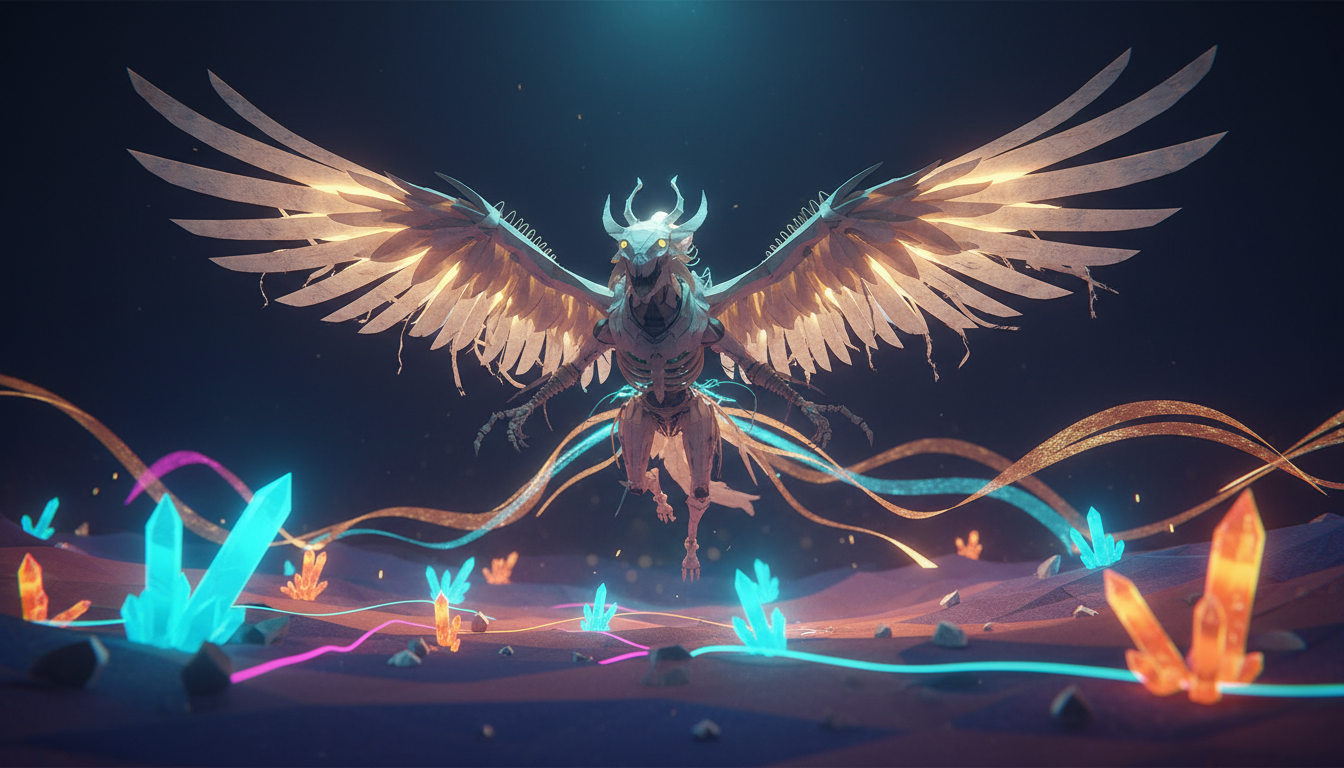
Snaring a crumpled, dog-shaped creature with an elastic beam of light and dragging it through a shimmering desert to distract a predator from its prey reveals immediately that Paper Beast operates on logic borrowed from no other video game. Eric Chahi — the designer behind Another World and From Dust — built this thing from the ground up for virtual reality, and that native intent shows in every interaction. You do not play Paper Beast so much as you visit it, poke at its laws, and hope the papercraft ecosystem responds in your favor.
This is a native VR title, not a retrofit. It debuted on PlayStation VR before arriving on PCVR, and later received an Enhanced Edition for PlayStation VR2 that adds sharper textures, HDR lighting, improved sand and water simulation, and an expanded sandbox. The core remains identical across all platforms: you are dropped into a hallucinatory datascape populated by origami-like creatures made of paper, rags, bone, and wire. Your job is to solve environmental puzzles by manipulating terrain, redirecting water, and herding wildlife whose behaviors emerge from a custom physics engine rather than scripted paths.
The control vocabulary is deliberately limited and tactile. You grab objects and creatures with a flexible beam that extends from your virtual hand, pulling and dangling them like a cosmic fishing line. On the original PlayStation VR release, only teleport locomotion and snap turning were available — a concession to the hardware that actually suited the game’s contemplative pace. The PCVR and PSVR2 versions introduce smooth locomotion and smooth turning for those who want them, but teleport remains the default, and the game never rushes you. Comfort is excellent; there is no combat, no forced camera motion, and no sudden spatial violence. The most stressful moment you will have is watching a fragile paper creature wobble toward a lava pool.
The creature behavior is the real star. These animals look abstract — low-polygon constructions with jerky, weightless animations — yet they behave with an uncanny authenticity. They hunt, flee, breed, and die according to environmental pressures you can shape. A puzzle might ask you to clear a path through sand, but the solution often involves understanding who eats whom and how to exploit the food chain. The creature designs escalate from simple quadrupeds to stranger things: burrowing worms that reshape terrain, floating jellyfish that pulse with heat, predators with jaws like scissors. Each new encounter teaches you a rule about the world without a single text prompt.
Chahi’s fingerprints are all over the terraforming tools, which let you scoop, carve, and redirect elements with your hands. The physics are playful enough that the game rewards experimentation, and mischievous enough that you can accidentally cause a small ecological disaster if you pull the wrong thread. That sandbox freedom extends to an actual Sandbox mode unlocked after the main story, where you spawn creatures and terrain objects to build miniature ecosystems. It is a lovely diversion, though its appeal is more scientific toy than long-term time sink.
The sound design does as much lifting as the visuals. There is no spoken dialogue, only the rustle of paper skin, the glug of redirected water, and a haunting electronic score that makes the whole world feel like a forgotten server dreaming in real time.
The main campaign lasts roughly three to five hours, and that is the most significant limitation. Paper Beast is memorable but brief, and once you have solved its puzzles there is little reason to revisit the story. Some of those puzzles, too, err on the side of cryptic. The game refuses to tutorialize, which is refreshing until you are staring at a wall of impossible geometry with no hint whether you are missing a tool or missing the point. A handful of sequences slow to a crawl while you wait for environmental reactions to cascade into place.
Platform differences matter here. On PSVR2, the Enhanced Edition is essentially the definitive version: stable, gorgeous, and responsive with Sense controllers. The original PSVR release holds up well too, though the visual fidelity and locomotion options are more restricted. PCVR is where the friction lives. Steam discussions and community reports document controller compatibility hiccups with certain headsets — unresponsive inputs on some Vive configurations, distorted rendering on HP Reverb G2 units, and occasional launch failures when using Quest with Air Link. The game is not broken on PC, but it is pickier than a native VR title ought to be, and you may need to adjust SteamVR super sampling manually before launching to avoid visual corruption.
Performance is otherwise modest. The art style — vivid, low-poly, and surreal — does not tax hardware the way a photorealistic production would. On PSVR2 it runs smoothly with enhanced effects, and on PCVR it is efficient when it is cooperating.
Who should bother? Anyone who owns a PlayStation headset and wants something that could not exist on a flat screen. Puzzle fans, art-game enthusiasts, and players who loved the elemental manipulation in From Dust will find kindred design philosophy here. If you are looking for action, narrative depth, or a twenty-hour campaign, this is not your game. PCVR owners with headsets outside the most common ecosystems should check recent community reports for their specific hardware before buying.
Paper Beast is one of the most distinctive native VR games available — an ecosystem simulation disguised as a puzzle adventure, rendered in paper and light. Its short runtime and occasional PCVR rough edges keep it from essential status, but there is nothing else in virtual reality that feels quite like standing in Chahi’s handmade wilderness, watching a creature you just saved unfold its wings and drift away.