
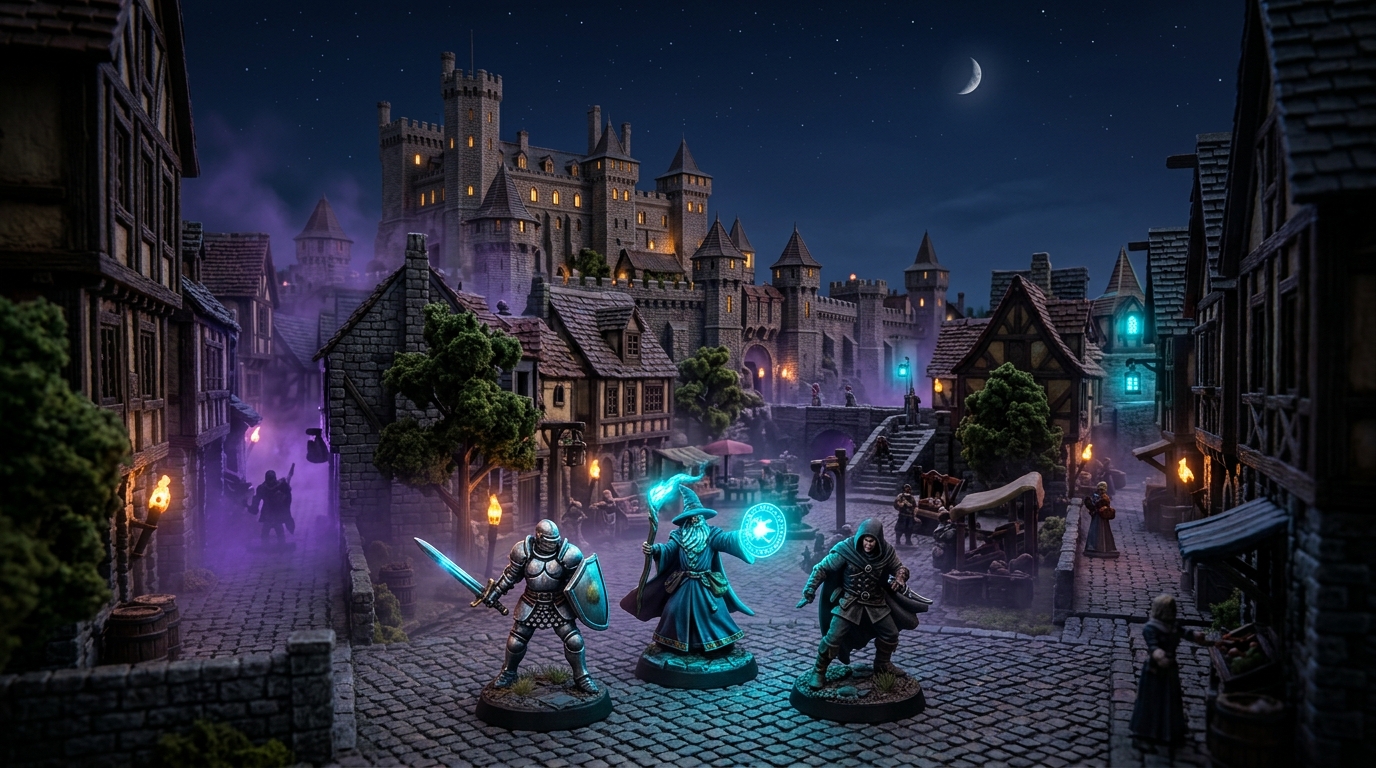
There is a particular kind of pleasure in leaning over a miniature world. CRPGs have always traded in that fantasy — the god’s-eye view, the tiny hero marching across a painted map, the dice rolling somewhere behind the curtain. Neverwinter Nights, BioWare’s 2002 D&D powerhouse, built an entire ecosystem around that perspective: module creation, persistent worlds, thousands of hours of player-made campaigns. The idea of stepping inside it in VR carries a specific romantic weight. You are not just observing the Sword Coast. You are inhabiting it.
The reality is more restrained. Neverwinter Nights in VR exists only through VorpX, the stereoscopic injection driver that intercepts a game’s rendering pipeline and forces it into a headset. For the original 2002 release, a cloud profile has been available for years, most recently refined in October 2021 with better HUD readability and text scaling. The Enhanced Edition, released by Beamdog with a modernized OpenGL 3.3 renderer, does not share that fortune. The shader-heavy pipeline breaks VorpX’s OpenGL support in ways that produce severe flickering, blacked-out eyes, and intermittent graphical corruption. Some users have attempted workarounds — cloning profiles from Quake III or Quake IV, running both executables as administrator — but the consensus is clear: NWN:EE in VR is a technical dead end.
This article covers what actually works, which is the original release through VorpX’s Geometry 3D profile.
What You Actually Get
VorpX for Neverwinter Nights delivers stereoscopic 3D and head tracking. That is the complete list. There are no motion controls, no hand presence, no VR-native UI, no positional interaction with the world. You are playing the 2002 CRPG you remember, rendered in depth, on a virtual screen that can be expanded to fill your vision. The profile supports both immersive screen modes and a more traditional cinema-style presentation.
Head tracking maps to camera rotation, which in a CRPG means you are essentially controlling the isometric or chase camera with your neck. In practice this feels less like “being there” and more like hovering over an elaborate physical diorama. The Geometry 3D reconstruction gives genuine depth to the environments — dungeons gain verticality, forest paths stretch into the middle distance, character models take on a toylike solidity that flat rendering never quite achieved. At its best, it resembles sitting at a particularly lavish tabletop setup where the miniatures have come to life.
The UI remains untouched and unscaled. Menus, dialogue boxes, inventory screens, and spellbooks all render at their original resolution, floating in space. Text is readable after the 2021 profile update, but the interface was designed for a monitor at arm’s length, not a headset inches from your eyes. Expect to squint at spell descriptions and lean into your inventory.
How It Handles in Practice
Input is entirely conventional: gamepad or mouse and keyboard. There is no motion controller support, no gesture casting, no physical sword swinging. You are playing a twenty-year-old CRPG with the same inputs you used in 2002, only now the screen is wrapped around your head.
Comfort is surprisingly manageable. The isometric camera minimizes the vection and motion sickness that plague first-person VR adaptations. You are not simulating walking; you are observing a character walk. For experienced VR users, sessions of an hour or more are feasible without discomfort. For newcomers, the static camera and slow-paced gameplay make this one of the gentler injection-driver experiences available.
Performance is a non-issue. Neverwinter Nights runs on hardware from two decades ago. Even with VorpX’s overhead, modern headsets and GPUs maintain stable framerates without breaking a sweat. The original engine is lightweight, well-behaved, and largely crash-free in this configuration.
The real friction is setup. VorpX itself requires purchase, configuration, and a willingness to tinker with profile settings. The cloud profile must be imported. Some users report needing to disable HD texture packs and visual effects for optimal stability. None of this is insurmountable, but it places the experience firmly in the territory of users who already know their way around injection drivers and are willing to spend twenty minutes tuning before they play.
The Enhanced Edition Problem
It is worth stating plainly: if you own only the Enhanced Edition on Steam or GOG, this route is not viable. The modern OpenGL renderer with its shader pipeline is outside VorpX’s robust support window. Community attempts to force compatibility produce flickering, partial black screens, and visual glitches severe enough to make the game unplayable. The developer has characterized OpenGL support as a limited-scope feature rather than a priority, and NWN:EE’s architecture sits at the wrong end of that limitation.
The original 2002 release, available on GOG and still functional on modern Windows, is the only path that produces a stable result.
The tabletop fantasy, half-realized
What works about Neverwinter Nights in VR is conceptual, not mechanical. The stereoscopic depth genuinely reframes the game. Walking through the Beggar’s Nest or the Peninsula District with real spatial separation between foreground and background gives the environments a physical presence that flat rendering cannot replicate. Character models, chunky and low-poly by modern standards, acquire a kind of artisanal charm in 3D — like hand-painted miniatures arranged on a terrain board.
The module ecosystem compounds this. Community campaigns, some of them better written than the original campaign, suddenly gain a spatial dimension. Persistent worlds with player-run roleplay sessions become oddly theatrical when viewed from inside the headset. It is not full VR immersion, but it is a meaningful shift in perspective.
What does not work is everything else. The lack of motion controls removes any physical connection to the world. The UI is an artifact from another technological era, stubbornly unadapted. Combat remains a matter of clicking targets and watching dice rolls resolve. The camera, freed from the monitor’s frame, sometimes behaves in ways that feel more seasick than cinematic. And the absence of any official or community VR mod means there is no meaningful development path — what exists is what will exist.
Who This Is For
This is for a narrow audience: CRPG enthusiasts who already love Neverwinter Nights, already own or are willing to acquire the original release, and are curious enough about stereoscopic CRPGs to justify buying and configuring VorpX. If you have fond memories of the Aurora toolset, if you have strong opinions about which community module is the true spiritual successor to Baldur’s Gate, if you have ever wished you could lean over your monitor and peer into the game world like a dollhouse — this is your ticket.
Everyone else should pass. If you are looking for a polished VR RPG with motion controls and native interaction, this is not it. If you own only the Enhanced Edition, there is currently no functional path. If you are unwilling to spend money on VorpX and time on configuration, the payoff is too slight to justify the friction.
Neverwinter Nights in VR is a successful experiment that stops well short of a transformation. The stereoscopic depth adds something real to the experience, a tangible spatial quality that flat play cannot match. But it is a layer of visual enhancement wrapped around a fundamentally unchanged game, constrained by the absence of motion controls, the stubborn legacy UI, and the dead end that is the Enhanced Edition. For the right player — the patient, the nostalgic, the tabletop-inclined — it is worth an evening. For everyone else, the Sword Coast is better visited on a monitor.