
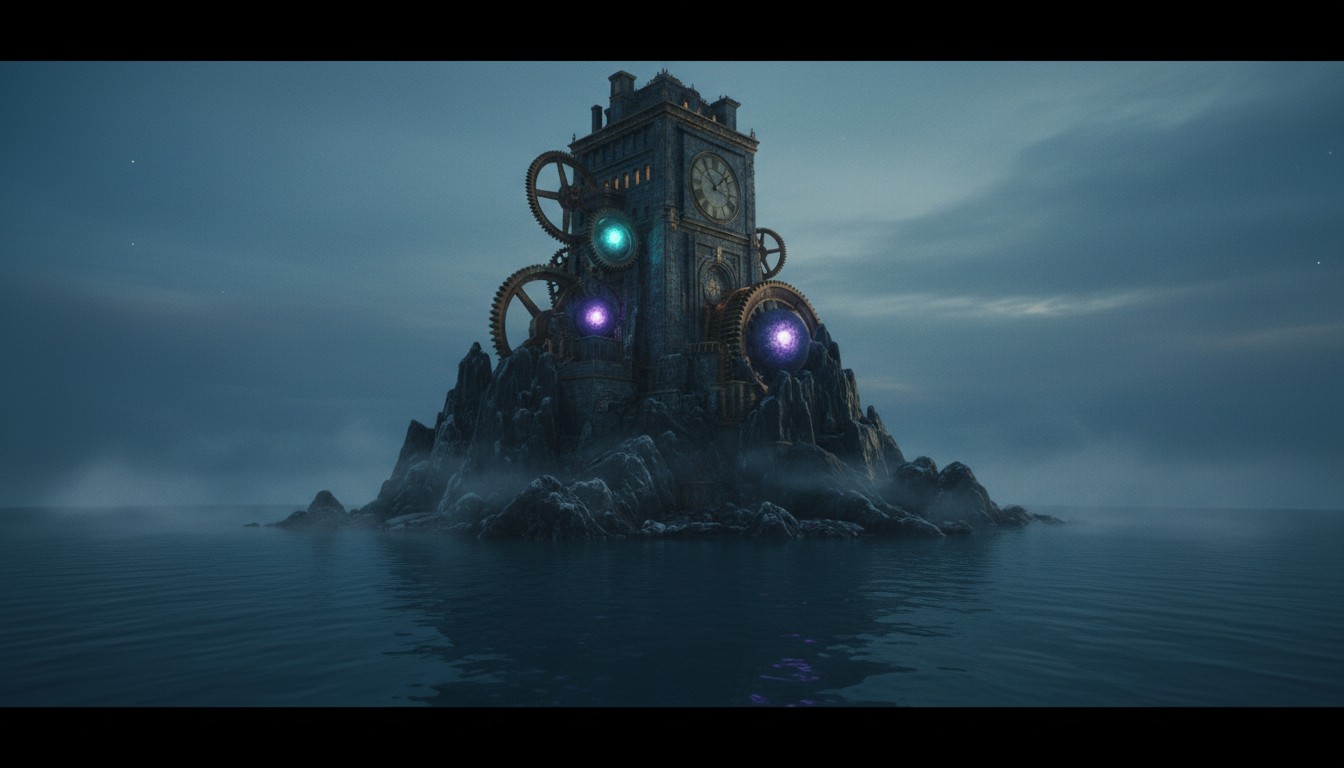
Here’s the thing about Myst: I never actually visited it before this.
I played the original in the 90s like everyone else. Clicked through static pre-rendered scenes. Took notes in a spiral notebook. Got stuck on the piano puzzle for three days. But I never stood on those islands. I never looked up at the gears of the clock tower and felt small. I never physically reached out and turned a valve with my actual hand, hearing the metal clank as the mechanism engaged.
Myst VR changed that. And I’m not being hyperbolic when I say this is the definitive way to experience one of gaming’s most important titles.
Cyan Worlds — the original developers, not some outsourced port team — rebuilt Myst from the ground up in Unreal Engine 4 specifically for VR. This isn’t a flat game with VR support bolted on. This is a game redesigned around presence. The static slides are gone, replaced by fully realized 3D environments you can walk through. The point-and-click interface is gone, replaced by direct physical interaction. You grab books. You twist dials. You pull levers and push buttons and actually feel like you’re manipulating these strange mechanical contraptions.
The core loop remains unchanged: explore mysterious islands, find clues, solve environmental puzzles that span multiple locations, and gradually piece together what happened to the family that once lived here. But experiencing it in VR transforms what was already atmospheric into something genuinely transportive. The sound design — wind through trees, water lapping against stone, the unsettling ambient hum of machinery — surrounds you. The isolation feels real. When you link to a new Age and materialize in an alien landscape, the scale hits differently when you’re standing there rather than viewing it through a window.
Let’s talk about those puzzles, because this is where the caveats come in. Myst’s puzzles are notoriously cryptic. We’re talking “write down symbols you found in a different Age and cross-reference them with a calendar system you discovered in a third location” levels of abstraction. The game does not hold your hand. It does not highlight interactable objects. It trusts you to pay attention, take notes, and experiment. Some puzzles have been redesigned for 3D interaction — clock puzzles now use rotatable dials instead of abstract valve-turning — but the underlying logic remains old-school obtuse.
If you get frustrated by puzzles that require external note-taking (despite the excellent in-game photo journal), Myst will try your patience. If you need narrative momentum or guided experiences, this isn’t your game. The story exists in environmental details and scattered journals, not cutscenes.
The VR implementation, though, is genuinely excellent. On Meta Quest, you get full hand tracking support — the entire game playable without controllers, using intuitive gestures to move, grab, and interact. Point your finger to teleport. Make a fist to grab objects. Thumbs-up and rotate your wrist to turn. It’s not a gimmick; it’s a fully viable way to play, and it adds to the sense of embodied presence. Controller support is equally solid, with natural grab mechanics and comfortable teleport or smooth locomotion options.
Comfort-wise, Myst is as gentle as VR gets. This is a slow, contemplative experience. No artificial movement unless you choose it. No combat, no sprinting, no surprises. Extensive comfort options including snap turning, quick travel for stairs, and height quantization make this accessible to VR newcomers. I played seated for several hours without issue.
Performance is reasonable across platforms. On Quest 2 and 3, you’ll notice texture pop-in and reduced draw distance compared to PC, but the art style holds up. The visual compromises don’t break the atmosphere — this isn’t a game about photorealism anyway. PCVR delivers superior fidelity if you have the hardware, with better textures, foliage, and post-processing. Both versions support cross-buy and progress sync, which is genuinely consumer-friendly.
The “Hands & More” update added an in-game photo journal (crucial for a game that demands note-taking) and optional puzzle randomization for replayability. Support has been stable but quiet since — not abandonware, but don’t expect aggressive content updates. This is a finished product.
Who is this for? If you’ve ever been curious about Myst, this is the version to play. If you loved the original and want to revisit it, the VR perspective offers something no previous remake could. If you’re a puzzle enthusiast who enjoys environmental problem-solving and doesn’t need hand-holding, this is catnip. If you want gaming history in your headset — a chance to understand why this game mattered while experiencing it in the most modern way possible — this is essential.
Who should skip? Players who need action or fast pacing. People who get frustrated by obtuse puzzles without guided hints. Anyone seeking multiplayer or social features — this is solitary, meditative, sometimes lonely by design.
Myst VR isn’t for everyone. The puzzles are still stubbornly cryptic, the pacing demands patience, and the atmosphere of isolation can feel oppressive. But for those who sync with what Cyan built — for players who want to stand on those impossible islands and physically reach into a world that once only existed behind glass — this is transformative. The original developers rebuilt their masterpiece with care and intent. You’re not just replaying history. You’re finally visiting it.