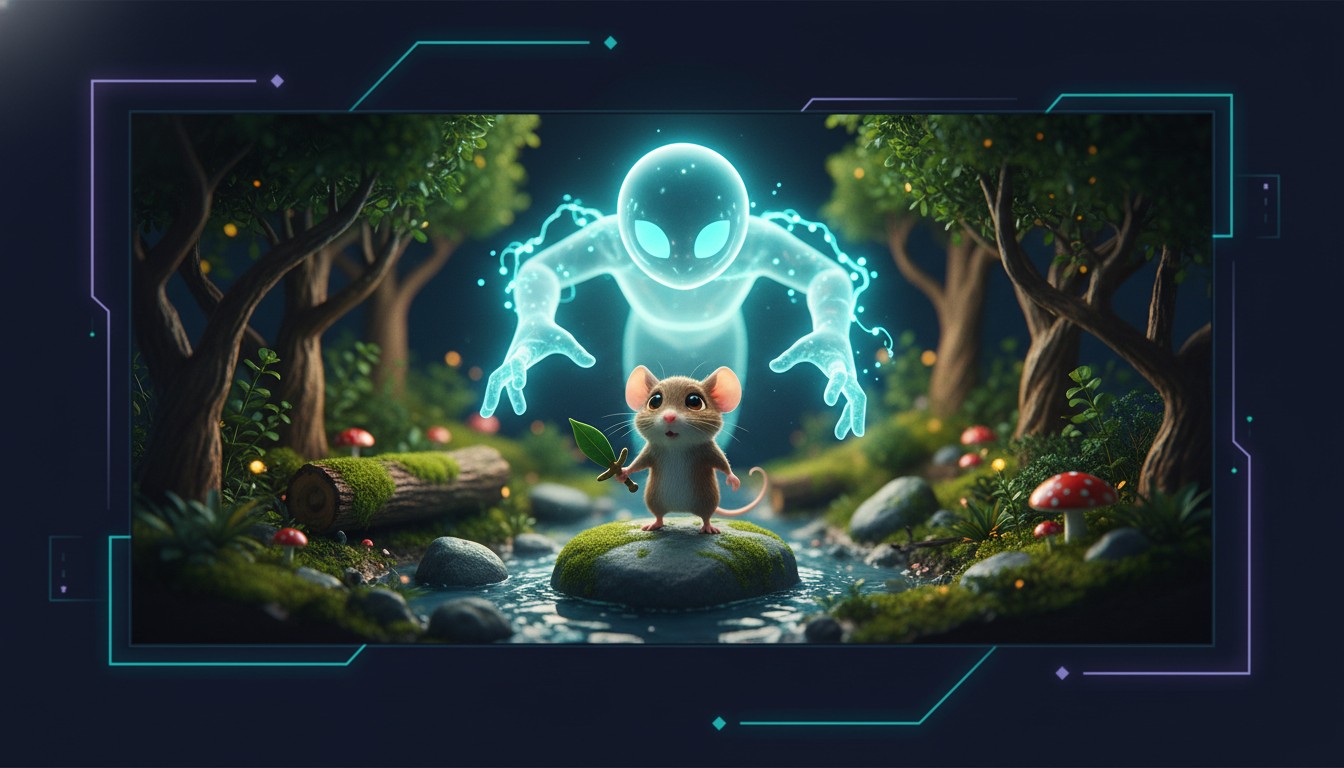
Moss doesn’t try to put you inside the hero’s head. It puts you beside her — a towering spirit leaning over a storybook forest, watching a tiny mouse look up at you and wave. That moment, when Quill first acknowledges your presence, is the entire game in miniature. You’re not the protagonist. You’re the guardian. And that relationship is why Moss remains one of the most convincing cases for VR as a storytelling medium, years after its release.
This is a VR-native puzzle-adventure built from the ground up by Polyarc. There is no flat version. You play as “The Reader,” a masked, orb-like presence floating above diorama-like environments, while directly controlling Quill — a small mouse on a quest to rescue her uncle from an evil snake named Sarffog. The dual-perspective design is the core innovation: Quill runs, jumps, and fights with analog stick controls, while your hands (as The Reader) grab, push, rotate, and manipulate pieces of the world too large for her to handle alone. You clear paths, redirect enemies, and operate machinery, all while peering down into these intricately crafted miniature spaces.
The controls vary slightly by platform. The original 2018 PSVR release used the DualShock 4’s motion sensing for hand interactions, which worked but could feel finicky during precise manipulations. The 2019 Quest release and 2023 PSVR2 enhanced version move to dedicated motion controllers — Touch controllers on Quest, Sense controllers on PSVR2 — and the difference is substantial. Two-handed interaction feels natural, and the PSVR2 version adds adaptive trigger tension so you feel the weight of objects you grab. Eye-tracking on PSVR2 highlights interactive elements with a subtle glow when you look at them, and Quill can actually notice where you’re looking and offer hints if she spots the solution first. It’s a small touch that reinforces the sense that she’s a real presence watching you back.
What makes the experience stick is Quill herself. She doesn’t speak. She communicates through gestures, emotive squeaks, and — most distinctively — American Sign Language. When she needs help with a puzzle, she signs. When she’s grateful, she signs. When she’s scared, her body language tells you before any UI element could. It’s not a gimmick; it’s a design choice that creates an emotional bond without voice acting or text dumps. You end up caring about this mouse because her communication feels human and vulnerable.
The world reinforces that connection. Every environment in Moss looks like a detailed diorama — a physical space you could reach into and touch. The sense of scale is constant and deliberate. You tower over Quill. A mossy log is a cliff to her. A puddle is a lake. The VR headset becomes a window into a miniature realm, and the static, seated perspective means there’s no locomotion discomfort. No artificial movement, no nausea, no adaptation period. You just sit, lean forward, and watch your small friend navigate a world that feels tactile and real.
The puzzles are environmental and gentle — block pushing, lever pulling, enemy manipulation, pathfinding. None are brutal, but several require coordination between Quill’s movement and your hand interactions. Combat is simple: Quill has a sword, you can grab enemies to hold them in place, and together you handle encounters that would overwhelm her alone. It’s never demanding in the way a full action game is. The difficulty is calibrated to keep the story moving, not to test your reflexes.
Here’s the honest caveat: Moss is short. A first playthrough runs roughly three to five hours. The PSVR2 version includes the Twilight Garden expansion, which adds some runtime, but this is still a brief experience by flat-game standards. The question is whether those hours are dense enough to justify the purchase. The consensus, across basically every platform and review, is yes — but with the understanding that you’re paying for a polished, memorable journey, not a 20-hour epic. Replayability is limited. There are collectibles, but no branching paths or alternate modes. You play it for the experience once, and that experience is strong enough that most people don’t mind the brevity.
Visually, the game holds up. The original 2018 PSVR release was already one of the prettier titles on that headset, and the 2023 PSVR2 enhanced version pushes it further: 4K resolution per eye, 90fps, foveated rendering, improved textures and lighting. The PCVR and Quest versions sit somewhere between — crisp, stable, and charming, if not as technically impressive as the PSVR2 treatment. Performance is efficient across the board. This is not a game that will stress your hardware.
Comfort is one of Moss’s biggest selling points for VR newcomers. Seated play, no smooth locomotion, no camera shake, no forced movement. You can lean around the diorama to get better angles, but your virtual body stays still. If you’re looking for a first VR game to show someone who gets motion sick easily, this is consistently near the top of the list.
The sequel, Moss: Book II, arrived in 2022 for PSVR and 2023 for PSVR2, expanding the story and adding new mechanics. It carries the same strengths and the same brevity. If you finish Moss and want more of that specific feeling, the sequel delivers. But the original remains the stronger introduction — the moment when Polyarc proved that VR could do intimate, emotional, third-person storytelling without sacrificing what makes the medium unique.
Who is this for? Anyone who owns a VR headset and wants proof that the medium can be gentle, smart, and emotionally resonant. It’s the game you hand to someone who thinks VR is just shooting galleries and tech demos. It’s also ideal for newcomers — the comfort profile is forgiving, the controls are intuitive, and the narrative doesn’t require genre experience to appreciate.
Who should skip it? Players who want length above all else, or those looking for intense action or complex systems. Moss is quiet, deliberate, and small in scope. It knows exactly what it wants to be and doesn’t pretend to be anything else.
The verdict lands easily. Moss is one of the best VR games ever made — not because it’s the biggest or the most technically advanced, but because it understands what VR does that flat screens cannot. It gives you presence without putting you in the protagonist’s body. It makes you a witness, a helper, and a friend to a character who feels real enough to miss when the credits roll. The hours are few, but the quality is undeniable. If you have a VR headset and you haven’t played this, fix that.