
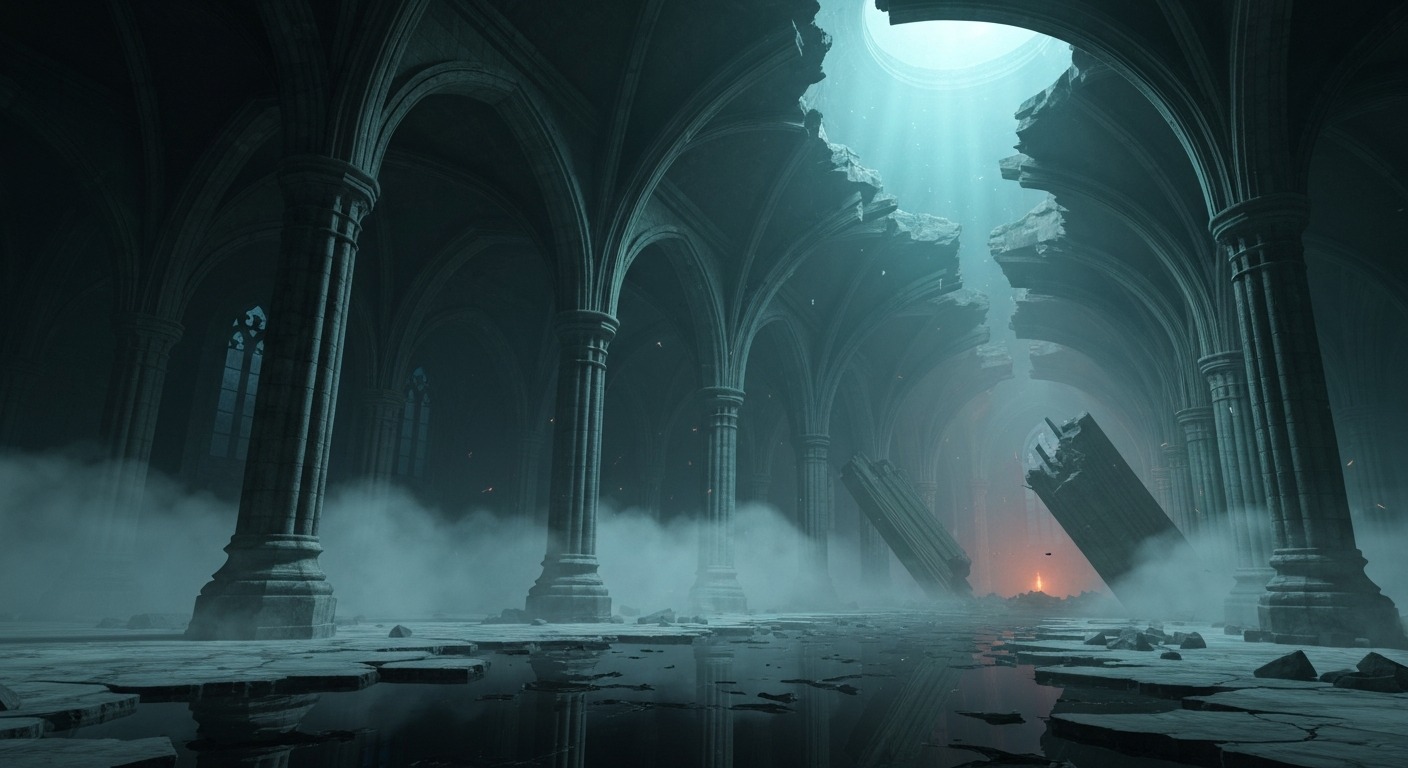
The first thing you notice in Mortal Shell’s UEVR conversion is how small the world makes you feel. Not in scale — the characters are human-sized — but in threat. The fogged swamps, tilted cathedrals, and collapsing fortresses press in from every direction, and with a headset on, that oppressive art direction stops being wallpaper and starts feeling like weather. You can look up at the things that are about to kill you. You can lean around a corner to see if something is waiting. The dread gets spatial.
That’s the pitch. The reality is more complicated.
What the VR Option Actually Is
Mortal Shell has no official VR mode. The way in is UEVR, Praydog’s Universal Unreal Engine VR mod, which supports UE4.8 through UE5.4 games. Mortal Shell was built in Unreal Engine 4, so it sits inside UEVR’s compatibility window. That means you get full stereoscopic 3D, 6DOF head tracking, OpenXR/OpenVR runtime support, and a working in-VR UI projection layer straight out of the box.
What you don’t get out of the box is a bespoke VR mod. Unlike some higher-profile UEVR games that have community plugins adding first-person cameras and motion-controlled weapons, Mortal Shell appears to rely on the generic framework. There’s no equivalent of the Silent Hill 2 or Hogwarts Legacy UEVR plugins tailored to this game’s shell-possession and harden systems. You’re playing Mortal Shell as it was shipped, with a VR camera attached.
Setup is moderate by flat-to-VR standards: install UEVR, launch the game, pick the process from the frontend, inject, then tweak rendering mode and camera settings from the in-VR menu. It’s not beginner-friendly, but it’s also not a weekend project. If you’ve used UEVR before, you can be inside Fallgrim in ten minutes.
How It Actually Plays
Mortal Shell is a third-person Souls-like by design. In UEVR, that means the camera hangs behind your possessed shell while you move, dodge, harden, and parry. Head tracking lets you look around freely, which is genuinely useful for tracking multiple enemies and reading attack tells. The stereoscopic depth also helps with spacing — you can feel when a greathammer swing is going to connect, which is harder to judge on a flat screen.
But third-person melee in VR has a ceiling. Your body isn’t doing the parries; your thumb is. The harden mechanic, which freezes you mid-animation to absorb a hit, is already disorienting in flat mode — in VR, locking the camera while an enemy’s weapon arcs toward your face is a lot more visceral, and not always in a good way. Roll animations snap the camera hard. Enemy grabs pull the viewpoint around. Tight corridors can feel claustrophobic when the camera is glued to your back.
Comfort is the real variable here. Souls-likes are built on sudden motion: rolls, sprint attacks, stagger animations, area-of-effect bursts. In VR those become vestibular stress tests. There’s no teleport option, no snap-turn comfort setting, no vignette. If smooth third-person camera movement bothers you, Mortal Shell will bother you more than most.
Performance sits in the heavy-demand range. Mortal Shell was a mid-range flat game at launch; rendering it twice for VR while UEVR does its own overhead work pushes it toward high-end territory if you want stable 90 Hz without reprojection. The good news is the game isn’t a dense open-world title, so it’s manageable. The bad news is its grimy, particle-heavy effects and dense fog can spike the GPU when multiple enemies are on screen.
The Good Parts
The atmosphere is the star. Mortal Shell’s world is one of the most suffocating in the Souls-like subgenre, and UEVR turns that suffocation into presence. Standing in a torch-lit shrine while something huge shuffles in the fog outside is the kind of moment VR was made for. The audio design — hollow footsteps, distant chanting, the wet crunch of a parry — lands harder when it’s wrapped around your head.
Combat also gains something. Depth perception makes dodging more reliable. Reading an enemy’s windup from two angles instead of one lets you react earlier. For players who already know the game, UEVR can make the fight loop feel sharper, not just bigger.
And the framework itself is a strength. UEVR is free, actively maintained, and has a large community. If something breaks, there’s a decent chance someone has already posted a fix or profile.
The Problems
The biggest gap is the lack of motion-controlled melee. A Souls-like in VR where you still swing with a button press is missing the obvious fantasy. You don’t physically raise a sword. You don’t chamber a parry with your wrist. Your hands hold a gamepad while your eyes do all the immersion work. That puts a hard cap on how transformed the experience feels.
The third-person camera is also a mixed bag. It’s the correct way to play Mortal Shell — the game was animated around it — but VR turns the camera into a physical object. When it clips through a wall during a roll or gets yanked by a lock-on, your brain notices. Multi-enemy fights can become a mess of tracking orbs and off-screen attacks.
Then there’s the UI. UEVR projects the flat menus into 3D space, which works for inventory and settings, but the HUD, item pickups, and tutorial prompts were never designed to be read inside a headset. Text can be small, and pop-ups sit at a fixed distance that may not match where you’re looking.
The Verdict
Mortal Shell in UEVR is a strong conversion of a solid Souls-like, not a reinvention. The world gains a real sense of place, the combat gains depth, and the dread gains physical weight. But without motion controls and with the game’s punishing camera habits intact, it’s best suited to players who already love the genre and don’t mind trading some comfort for atmosphere. If you want to step inside Fallgrim, this works. If you just want a polished VR melee game, there are better places to spend the evening.