
The Elder Scrolls III: Morrowind in VR: Two Roads to Vvardenfell
Morrowind is one of the most celebrated open-world RPGs ever made — a game of strange lore, alien landscapes, and systems that trust the player enough to let them break everything. Playing it in VR is a tantalizing idea. Standing on the slopes of Red Mountain, silt striders looming overhead, ash storms swirling — that’s the dream. Two routes make it possible, and they could not be more different.
What These VR Routes Actually Are
OpenMW-VR is the primary and recommended route. It’s a fork of OpenMW, the open-source reimplementation of Morrowind’s original Gamebryo engine. OpenMW itself is a mature, actively developed project that has made the base game fully playable for years. The VR fork adds OpenXR-based rendering, head tracking, and motion controller support directly into the engine. This is not a hack or a wrapper — it’s VR built into the game engine at the rendering level, which means proper stereoscopic 3D, real head tracking, and actual motion controls with hand presence. The VR fork is maintained as part of the broader OpenMR ecosystem and receives ongoing development attention.
VorpX is the secondary route. It’s a commercial stereoscopic injection driver that hooks into the game’s rendering pipeline and outputs a side-by-side image for a VR headset. Morrowind appears on VorpX’s official supported game list, but with a critical caveat: it requires a DirectX 9 mod to be installed first, because the original Morrowind engine uses an older DirectX version that VorpX cannot hook into directly. VorpX provides stereoscopic 3D and head tracking — nothing more. There are no motion controls, no hand presence, no VR-adapted UI, and no meaningful interaction beyond what you’d get playing the flat game on a virtual screen. It’s a viewing mode, not a VR adaptation.
Between the two, OpenMW-VR is the route that actually delivers a VR experience. VorpX provides a way to view the game in your headset.
How It Plays
Controls
OpenMW-VR supports motion controllers via OpenXR. You can use your VR controllers to look at and interact with menus, swing weapons, and cast spells with motion-based input. The implementation is functional but uneven — weapon swings don’t have the physics-driven heft of a purpose-built VR combat system, and spellcasting is mapped rather than gestural. Menus and inventory work but are clearly flat-game UIs adapted for VR viewing rather than designed for hand-tracked interaction. A gamepad remains the most comfortable option for extended play sessions, though motion controls work well enough for immersion.
With VorpX, you’re playing the flat game on a gamepad or keyboard and mouse. VorpX can map standard game inputs to VR controllers, but this is button mapping on a gamepad substitute, not motion control. There’s no hand presence. There’s no spatial interaction. The game plays exactly as it does on a monitor, just rendered in stereoscopic 3D inside your headset.
Comfort
Comfort is highly variable regardless of route. Morrowind is a first-person game with no VR-native locomotion options. Movement is stick-based, there’s no snap-turn by default, and the world is full of sudden elevation changes, narrow interiors, and cliff-sided terrain. Motion sickness is a real risk for anyone sensitive to artificial locomotion. OpenMW-VR adds some comfort options through its settings, but the underlying game was never designed with VR comfort in mind.
VorpX offers its standard play style options — FullVR mode, Immersive Screen, and Cinema — which give some control over how the image is presented, but the locomotion discomfort problem is the same.
Performance
OpenMW is significantly more efficient than the original Morrowind engine, and the VR fork inherits that advantage. A mid-range system handles the base game well. However, Morrowind’s open world means draw distances and cell loading can stress hardware, especially if you push render resolution high. The original game’s assets are low-poly by modern standards, which helps — but also means you’re looking at early-2000s geometry and textures in stereoscopic 3D, which can make the low fidelity more apparent than it is on a flat screen.
VorpX’s stereoscopic rendering adds overhead. Geometry 3D mode renders everything twice, which is more demanding; Depth Buffer 3D is faster but less accurate. For an older game like Morrowind, the performance delta between modes is modest on modern hardware, but the DX9 mod prerequisite adds a layer of complexity.
Stability
OpenMW-VR is stable enough for a full playthrough but is still a fork of an engine that hasn’t reached its 1.0 milestone. Bugs exist — some are inherited from OpenMR itself, some are VR-specific. Save often. The VR fork’s development pace has been steady, with community members actively contributing fixes and improvements.
VorpX is commercially maintained and generally stable, but the DX9 mod requirement for Morrowind introduces a dependency chain that can break with updates. The combination of Morrowind + DX9 mod + VorpX is more fragile than either route alone.
What Works Well
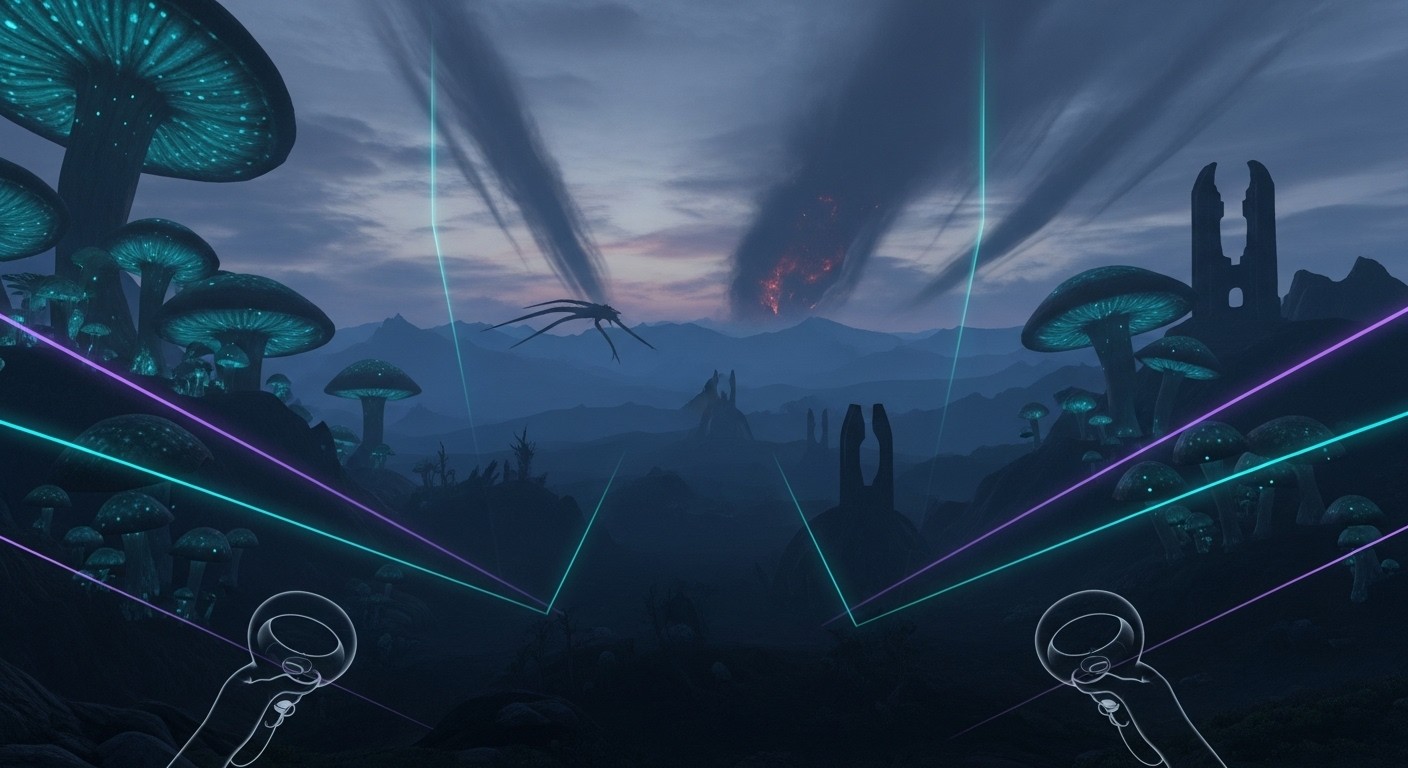
The world of Vvardenfell sells itself. Morrowind’s alien environments — the mushroom forests, the ashlands, the Telvanni towers — have a strange beauty that VR’s sense of scale and presence amplifies. Things that were impressive on a flat screen become genuinely striking when you’re standing inside them. The silt striders are enormous. The Dunmer architecture is strange and looming. Red Mountain dominates the skyline.
OpenMW-VR’s engine-level integration means no fighting the renderer. Unlike injection drivers that wrestle with a game’s camera and rendering pipeline, OpenMR-VR was built to output proper VR frames from the start. Head tracking is low-latency, stereoscopic rendering is correct, and there’s no z-buffer estimation or geometry guessing.
OpenMW’s modding ecosystem carries over. Many visual and gameplay mods that work with OpenMR also work in the VR fork, meaning you can improve textures, draw distance, and gameplay systems while playing in VR. This is a significant advantage over the original engine.
Performance is reasonable thanks to OpenMW’s modern rendering architecture. You’re not fighting a 2002 engine trying to render twice.
What Doesn’t Work
Morrowind’s UI was never designed for VR. The inventory, spell selection, dialogue, and map systems are all flat-game interfaces. OpenMW-VR renders them in world space so you can see and interact with them, but they’re dense, text-heavy, and require pointer-based interaction. Extended menu sessions break presence. This is the single biggest immersion gap.
Combat isn’t satisfying in VR. Morrowind’s combat is dice-roll based — your swing connects or doesn’t based on character stats, not physics. In VR, where you’re physically swinging a weapon and watching it pass through enemies because your skill number is too low, the disconnect is jarring. This is a fundamental mismatch between the game’s RPG system and VR’s expectation of physical interaction.
Comfort options are limited. There’s no built-in vignette, no snap-turn by default, and no comfort locomotion mode. Players prone to motion sickness will struggle, especially in Morrowind’s many interior spaces and vertical terrain.
VorpX is a compromised experience. No motion controls, no hand presence, UI designed for a monitor, and a DX9 mod dependency. It works as a way to see Vvardenfell in 3D, but calling it “Morrowind in VR” is generous. It’s Morrowind on a stereoscopic virtual screen with head tracking.
Visual fidelity is a double-edged sword. VR makes the world’s scale impressive but also makes the 2002-era character models, animations, and textures more obviously dated. Some players find this charming; others find it difficult to look past.
Platform Differences
Morrowind VR is PCVR-only regardless of route. OpenMW-VR requires a SteamVR or OpenXR-compatible headset connected to a PC. VorpX requires the same. There is no standalone Quest version, no PSVR version, and no mobile VR option. The game’s age makes this unsurprising, but it does mean you need a PCVR setup to play.
Who This Is For
Good for:
- Morrowind fans who want to revisit Vvardenfell with presence and scale
- Players who don’t mind janky VR interfaces and are comfortable with advanced setup
- RPG enthusiasts who value world depth over VR polish
- Modders who want to enhance the experience with OpenMR’s ecosystem
Not for:
- VR players who expect native-quality motion controls and UI
- Anyone sensitive to motion sickness with stick locomotion
- Players who want physically satisfying melee combat
- People looking for a plug-and-play VR experience
The Verdict
Tier: B
Game Quality: A Morrowind is one of the greatest RPGs ever made — its world-building, freedom, and systems remain unmatched by most modern open-world games. The game itself earns top marks on its own merits.
VR Implementation Quality: C OpenMW-VR does the hard part right — engine-level stereoscopic rendering, proper head tracking, and motion controller support — but the flat-game UI, dice-roll combat, and limited comfort options mean the VR adaptation never fully escapes its origins. It’s functional and impressive as a community project, but it’s not a native VR experience.
Overall Tier: B Morrowind’s world is worth experiencing in VR for anyone who loves the game and can tolerate the compromises. OpenMW-VR is the real route; VorpX is a novelty. The gap between how good Vvardenfell feels in VR and how clunky the interaction remains is the defining tension of this experience. For fans, it’s a pilgrimage worth making. For VR-first players, there are smoother paths elsewhere.