
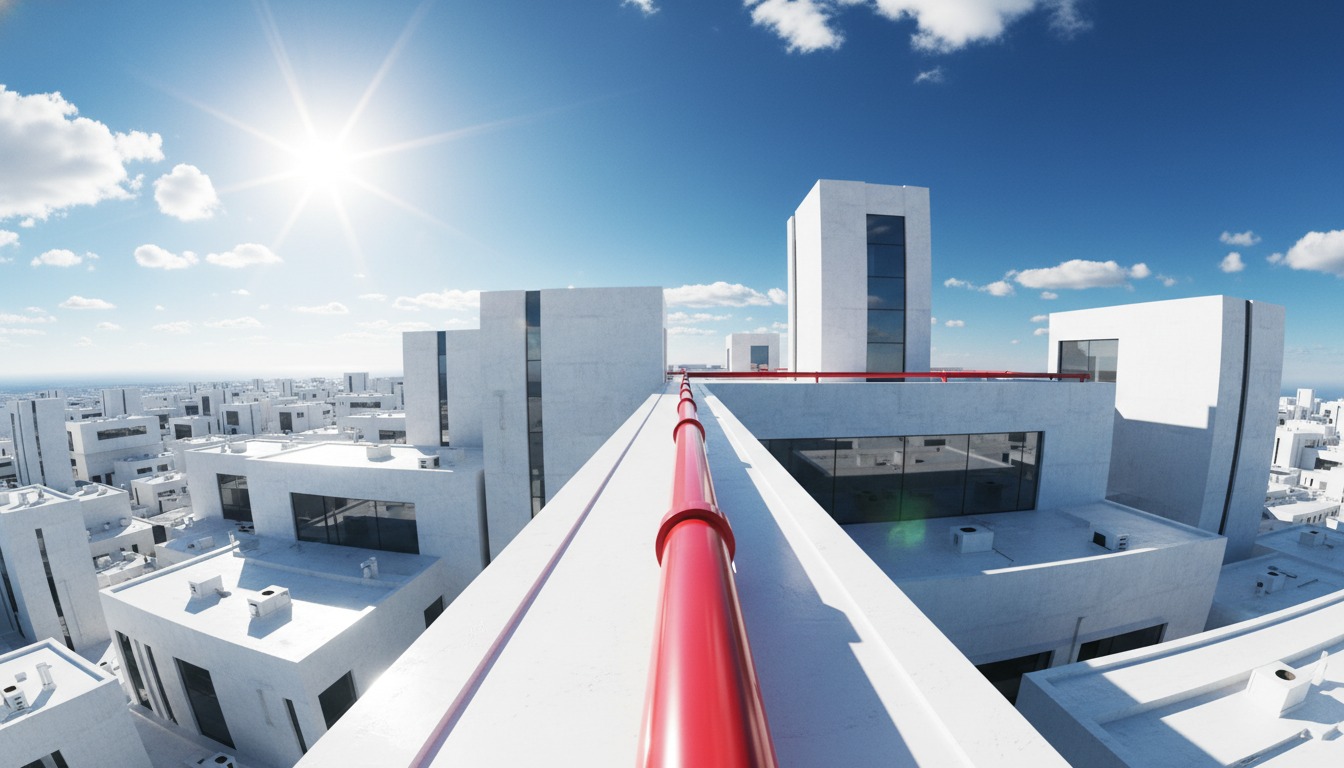
The first time you look down from a rooftop in Mirror’s Edge in VR, your body rebels. The city falls away in layers of white concrete and arterial red, and some primitive part of your brain insists that you are actually standing on the edge of a building. That moment — the lurch in your stomach, the instinct to step back — is the entire pitch. Mirror’s Edge was always about height and momentum and clean lines, and in stereoscopic 3D, those qualities become physical in a way the flat screen never managed.
The way to get there is through an injection driver, primarily VorpX. The original game has a well-maintained profile that supports full Geometry 3D rendering and DirectVR scanning, which means real depth, positional head tracking, and automatic field-of-view adjustment. Historically, Vireio Perception also supported the game for early VR headsets, but that project is effectively abandoned now and not practical for modern hardware. If you are doing this in 2026, you are doing it through VorpX.
What that gets you is straightforward: you see the game in true 3D, you look around naturally, and you lean into the space. What it does not get you is motion controls, VR-native UI, or any redesign of the game for headsets. You play with a keyboard and mouse or a gamepad, exactly as the game was originally built. The headset is a display and a camera, not an input device. That limitation is worth stating plainly, because it defines everything else about the experience.
Getting it running takes some work. VorpX’s DirectVR scan can usually detect and adjust the in-game FOV automatically, but Mirror’s Edge is finicky. If the scan misses, the default view feels zoomed-in and claustrophobic, which destroys both the sense of scale and your comfort. You may need to push the horizontal FOV toward 112 degrees, either through VorpX’s game optimizer database or by manually editing configuration files. Once it is dialed in, though, the transformation is immediate. The game’s distinctive visual style — bright sun-bleached rooftops against saturated reds and blues — was always clean and geometric, and that simplicity pays off enormously in VR. There is no visual noise to fight with, no muddy textures that collapse under close inspection. The world reads instantly, which matters when you are sprinting at full speed.
And you will be sprinting. The core parkour loop — vaulting barriers, wall-running between buildings, sliding under pipes, leaping gaps — feels kinetic and physical in a headset. The sense of speed is amplified by the depth. Judging distances for jumps becomes more intuitive with true stereoscopic vision, which is one of the rare cases where an injection driver actually improves a core gameplay system rather than just wrapping it in 3D.
But the same intensity that makes it thrilling also makes it punishing. Mirror’s Edge was built without any consideration for VR comfort, and it shows. Ledge grabs snap the camera in ways that are not stabilized. The roll animation after a hard landing yanks your view through a full rotation. Sliding down ramps at speed, which the game uses frequently, delivers sustained vestibular conflict. Cutscenes seize control of the camera entirely, locking your head movement and often moving the viewpoint in ways that can induce nausea quickly. This is not a game for newcomers to VR. Even experienced players report needing breaks after extended sessions.
The performance picture is manageable but not trivial. Geometry 3D mode doubles the rendering load, and while Mirror’s Edge is a 2009 release, pushing it through modern VR resolutions at high refresh rates still demands a reasonably capable PC. If your hardware struggles, Z-Normal mode is available as a fallback, but the depth quality drops noticeably and the experience flattens. For this game specifically, Geometry 3D is worth the frame cost.
A brief word on the sequel: Mirror’s Edge Catalyst does not share the original’s good fortune. The VorpX profile for Catalyst relies on Z-Normal reconstruction rather than Geometry 3D, which produces a weaker stereo effect that degrades further on nearby objects. Head tracking is handled through mouse emulation with visible latency, making precise platforming harder rather than easier. If you are looking for parkour in VR, stick to the original game.
So who is this for? If you have strong VR legs, a tolerance for keyboard-and-mouse play inside a headset, and any affection for first-person platforming, Mirror’s Edge is arguably the best case for injection drivers. It amplifies what the game already did brilliantly — speed, verticality, and visual clarity — without pretending to be something it is not. The lack of motion controls is a real ceiling, and the comfort demands are genuine, but the core experience of running across those rooftops in true 3D is hard to replicate anywhere else in VR.
If you are prone to motion sickness, if you expect hand tracking or motion-controlled interactions, or if you want a plug-and-play experience with no configuration, this is not your game. The setup is moderate, the comfort is intense, and the input is firmly rooted in 2009. But for the right player, the trade is worth it. Those rooftops are still there, waiting, and in a headset they feel higher than ever.