
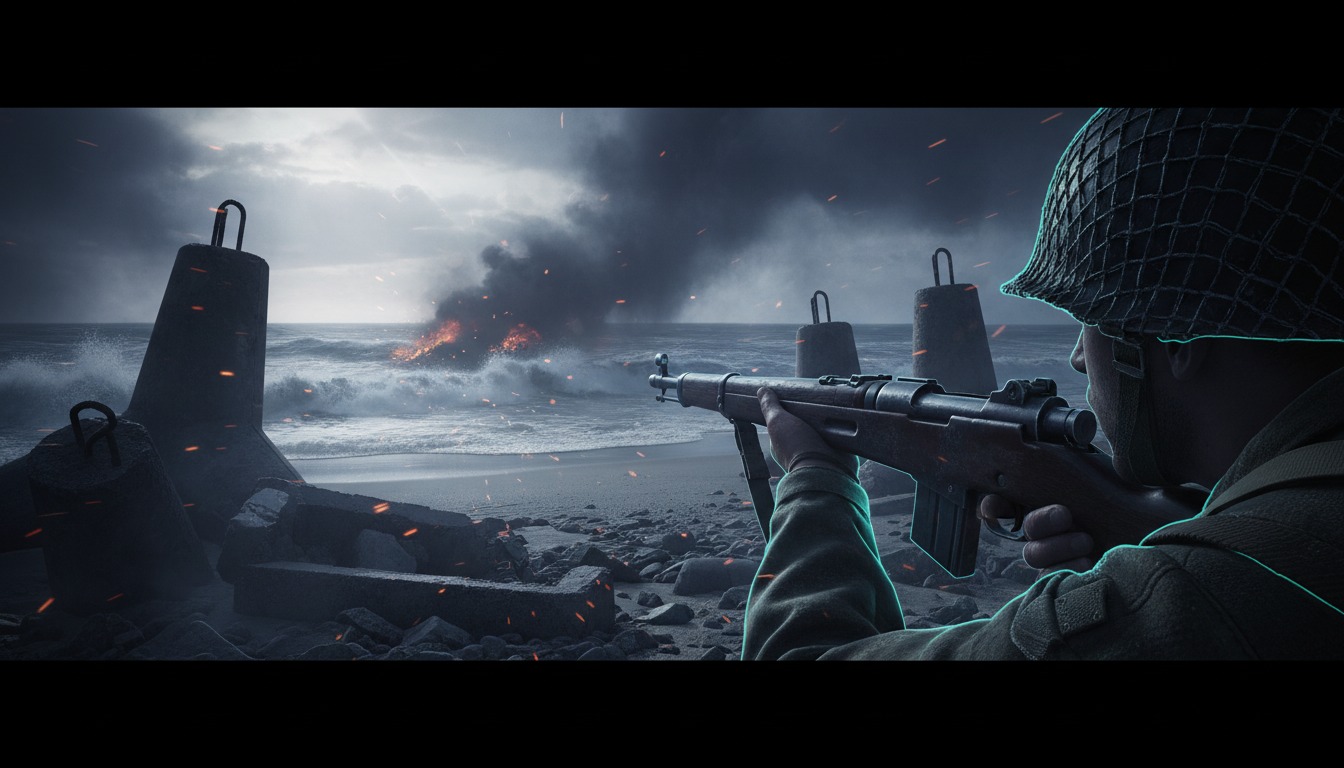
Respawn Entertainment’s first venture into virtual reality was never going to be subtle. Medal of Honor: Above and Beyond arrived in late 2020 as a full-scale native VR shooter, backed by EA’s budget and the pedigree of a studio that knows how to make guns feel good. The pitch was irresistible: a ten-hour World War II campaign with the production values of a modern blockbuster, rebuilt from the ground up for headsets. What actually showed up was more complicated — a game that delivers genuinely thrilling moments of VR combat, then trips over its own feet with loading screens, fragmented pacing, and a post-launch abandonment that turned a promising platform into a single-player-only time capsule.
This is a native VR title, sold as a VR product, not a retrofit. On PCVR it launched as a demanding showcase piece with a massive installation footprint. A year later, a full standalone port brought the entire campaign — cutscenes, gallery mode, multiplayer and all — to Meta Quest 2, a technical achievement that still impresses even if the visual compromises are obvious. Both versions share the same core design: you play as an OSS operative across six European missions, manually reloading authentic WWII weapons, throwing grenades pulled from your chest, and ducking behind cover that only works if you physically crouch. There is no duck button. The game expects your body to participate.
And when it clicks, it clicks hard. The weapon handling strikes a careful balance between simulation and accessibility. Shotguns require a satisfying pump action after every shot. SMG magazines drop free with a button press, and slamming a fresh clip home before racking the bolt feels tactile and immediate. Respawn wisely streamlined the fiddly parts — shells automatically reload into the shotgun so you can focus on the rhythm of aim, fire, pump — which keeps the action flowing without sacrificing the physicality that makes VR shooters compelling. Grenades can be primed by pulling the pin with your teeth. Knives can be thrown with a bit of assistance to ensure they hit. These touches show a team that understood what makes VR combat feel alive.
The problem is what happens between the firefights. Above and Beyond is structured as a series of short scenes — fifty-four of them — each bookended by fade-to-black transitions and loading screens. You might listen to French resistance fighters plan a train derailment, watch a “Victory!” poster flash for no reason, then load into the back of a jeep, have another conversation, fade to black again, and finally reach the actual combat. The episodic chopping turns what should be a continuous cinematic experience into a stop-start slideshow. Later missions open up with longer sequences — aerial dogfights, submarine infiltrations, tank assaults — but the fragmentation never fully goes away. It is the defining flaw of the campaign, and it undermines the sense of presence that the gunplay so carefully builds.
The AI does not help. Enemy soldiers occasionally stand in open fields waiting to be shot, while allies sometimes freeze mid-combat. At other times, distant Nazis land impossible shots from behind cover, creating difficulty spikes that feel manufactured rather than tactical. It is inconsistent in a way that breaks the fiction — one moment you are clearing a bunker with satisfying precision, the next you are respawning into immediate enemy crosshairs.
Platform choice matters significantly. On PCVR, the game can look genuinely impressive with capable hardware — storming Omaha Beach with detailed environments and strong lighting effects delivers the cinematic weight the campaign promises. But it is demanding, and even mid-range systems at launch struggled to maintain consistent performance. The Quest 2 port, released a year later, scales back textures, removes vegetation in places, and dials down lighting to levels that one reviewer charitably compared to a PlayStation 3-era title. Yet the full campaign is there, every set piece intact, and the trade-off is defensible for the freedom of standalone play — the Quest 2’s mobile silicon simply cannot render what the PC version does, and that’s a hardware physics problem, not a game design one. Hard to fault Respawn for it. On Quest 3, the sharper lenses and improved performance make the port arguably the best way to experience the game now — crisp enough to forgive the downgrades, smooth enough to avoid the PC version’s stutters. Just do not expect to max out the Quest 2 graphics settings without introducing frame drops and pop-in.
Comfort options are reasonably thorough for a smooth-locomotion shooter. There is no teleportation — movement is stick-based — but you can choose between smooth or snap turning, add blinders, toggle screen shake from explosives, and play seated. Some vehicle sections and skiing sequences introduce artificial motion that may challenge sensitive stomachs. Meta officially rates it “Comfortable,” which is optimistic for anyone prone to motion sickness, but the options are there to mitigate it.
The real gut-punch is the post-launch trajectory. Multiplayer servers shut down in December 2023, removing team deathmatch, capture the flag, and the bot-backed modes that extended the game’s life. No official reason was given, but low player counts were the likely culprit. Since then, the game has received no meaningful updates. Known glitches persist. The live-fire gauntlet and survival modes still work, but the broader multiplayer ecosystem is gone. What remains is the single-player campaign and the Gallery — a genuinely special collection of WWII veteran interviews and archival footage that offers something no other VR shooter has: historical context from the people who lived it. The Gallery alone justifies the disk space for history-minded players.
So who should bother? If you want a lengthy, scripted WWII shooter with excellent weapon handling, this is the best one VR has — full stop. The pacing is fragmented and the AI occasionally embarrasses itself, but neither kills what the good stretches deliver. History buffs should absolutely see the Gallery — it’s the only place in VR where you’ll find WWII veterans telling their own stories. Multiplayer seekers should look elsewhere entirely — the servers are dead and nothing is coming back. And if you are sensitive to smooth locomotion or need teleportation, this is not the shooter for you.
Medal of Honor: Above and Beyond is proof that AAA resources, pointed at VR, can produce something genuinely worth the headset time. Ten hours of campaign, weapon handling that still feels great years later, and a documentary Gallery no other shooter offers — all native, all in the headset. It is not perfect: the scene-by-scene pacing frays at the edges, the AI is inconsistent, and the multiplayer is gone. But on PCVR, this is an A-tier experience for shooter fans — the Quest port’s compromises are simply the hardware talking. Play it, and point the history buffs at the Gallery.