
Mass Effect in VR: The Galaxy at Eye Level
The Normandy’s bridge stretches out before you. The Citadel’s wards tower overhead. Commander Shepard stands in the foreground, your avatar in the ongoing war against the Geth and the mysteries beyond the Mass Relays.
But something feels incomplete. You can’t reach out and touch the holographic interface. You can’t gesture during dialogue. You can’t physically lean into conversations or aim your weapon with your hands. You’re watching Shepard, not being Shepard.
This is Mass Effect through VorpX—an injection driver that forces stereoscopic 3D and head tracking into a game that was built for televisions and monitors. The question isn’t whether Mass Effect is good (it is). The question is whether this VR option is worth your time.
What Injection Drivers Actually Do
VorpX and similar tools work by intercepting a game’s rendering pipeline and forcing it to output stereoscopic images. They inject head tracking so you can look around.
That’s the entire proposition.
They do not provide:
- Motion controller support (you use gamepad or keyboard/mouse)
- VR-optimized UI (menus and HUDs remain flat-screen designs)
- Hand presence or interaction systems
- Comfort vignettes or teleport options
- Rebuilt cameras or animation systems
The game still thinks it’s running on a monitor. You’re just wearing a headset.
For third-person games like Mass Effect, this limitation cuts even deeper than it does for first-person games. You’re not inhabiting a character. You’re hovering behind a character, watching them from a floating camera that you can marginally adjust with your head.
How Mass Effect Works With VorpX
Mass Effect (2007) runs on Unreal Engine 3, which grants it VorpX compatibility through Geometry 3D mode—the better option for stereoscopic rendering. Objects have genuine depth, environments feel spatial, and the effect is substantially better than simpler Z-Buffer 3D approaches.
DirectVR scanning is available, automatically configuring FOV and camera parameters. By injection driver standards, this should be plug-and-play.
But here’s the problem: Mass Effect is a third-person game.
The Third-Person Problem
In first-person games, injection drivers give you head tracking that feels natural—you’re looking around the world as if you’re in it. In third-person games, the camera follows your character, and your head movements adjust the view around that external camera position.
This creates a disconnection. The immersion that works in first-person Dishonored or Bioshock translates awkwardly when you’re already one step removed, viewing Shepard from behind. The added depth does enhance certain moments—standing on the Citadel’s wards, looking up at the Presidium’s architecture—but the fundamental design fights against VR’s strengths.
You’re not looking through Shepard’s eyes. You’re looking at Shepard, with some 3D enhancement.
The Experience: What Works
Environmental Scale
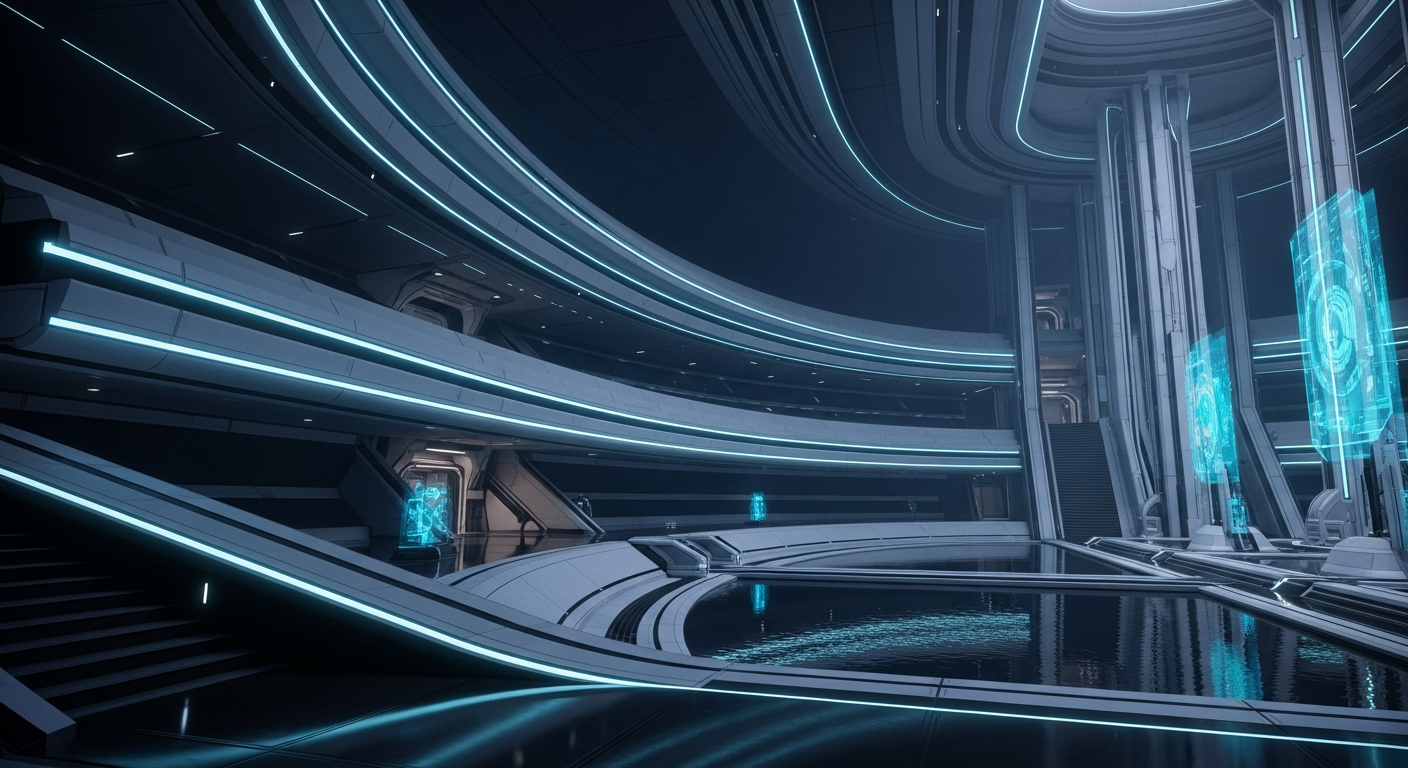
The Citadel in VR is genuinely impressive. The station’s ward arms stretch into the distance. The Presidium’s lake and embassies feel appropriately grand. Standing in Flux, looking at the holographic displays, scanning the crowds—the scale that Mass Effect struggled to convey on 2007 displays lands with more impact when the environment surrounds you.
This is where injection drivers accidentally succeed: when the art direction was already strong, the shift to stereoscopic 3D adds genuine value.
Cinematic Conversations
Mass Effect’s dialogue system, with its cinematic camera angles and close-ups, translates interestingly to VR. When the camera cuts to a character’s face during conversation, you’re suddenly much closer, much more present. The performances—already strong—feel more intimate.
This is a mixed blessing. The cuts between camera angles during conversations can be jarring in VR, where your head position suddenly matters less than the director’s choice of shot. But for players who enjoy the theatrical presentation, the added depth during close-ups can enhance emotional moments.
Combat and Cover
Third-person cover shooting gains minor benefits from stereoscopic depth. Judging the distance to cover, seeing how enemies are positioned relative to your squad—these small spatial improvements matter in a game where positioning determines success.
The effect isn’t transformative. Mass Effect’s combat is fundamentally a flat-screen experience with RPG mechanics layered on top. But if you already know the game, the added depth doesn’t hurt.
The Limitations: What Doesn’t Work
No Motion Controls, No Hand Presence
You cannot use a Medi-Gel with your hands. You cannot physically point your weapon. You cannot interact with any object in the world through gesture or touch. Everything is gamepad or keyboard/mouse, the same control scheme from 2007, translated onto a headset.
For a game about being Commander Shepard—about making choices, exploring the galaxy, leading a team—the inability to actually be in the world rather than just watch it from behind is a significant loss.
The HUD Problem
Mass Effect’s interface was built for 2007 displays. In VR, the HUD floats awkwardly in front of your face. Text leans toward illegibility. Weapon wheels and squad command interfaces require navigating with buttons rather than pointing.
This is standard for injection drivers, but it’s worth repeating: VR doesn’t just mean wearing a headset. It means an interface designed for presence and interaction. Mass Effect via VorpX has none of this.
Third-Person Camera Disorientation
In third-person games with injection drivers, head tracking doesn’t move your character—it moves the camera around your character. This can create a sense of disconnection and, for some players, motion discomfort.
If the camera pans while you’re turning your head, the combined motion can cause issues. This isn’t unique to Mass Effect, but it’s exacerbated by the game’s cinematic presentation—camera cuts during dialogue, scripted sequences, and dramatic angles that the game chooses, not you.
Narrative Interruption
Mass Effect is a long game, heavy on story and dialogue. Wearing a headset for 30+ hours of conversations, elevators, and inventory management is a harder sell than wearing it for a focused action experience. The novelty of stereoscopic depth wears off during the fifteenth side quest.
Legendary Edition: A Note
The 2021 Mass Effect Legendary Edition remasters the trilogy on a modernized version of Unreal Engine 3. VorpX support for Legendary Edition is less established than for the original releases, and the different engine configuration introduces variables.
If you’re choosing between versions for injection driver purposes, the originals (Mass Effect 1, 2, and 3 individually) have more established VorpX profiles. But neither version delivers what you’d call a genuine VR experience—they’re the same injection driver compromise in either form.
The Verdict
Game Quality: A
Mass Effect is essential. The world-building, character writing, and narrative scope create one of the most memorable sci-fi RPGs of its generation. The trilogy as a whole is among the medium’s great accomplishments. This rating reflects the absolute quality of the game, independent of VR.
VR Implementation Quality: D
Injection driver. No motion controls. No hand presence. No VR UI. Third-person camera in a format designed for first-person presence. Cutscenes that ignore your head position. HUDs that fight against headset optics. The Geometry 3D rendering is technically competent, but the implementation is fundamentally a flat game viewed stereoscopically—not a VR experience.
Overall: D
Great game, poor VR implementation, limited value as a VR experience. The atmosphere gains minor enhancement from stereoscopic depth, but the third-person design and lack of any VR-native features make this a hard recommendation. The math is simple: A-tier game quality times D-tier VR implementation yields a D-tier overall experience.
This is a novelty for devoted fans who already own VorpX. It is not a reason to buy VorpX, and it is not an experience worth choosing over actual VR games.
Who Is This For?
For:
- Mass Effect superfans who want to see the Citadel and Normandy in stereoscopic 3D
- VorpX owners building a broad flat-to-VR catalogue
- Enthusiasts curious about third-person injection driver experiences
- Players who’ve already experienced Mass Effect on flat screen and want a different visual perspective
Not For:
- Anyone expecting native VR or hand presence
- First-time Mass Effect players (play the definitive flat-screen version instead)
- Those sensitive to motion discomfort from third-person cameras
- Players who want to be Commander Shepard, not watch Commander Shepard
- Anyone buying VorpX specifically for Mass Effect
Worth Buying VorpX For This Alone?
No.
This is the core question, and the answer is straightforward. If you’re considering a VorpX purchase primarily for Mass Effect, you’re investing in a D-tier experience. That same investment, directed toward a B-tier or higher native VR game, delivers more VR value.
The value proposition shifts if you already own VorpX and maintain a library of injection driver titles. In that case, Mass Effect becomes one more entry—worth trying if you love the game, the series, or the universe. But buying VorpX specifically for this? The conversion rate from dollars to VR experience is poor.
The Honest Assessment
Mass Effect via VorpX gives you stereoscopic 3D and head tracking in a legendary RPG. That’s the complete offering.
You will not:
- Use motion controllers to interact with the world
- Experience hand presence or physical engagement
- Make dialogue choices naturally through gesture or gaze
- Aim weapons or use powers by pointing
- Navigate menus designed for VR
- Feel like Commander Shepard rather than a camera operator
What you will get:
- Enhanced depth perception that makes the Citadel and Normandy environments more spatially impressive
- A novel visual perspective on a game you may already love
- A reminder that injection drivers are fundamentally different from native VR
- A D-tier VR experience wrapped around an A-tier game
The tier is D, not C or higher. Great game, but the VR implementation is the wrong tool for the material. Mass Effect was designed for a flat screen, and injection drivers cannot change that fundamental architecture. If you want to experience Mass Effect for the first time, play it the way it was meant to be played. If you want to revisit it and already own VorpX? It costs you nothing except time. But manage your expectations: this is viewing a classic from inside a headset, not playing it in VR.
Technical Notes
Setup Friction: Moderate. Mass Effect has established VorpX profiles, but requires configuration—Geometry 3D mode, DirectVR scanning, FOV calibration. Not difficult for experienced PC users, but not seamless.
Performance: Unreal Engine 3 titles generally run well in stereoscopic rendering. The original Mass Effect is not demanding by modern standards, and mid-range systems should maintain playable framerates. Geometry 3D does require rendering the scene twice, reducing performance compared to flat play.
Key Adjustments: Geometry 3D mode for proper depth. DirectVR scan during first launch. Manual FOV adjustment if the default feels incorrect. Image zoom calibration for natural head height.
Legendary Edition: Different engine configuration. Less established VorpX profiles. Consider original releases for more reliable injection driver support.