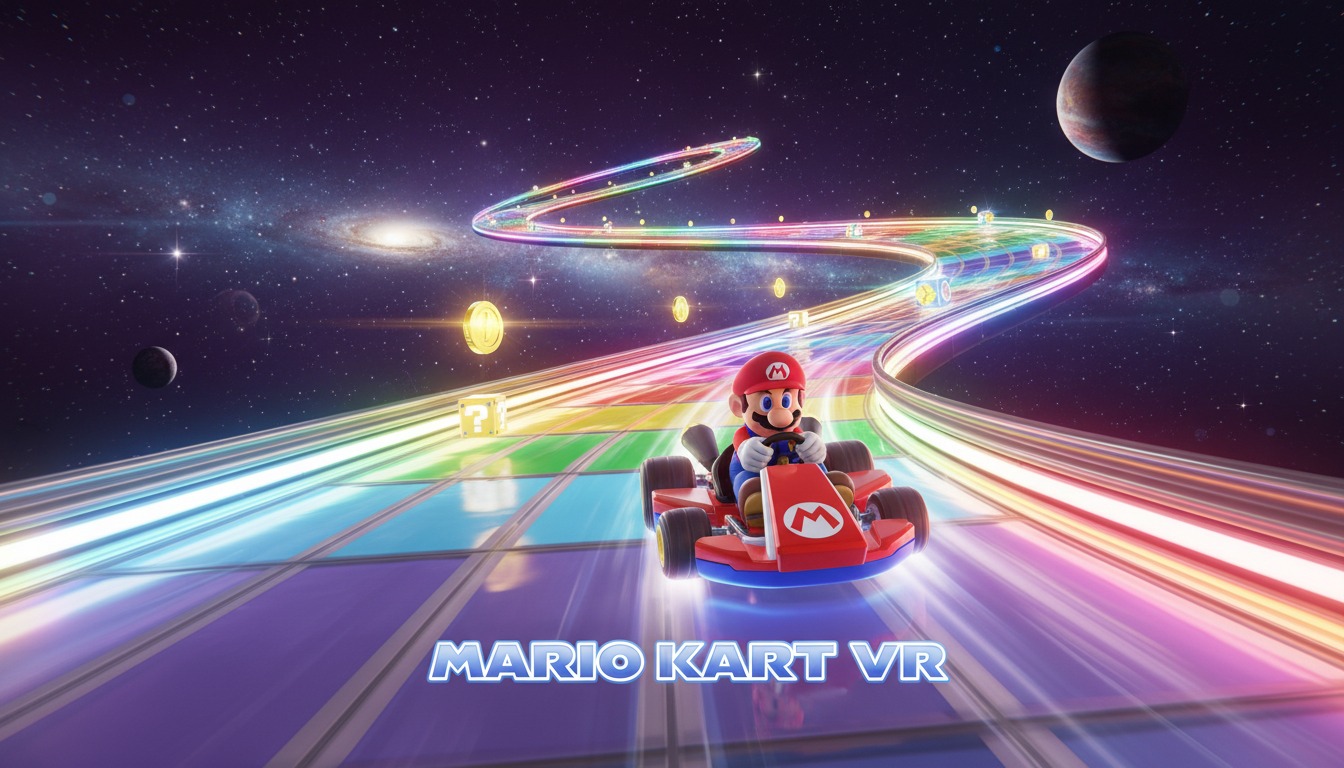
The first time you crest the loop on Rainbow Road and the track drops out beneath you, something clicks. You have played this course dozens, maybe hundreds of times. You know every shortcut, every item box placement, every cheap Blue Shell moment. But you have never been behind the kart like this, floating in space as the neon path spirals into the void, and the scale of what Nintendo built finally registers. Mario Kart was never meant for VR. And yet, here we are, strapped into headsets, grinning while a cartoon plumber drifts through space.
This is the work of Dolphin VR, a fork of the GameCube and Wii emulator that bolts stereoscopic 3D and head tracking onto games never designed for it. The path to getting here is not elegant. You are not downloading a native VR app from a store. You are configuring an emulator, tweaking graphics backends, and hoping your headset plays nice with a codebase maintained by a small group of dedicated hobbyists. The setup burden is real, and it should not be understated. But the payoff, for the stubborn and the curious, is one of the most unexpectedly effective flat-to-VR conversions in the emulation space.
The secret is the camera. Most third-person games struggle in VR because the camera is locked to the player character, and your brain rebels against a body that is not yours. Mario Kart sidesteps this neatly. The camera sits behind the kart, slightly elevated, giving you a chase-plane view that feels natural in a headset. You are not Mario. You are the ghost riding shotgun, leaning into turns, ducking when a shell whistles overhead. The head tracking lets you look around the cockpit area, check your blind spots, and watch the chaos unfold behind you. It is a small freedom, but it transforms the game from a screen-bound race into a physical event.
Speed is the other revelation. On a monitor, Mario Kart is fast. In VR, it is fast. The sense of velocity when you boost through a tunnel or drift around a tight corner is heightened dramatically. Tracks you thought you knew reveal new spatial relationships. Wario Stadium feels massive. Bowser’s Castle has actual verticality. Even the simple countryside roads of Luigi Circuit seem to stretch further than memory suggests. The environmental detail — the crowd, the signage, the architecture — pops in a way that makes the flat version feel strangely flat by comparison.
Most people are playing Mario Kart Wii through this option, though Mario Kart: Double Dash works too. Wii has the edge because the wider tracks and motion-control heritage map slightly better to VR sensibilities. If you are ambitious, you can approximate the Wii Wheel by mapping motion controls to your VR controllers, twisting your hands to steer. It is charmingly imprecise and occasionally frustrating, but when it works, it captures some of the original physicality Nintendo was aiming for. Most players will be better served by a gamepad, which keeps the experience stable and predictable.
The cracks show quickly, though. The UI was built for a television, and in VR it floats awkwardly in 3D space, sometimes too close, sometimes at odd angles, always reminding you that this is a hack, not a design. Motion sickness is a genuine concern. High-speed turns, especially on anti-gravity sections or twisting tracks like Rainbow Road, can overwhelm a stomach that is not VR-hardened. The boost pads, the spin-outs, the sudden camera jolts from item hits — they all land harder in a headset. Some tracks are outright disorienting. If you are sensitive to artificial locomotion, this is not the gentle introduction you are looking for.
Then there is the emulation itself. Dolphin VR is stable enough to play, but it is not a commercial product. Updates are sporadic. Compatibility varies by headset and graphics hardware. You will spend time in forums, reading threads about headset compatibility and depth buffer tweaks. It is the kind of tinkering that some people find meditative and others find infuriating.
So who is this actually for? If you love Mario Kart and want to see it from an angle that genuinely refreshes it, the answer is you. If you are a VR owner desperate for accessible, colorful, social racing that does not require a wheel rig and a garage, the answer is also you. The game works end-to-end. The multiplayer, if you can get multiple headsets and emulators coordinated, is a party highlight. But if you need polished VR native design, if UI elegance matters to you, or if motion sickness has ever sent you reaching for the headset early, this is a harder sell.
Mario Kart in VR is not the future of the franchise. Nintendo is not building this. It is a community experiment that happens to work far better than it has any right to. The speed is real. The scale is real. The grin when you nail a drift and watch the track blur past your peripheral vision is real. So is the nausea if you push it too hard. It is a B-tier VR experience built on an A-tier game, and that combination is enough to make it worth the hassle for anyone who already has the hardware and the patience. Just do not expect a product. Expect a very good hack that makes a very good game feel new again.