
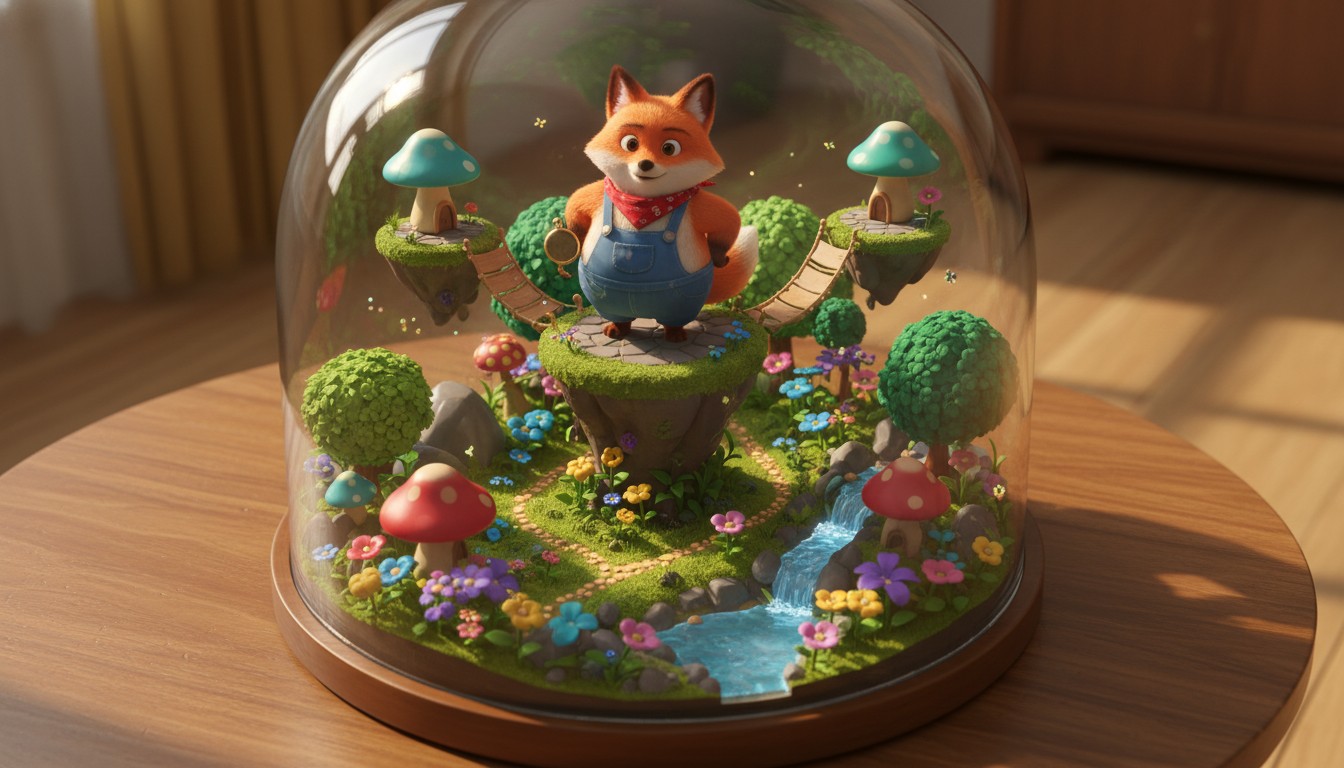
The first thing that hits you in Lucky’s Tale is the scale. You’re not inside a fox — you’re hovering above a toy world, leaning in to peer around mushroom caps and watching a little denim-clad hero scamper through diorama forests that feel like they were built for a giant’s coffee table. It’s disarming. And for a medium that was, in 2016, drowning in first-person cockpit demos and wave shooters, that third-person detachment was a genuine design choice, not a compromise.
Playful Corp built this as an Oculus Rift pack-in for a reason. They wanted to prove that VR could handle the fundamentals — comfort, clarity, approachable gameplay — before it chased the spectacular. The result is a 3D platformer that plays it safe in almost every respect except the one that matters: it makes you feel present in a space without making you nauseous.
The VR Reality
This is not a mod. It’s not an injection profile. It’s a native VR platformer built from the ground up for tracked headsets, and that lineage shows in the camera system. Rather than strapping a camera to Lucky’s back and letting the player control it — a recipe for discomfort in early VR — Playful locked the viewpoint to fixed, elevated positions that sweep along automatically as you progress. You can look around freely, lean in to inspect hidden nooks, and even physically reposition your head to line up jumps that would be blind from a flat screen. But the camera never asks you to manage it. The tradeoff is occasional awkwardness: sometimes Lucky runs off-screen before the camera catches up, or an angle obscures a ledge you need to see. It’s rare, but when it happens, it breaks the flow in a way a traditional platformer camera wouldn’t.
The original 2016 release was strictly PCVR and gamepad-controlled. A remastered version launched in 2021 for Quest 2 and Steam, adding visual upgrades and refined movement, with a PlayStation VR port following in 2022. Quest 3 owners can play the Quest 2 build via backwards compatibility. Setup is effectively zero — buy it, launch it, play. For anyone who’s spent an evening wrestling with OpenXR loaders and community controller configs, that frictionlessness is worth noting.
What It’s Actually Like
You’re Lucky Swiftail, a fox in overalls, rescuing your pig friend from a tentacled villain named Glorp. The story is excuse-plot territory. What matters is the feel: responsive jumps, a tail-swipe attack, ground-pound moves, and levels that borrow liberally from the genre’s greatest hits — floating platforms, coin trails, secret warps, head-stomp enemies. Nothing here surprises a platforming veteran. Everything here works.
The VR-specific flourishes are subtle but effective. You can look down into a well to spot a hidden passage. You can lean left to see around a tree trunk concealing a collectible. There’s a light head-tracking aiming element for certain projectile attacks. These aren’t transformative mechanics — they’re garnish. The core platforming would translate to a flat screen with minimal loss. But the diorama perspective does change the texture of exploration. Levels feel like physical spaces you could reach into, and that tactile quality is genuinely hard to replicate on a monitor.
Comfort is where Lucky’s Tale still earns its keep nearly a decade later. No artificial locomotion to stomach. No snap-turn debates. The fixed camera and gentle auto-movement make this one of the few VR titles I’d hand to someone who’s never worn a headset without warning them first. If you have a friend who’s VR-curious but VR-nervous, this is a better onboarding experience than most dedicated intro apps.
The downside is depth. The campaign runs roughly four hours. Hidden red coin challenges and time trials extend that, but not dramatically. The difficulty skews easy — this is a game designed to be finished, not to test you. For seasoned platformer fans, it’s a pleasant afternoon, not a mountain to climb. The music loops enough to notice. The enemy variety runs thin by the final worlds.
The Call
Lucky’s Tale sits in a specific niche: it’s a comfort-first VR platformer that prizes accessibility over ambition. That makes it an easy recommendation for some people and a skip for others.
Play this if: You’re new to VR and want a low-stakes, genuinely comfortable first experience that happens to be a real game, not a tech demo. You have kids or casual players in your household who need something approachable. You want a palette cleanser between intense VR sessions — something pleasant that won’t leave you sweating.
Skip this if: You’re looking for a platformer with mechanical depth, challenging level design, or substantial length. You want a VR experience that justifies the headset through interaction you couldn’t have on a flat screen. You’re hoping for motion controls or hand presence — this is a gamepad experience through and through.
The 2021 remaster keeps it visually presentable on modern headsets, but there’s been no meaningful content expansion or gameplay overhaul since. Support is stable but quiet. It works, it sells, it doesn’t change.
At its best, Lucky’s Tale is a reminder that VR doesn’t need to be elaborate to be effective. A well-placed camera, a charming art style, and a respect for the player’s physical comfort can carry an experience further than gimmicks. At its weakest, it’s a short, easy platformer that uses VR as a viewing mode more than a design revolution. Both things are true. Whether that equation solves in your favor depends on what you’re hoping to get out of your headset this weekend.