
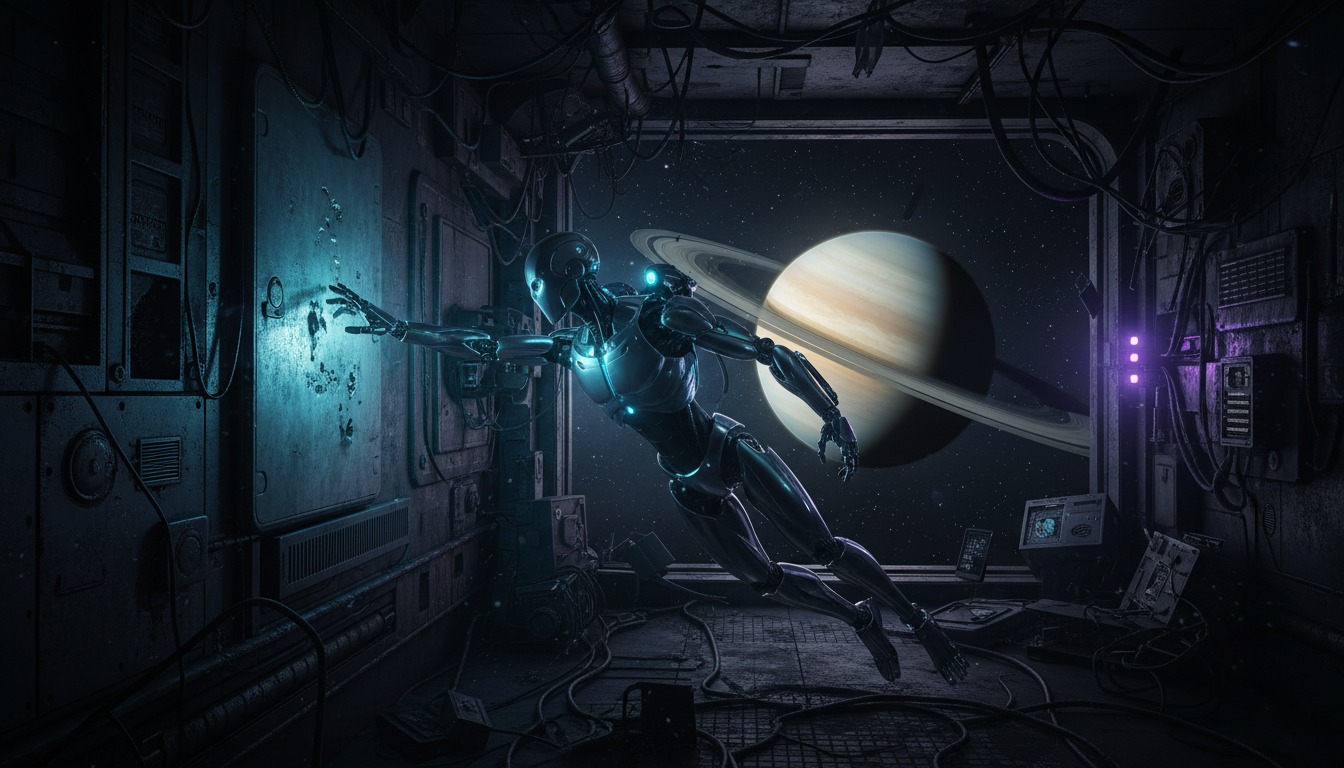
The first time you push off a bulkhead and drift through the Kronos II mining station, something clicks that doesn’t click in other VR games. Your virtual hand reaches out, grabs a pipe, and you shove off with your arm — not a thumbstick, not a teleport button, but your actual body generating momentum. You float. You correct with wrist thrusters. You grab another surface and redirect. It’s not “locomotion” as VR usually means it. It’s propulsion. And in 2017, nobody had done it like this.
Lone Echo is a native VR adventure developed by Ready At Dawn, released exclusively for Oculus Rift PCVR in July 2017. You play Jack, an android assistant stationed aboard a mining facility orbiting Saturn, tasked with helping Captain Olivia Rhodes investigate a spatial anomaly that starts tearing the station apart. The setup sounds like standard sci-fi adventure fare, but the execution is anything but standard. Every system in this game was built to answer the question: what would it actually feel like to move through a space station with your body?
The zero-gravity movement system is the star. You navigate by grabbing onto surfaces and pushing off, using momentum to drift through corridors and cavernous maintenance bays. Wrist-mounted thrusters let you make fine adjustments without breaking the illusion. The physics are forgiving enough that you won’t pinball endlessly into walls, but tactile enough that every push feels like it came from your arm, not an abstraction. What surprised early players — and what still holds up — is how comfortable this movement is. Full six-degrees-of-freedom drifting in open space should be a nausea factory. Instead, the direct correlation between your physical hand movements and your in-game motion seems to satisfy the brain’s vestibular system in a way that traditional artificial locomotion never quite manages. You’re not being moved; you’re moving yourself.
That hand presence extends beyond locomotion. Ready At Dawn invested heavily in inverse kinematics and procedural gripping so that Jack’s robotic hands realistically conform to whatever surface or object you grab. A handrail isn’t a generic interaction prompt — your fingers wrap around it. A control panel isn’t a floating highlight — your palm presses the surface. It’s a subtle thing until you notice it, and then you can’t unnotice how many other VR games treat your hands like floating wands. Here, your hands feel like they have weight, texture, and intelligence. They are part of a body that belongs in this space.
The world itself is built to sell that presence. The Kronos II station is detailed, lived-in, and believable — not a sterile corridor maze, but a working industrial facility with clutter, wear, and environmental storytelling. The lighting is dramatic and effective, with Saturn looming outside viewport windows and emergency lights flickering through smoke after the station takes damage. It was a AAA production at a time when “AAA VR” barely existed, and the visual fidelity still impresses against modern VR titles.
The narrative is more intimate than its space-disaster premise suggests. Your relationship with Captain Rhodes is the emotional anchor, conveyed through dialogue and environmental cooperation rather than cutscene theatrics. She’s competent, stressed, and entirely dependent on you — an android who, through your hands and your choices, becomes something like a partner. The writing won’t rewrite the rules of sci-fi storytelling, but the physical proximity of VR transforms what might be standard buddy-adventure dialogue into something genuinely affecting. When she reaches for you in a crisis, you feel the spatial relationship. That’s not something a flat screen can replicate.
The game also solved a UI problem that plagued early VR: how do you interact with computers, inventory, and systems without breaking immersion? Lone Echo’s answer was wrist-mounted displays and in-world touchscreens. Your tools and objectives sit on a virtual tablet in your hand or a display on your forearm. It sounds simple, but at the time it was revelatory. No laser-pointer menus floating in void space. Every interface exists inside the fiction, operated by the same hands you use to push off walls.
So what’s the catch? Availability. Lone Echo was and remains an Oculus Rift / Meta Store exclusive for PCVR. It was never ported to Quest standalone, and Meta has stated there are no plans to do so. You can play it on a Quest headset via Oculus Link or Air Link connected to a VR-ready PC, but you’ll still need a Meta account and a purchase through the Meta Store ecosystem. If you’re on a non-Meta PCVR headset, you’ll need Revive or similar compatibility layers — functional, but another hoop. Ready At Dawn was acquired by Meta in 2020 and shut down entirely in August 2024, which means no patches, no sequel beyond Lone Echo II (2021), and no future support. The multiplayer spinoff Echo VR, which grew out of this game’s locomotion foundation, was shuttered in August 2023.
Performance is reasonable on modern hardware but was demanding for its era. The zero-gravity environments are complex, with lots of dynamic objects and detailed geometry. On a contemporary mid-range PCVR setup it runs well; on older hardware, you may need to compromise. The game is stable and complete — no missing features, no abrupt endings, no “early access” asterisks — but the knowledge that nothing will ever be fixed if something breaks adds a faint fragility to the experience.
This is a game that influenced an entire generation of VR design without most players realizing it. The procedural hand gripping showed up in later titles. The in-world touchscreen interfaces became a template. The zero-gravity movement directly spawned Echo Arena, one of VR’s most beloved multiplayer experiences. When developers today talk about “hand presence” and “natural VR locomotion,” they’re often chasing standards that Lone Echo set before many current headsets even existed.
Who should play this? Anyone with a PCVR setup who cares about what VR can do when it’s built from the ground up for the medium. If you’ve ever complained that VR games feel like flat games with headsets strapped on, this is the counterargument. It’s a must-play for VR enthusiasts interested in the medium’s history and potential. Who should skip it? Players without access to PCVR or a Meta Store account, and those looking for ongoing support, multiplayer, or a modern content pipeline. This is a completed artifact from a shuttered studio, not a living service.
Lone Echo remains one of the most accomplished native VR experiences ever released. Its movement, its hand presence, and its environmental storytelling are still reference-grade nearly a decade later. The caveats are real — platform lock-in, studio closure, no forward compatibility — but the game itself is a masterclass in what happens when developers treat VR as a native language instead of a translation. If you can access it, you should.