
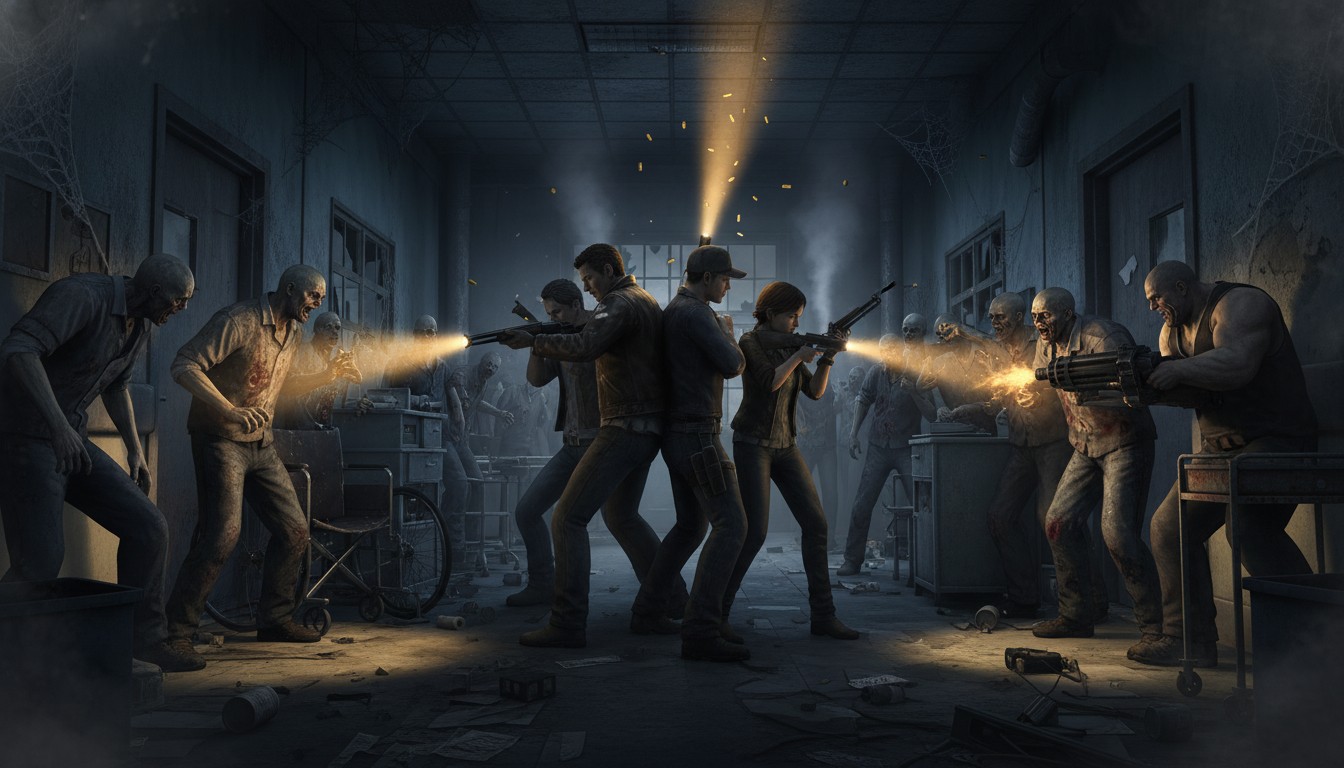
There is a very specific kind of terror that comes from hearing a Hunter scream while you are wearing a VR headset. In flatscreen, Left 4 Dead trained me to spin 180 degrees and panic-fire. In VR, with head tracking and stereoscopic depth, that same scream hits different — it has direction, it has presence, and your lizard brain responds before your thumbs do. The problem is that your thumbs are still doing all the work.
This is Left 4 Dead through VorpX, a commercial 3D-injection driver with a Geometry 3D profile that has existed since 2021. It is not a mod. It does not give you motion controls or hand presence or a VR-native interface. What it gives you is depth and head-tracked look wrapped around the original 2008 Source engine game. For a co-op zombie shooter built around split-second reactions and 360-degree threat awareness, head tracking actually changes something meaningful. You can glance over your shoulder while reloading. You can track a Smoker’s tongue arc through the air. The alleyways of Mercy Hospital and the cornfields of Blood Harvest gain a spatial density that flatscreen never quite conveyed.
Getting it running is relatively painless by VorpX standards. The community cloud profile works for both the Steam and retail versions. The main recommendation is cranking shader quality to High, which the Source engine handles without breaking a sweat. Full VR mode is available, though the profile defaults to cinema mode, so you will need to toggle that. FOV and head tracking sensitivity might need a nudge in the VorpX menu, but this is not the kind of profile that demands console commands and compatibility fixes. Compared to some of the nightmare setups I have wrestled with, this one is almost polite.
Once it is running, the immediate impression is mixed in the way all injection drivers are. The environments — those tight apartment stairwells, the foggy forest paths — gain real depth. A Tank charging at you is genuinely imposing when it occupies actual volume in your vision rather than a flat screen rectangle. Head tracking for look works, which means your awareness of the space around you improves dramatically. But the moment you try to physically raise a weapon or duck behind cover, the illusion cracks. You are holding a gamepad or resting your hands on a keyboard, and the game has no idea you are in VR beyond the camera feed VorpX hijacks.
The campaign is fully playable this way. All four campaigns, all twenty maps, all the AI Director chaos. Performance is a non-issue; a Source engine game from 2008 runs effortlessly under VorpX on even modest modern hardware. The real friction is comfort. Left 4 Dead is built for intensity — sprinting, explosions, sudden horde rushes, the screen shake of a Tank punch. There are no comfort options, no vignette, no snap turning. The continuous motion plus head-bob plus the game’s relentless pacing creates an intense comfort profile. The cartoon-ish aesthetic helps a little — this is not photorealistic gore, and that distance matters for some players — but the motion is still aggressive. I would not recommend this as anyone’s first VR shooter.
The HUD is another reminder of what this is. Health bars, ammo counts, and the survivor outlines float as flatscreen elements in your peripheral vision. They are readable enough, but they never feel integrated. You will adapt, but you will never forget you are looking at a screen someone shoved into a headset.
So who is this actually for? If you already own VorpX, already love Left 4 Dead, and want to replay the campaign with spatial depth and head-aimed awareness, this profile delivers exactly that. It is a nostalgia trip with a stereo upgrade. The co-op still works — you can run the full campaign with friends, and they do not need VR to join you. That is genuinely special: sitting in a headset, hearing a Boomer around the corner, communicating with flatscreen friends who have been playing this game with you for fifteen years.
But the caveats are real. If you are looking for motion-controlled melee swings, physically reaching for pills, or the kind of embodied zombie combat that makes VR shooters thrilling, this is not your answer. And if you are choosing between this and Left 4 Dead 2’s community VR mod — which has motion controls, 6DoF, and actual hand presence — there is no contest. L4D2VR is the fuller experience, and it costs nothing beyond the base game.
Valve has confirmed there is no official Left 4 Dead VR game in development. That leaves the original in a very specific niche: a solid, playable, slightly haunted way to revisit a co-op classic, provided you already have the tools and the stomach for it. For anyone else, the memories are probably better left in flatscreen.
If you’d rather get Left 4 Dead’s co-op energy into a headset with motion controls and hand presence, the community also rebuilt those zombie maps inside Pavlov’s Workshop — worth a look if VorpX’s gamepad-and-head-tracking approach leaves you wanting more.