
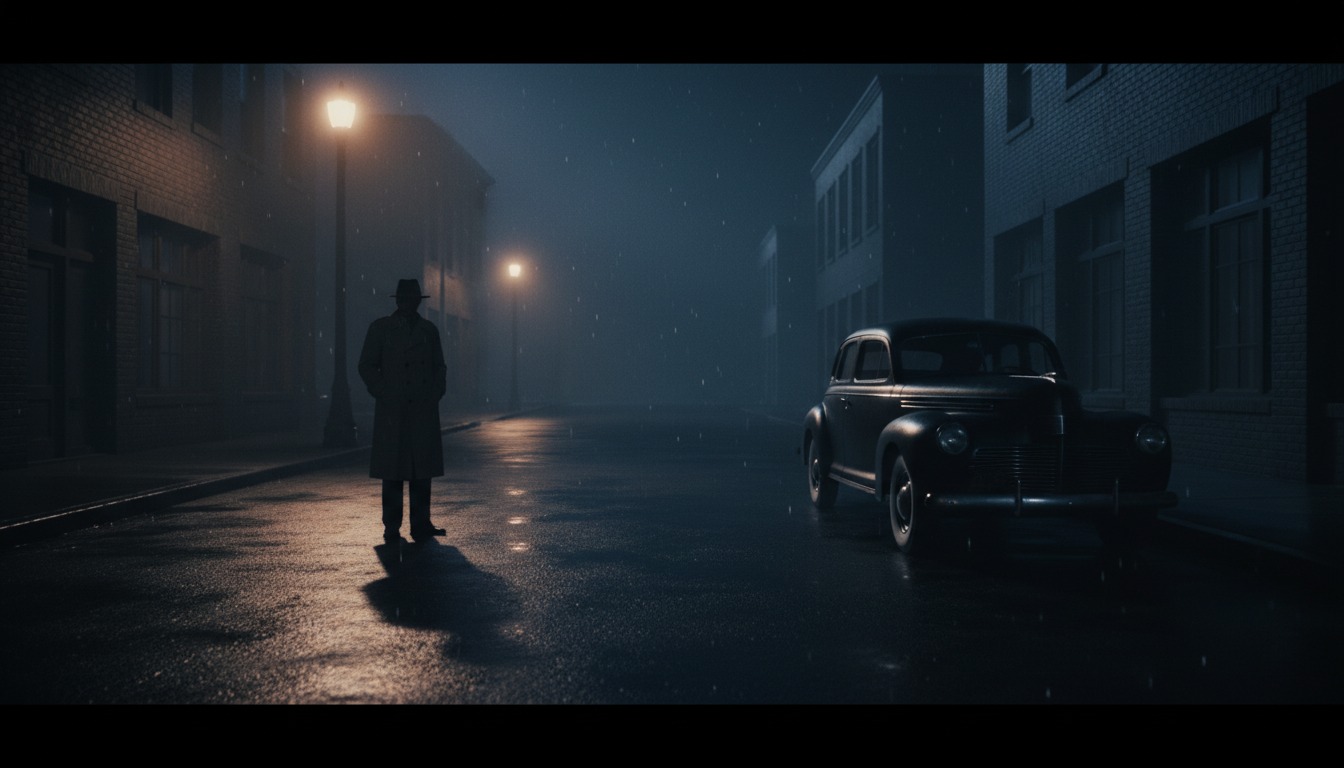
The suspect’s face is inches from yours. You can see the sweat on his upper lip, the way his eyes dart to the left when he claims he was home all night. In the flat version of L.A. Noire, this moment was impressive. In The VR Case Files, it is unsettling in the best way — you are not watching a detective interrogate someone, you are the detective, leaning in close enough to smell the cigarette smoke.
This is L.A. Noire: The VR Case Files, a standalone VR release from Rockstar that takes seven hand-picked cases from the 2011 original and rebuilds them for virtual reality. It is not a retrofit or a mod. It is a native VR product with its own store page, its own controls, and its own set of problems that have only gotten worse with age.
The Detective Fantasy, Physical
What The VR Case Files gets right, it gets almost uniquely right. The core of L.A. Noire has always been detective work — examining crime scenes, collecting clues, reading faces — and VR transforms this from a point-and-click exercise into physical performance.
You reach into your left shirt pocket to pull out a notebook. You scribble notes with a pencil, physically picking up evidence and rotating it in your hands to find the detail that cracks a case open. Crime scenes become spaces you walk through rather than screens you parse. A bloodstain on a wall is something you crouch to inspect. A hidden drawer requires you to physically pull it open.
The star of the show is the interrogation. L.A. Noire was built around MotionScan, a technology that captured actors’ facial performances with 32 cameras and translated every micro-expression into the game. In VR, this pays off in a way the flat version could never quite achieve. Suspects fill your field of view. Their nervous twitches, their avoiding eyes, their barely-there smirks — you read them instinctively, the way you would read a real person standing too close. The three-response system (“Good Cop,” “Bad Cop,” “Accuse”) becomes a genuine social pressure moment because the person on the other end of it feels present.
No other VR game has made interrogation feel this immediate. It is the single best argument for why L.A. Noire deserved a VR version in the first place.
The Rest of the Job
Between investigations, you are driving through a meticulously recreated 1947 Los Angeles, and the scale of it in VR is genuinely striking. Eight square miles of period-accurate streets, and you are behind the wheel, gripping it with both hands, turning the ignition key, pulling the siren cord. The driving works well — maybe too well, given how much of it there is. The city is beautiful and largely empty. Without the side missions and random encounters of the original, driving from one case location to another can feel like commuting through a particularly detailed movie set.
The action sequences — fistfights, shootouts, car chases — are more mixed. Fistfights translate reasonably to motion controls: grip to make a fist, extend your arm to punch, raise your arms to block. It is simple and works. Shootouts require physically drawing your revolver from its holster, and the manual reload animations have a satisfying weight to them. But the third-person cutscenes that interrupt these moments break immersion hard, yanking you out of first-person to watch your character do something you were just doing yourself. It is a reminder that this is a port of a flat-game structure, not something built from the ground up for VR pacing.
The PSVR version adds a few bonus distractions — a shooting gallery, boxing ring, and racing modes — that are fine but feel like padding. The PCVR version offers more locomotion options, including arm-swinging movement, though the default “Hand” mode (movement relative to your hand direction) takes some getting used to.
The Rockstar Launcher Problem
Here is where the story turns sour. As of 2024 and into 2025, the PCVR version of The VR Case Files is, for many Steam buyers, literally unplayable.
The issue is the Rockstar Games Launcher. New purchasers report activation errors where their Steam-provided key is flagged as “already in use.” Others encounter launcher loops, offline-mode failures, or “Oculus Failed to Initialize” errors on Meta headsets. Rockstar has reportedly told support ticket submitters that they do not intend to fix the activation problem. The game remains for sale. People continue to buy it. Many cannot launch it.
Community workarounds exist — running as administrator, reinstalling the launcher, modifying ini files, dropping in a replacement openvr_api.dll for Oculus users — but the fact that buyers need to troubleshoot launcher DRM for a game released in 2017 is absurd. The official headset support list only includes HTC Vive. Oculus Rift and Windows Mixed Reality rely on community fixes.
This is not a “PC gaming is tinkering” situation. This is a major publisher selling a product that does not work for a significant percentage of its audience and declining to repair it. If you are considering the PCVR version today, you should know you are rolling the dice.
The PSVR version, released in late 2019, does not share these launcher problems. It requires PlayStation Move controllers, and the controls are sometimes described as fiddly — smooth turning lacks speed adjustment and can trigger motion sickness, and the Move controllers’ lack of analog sticks means locomotion is handled through button presses or teleportation. But it works. It launches. It plays. For PSVR owners, that is a meaningful distinction.
What You Actually Get
Seven cases. Six to eight hours. No access to the full 21-case original campaign, no side content, no street crimes. This is a curated tasting menu of L.A. Noire’s best moments, rebuilt with physical interaction in mind. The brevity is both a strength and a limitation — you get the tightest narrative beats without the open-world bloat, but you also lose the sense of being a cop on the beat in a living city.
Performance sits in the moderate-demand range. The game is built on an older engine and scales reasonably across mid-range hardware, though PSVR owners should expect the usual softness inherent to that headset’s resolution.
Who Should Play This
If you own a PSVR headset and enjoy narrative-driven experiences, The VR Case Files is one of the more interesting detective games available in VR. The interrogations alone justify the time. If you are willing to tinker with PCVR workarounds and already own the game, the PCVR version is arguably the definitive way to experience those seven cases. But if you are a new PCVR buyer looking at this on Steam in 2025, the risk is real. You may buy a game you cannot play, and Rockstar has shown no interest in helping you.
This is the tragedy of The VR Case Files. The design is genuinely ambitious. The detective work is the best of its kind in VR. The facial animation technology, nearly fifteen years old now, still feels ahead of most modern games when experienced up close in a headset. Rockstar proved that a big-budget noir thriller could work in virtual reality. Then they abandoned it to rot behind a broken launcher, and the only people still talking about it are the ones trying to fix what the publisher broke.
It is worth playing. It is just not always worth buying.