
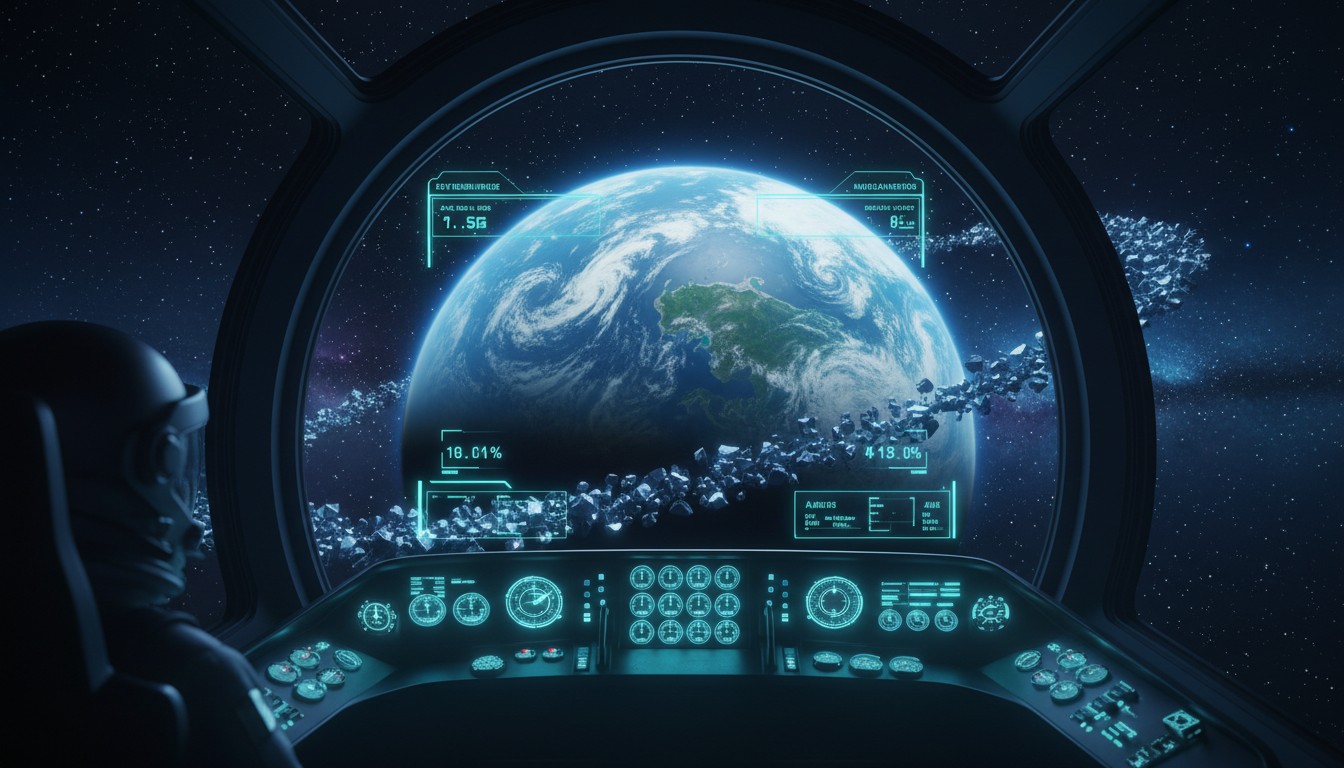
There is a moment in Kerbal Space Program when you realize your rocket is not going to make it. The center of mass shifted, the staging fired in the wrong order, and now you are watching a fuel tank tumble end-over-end toward the atmosphere while three green astronauts stare at you from their capsule windows. In flatscreen, this is hilarious. In VR, sitting inside that capsule, watching the horizon spin through a porthole the size of a dinner plate, it is something else entirely. Your stomach drops. You did this. You are inside the thing you broke.
KerbalVR is a community mod that adds native VR support to Kerbal Space Program 1. It is built on the OpenVR SDK and works through SteamVR, which means any PCVR headset — Index, Vive, Rift, Windows Mixed Reality, Quest via Link — can run it. The current fork by JonnyOThan uses Unity’s native VR rendering systems, and it is actively maintained with updates as recent as early 2025. This is not a quick injection hack. It is a proper mod that rebuilds how the game renders your headspace, and the difference between this and something like VorpX is the difference between sitting in a chair and sitting in a cockpit.
The setup is not trivial. KerbalVR itself is only the beginning. To get the full experience you need companion mods: RasterPropMonitor for interactive cockpit displays, MOARdV’s Avionics Systems for deeper instrumentation, DE_IVAExtension and FreeIva for navigable interiors in parts that otherwise have none, and ALCOR if you want a proper advanced lander cockpit. Some players add kOS-Computer for in-VR guidance computer programming. You are building a mod stack, not installing a single file, and CKAN helps but does not eliminate the complexity. This is advanced-setup territory, and if the phrase “dependency resolution” makes you anxious, this mod will test you.
But the payoff is real. The Internal Vehicle View — IVA — is where KerbalVR becomes something no other space sim offers. You are not looking at a capsule from the outside. You are inside it. The gauges are right there. The windows are actual windows. When you fire a stage, the whole frame shakes and your head tracks the motion naturally. During a Mun landing, the descent rate readout is inches from your face while the surface craters slide past the viewport. In flatscreen, landing is a math problem. In VR, it is a physical act of judgment and nerve, and it is significantly harder. Depth perception changes everything. Lateral momentum is harder to read. You will crash more often, and you will feel each crash more personally.
Room-scale in the Vehicle Assembly Building and Space Plane Hangar is another standout feature. You can walk around your creation at one-to-one scale. A rocket that looks manageable on a monitor becomes genuinely imposing when you are standing underneath it. You understand the height of your landing legs in a way the flatscreen camera never conveys. It is not just cool — it changes how you design. You start building with ergonomics in mind because you are the one who will be sitting inside this thing.
Outside IVA, the experience gets rougher. The map view, the tracking station, and most of the UI are still flatscreen elements floating in space. You will take the headset off to plan interplanetary transfers, or you will squint at the maneuver node editor while your virtual helmet clips through the cockpit glass. EVA spacewalks work and can be breathtaking, but they are also disorienting and lack the grounded reference frame that makes IVA comfortable. Performance is the biggest wildcard. Kerbal Space Program was not built for VR, and physics simulation plus stereoscopic rendering hits your system hard. Frame rates vary wildly depending on part count, visual enhancement mods, and your hardware. Some players report 40–60 FPS even on reduced settings, and stuttering is common enough that SteamVR’s Legacy Reprojection Mode is a frequently recommended workaround. Crashes happen. Save often.
The comfort profile is generally manageable in IVA because the cockpit gives your brain a stable reference frame, but EVA and re-entry can be intense. There are no built-in comfort options like vignettes or snap turning because this mod does not try to be a polished commercial product. It is a labor of love by people who wanted to sit inside their rockets, and that is exactly what it delivers.
So who is this for? If you already love Kerbal Space Program, already know your way around CKAN, and own a decent gaming PC with a PCVR headset, KerbalVR is essential. It transforms the game from a brilliant simulation into something you physically inhabit. The moments it creates — a perfect docking alignment viewed from the crew cabin, a solar eclipse through the cupola window, the silent drift of EVA with nothing but your own breathing — are unmatched in VR.
If you have never played KSP, do not start here. The learning curve is already a cliff, and adding VR complexity, performance troubleshooting, and mod dependency management on top of it is a recipe for frustration. If you are looking for a polished, pick-up-and-play space experience, this is not it. But if you are the kind of person who spends three hours getting a single-stage-to-orbit design right and wants to sit inside it while it works, KerbalVR is the only option that matters.