
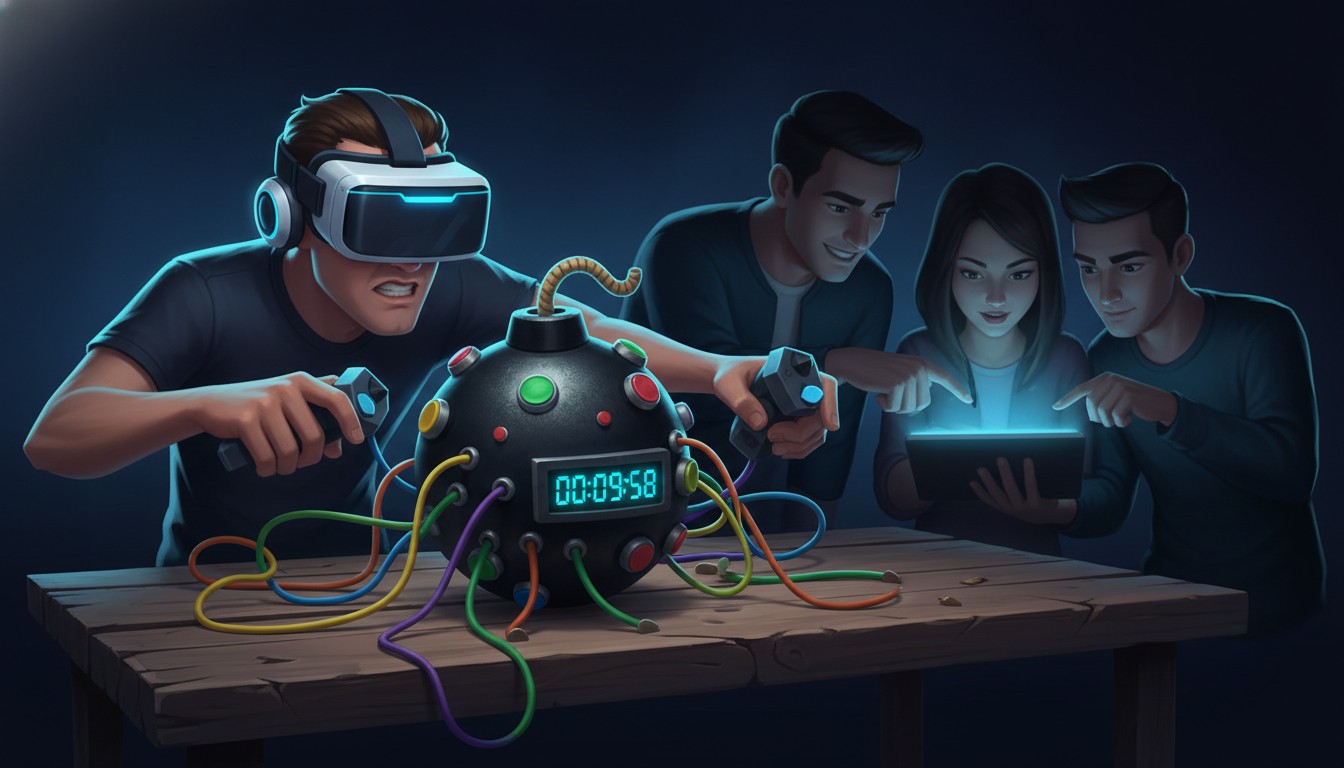
The first time you cut the wrong wire and your friend shouts “NO, THE RED ONE” while the timer hits zero, you understand exactly what this game is.
Keep Talking and Nobody Explodes is an asymmetric bomb-defusal party game that was designed for VR from the start. One player straps on a headset and stares at a procedurally generated bomb packed with wires, buttons, keypads, and modules. Everyone else — the “experts” — cannot see the bomb. They have the manual. You have three to five minutes before everything goes wrong.
The genius is in the communication gap. The manual is free online at bombmanual.com and works on any phone, tablet, or printed page. The experts do not need the game, a headset, or even to be in the same room. Voice chat works perfectly fine. This is VR’s most effective social party game not because of avatars or hand-tracking gimmicks, but because it forces actual human conversation under genuine pressure.
The VR Reality
The VR player is stationary — seated or standing at a table with the bomb directly in front of them. No locomotion, no smooth turning, no artificial movement whatsoever. You reach out with motion controllers to flip switches, cut wires, press buttons, and twist knobs. On Quest, the inside-out tracking handles this cleanly. On PCVR through SteamVR, the interaction is similarly straightforward. The game also supports gamepad input as a fallback, though motion controllers feel natural for manipulating the bomb’s physical modules.
This is one of the most comfortable VR experiences you can buy. There is zero motion sickness risk, no comfort settings to tweak, no “VR legs” required. You could put a complete newcomer in the headset, hand them the controllers, and they are defusing bombs inside two minutes. The static nature of the experience also means performance is rock solid across every platform it runs on.
Setup is essentially nonexistent. Buy it, launch it, hand someone the manual. There are no dependencies, no mod managers, no config files, no troubleshooting. On Quest, it is a native standalone title. On PCVR, it is a standard Steam purchase with built-in VR support. This is the lowest-friction VR party game you can find.
How It Actually Plays
The tension builds in a very specific way. The timer ticks down. Your friend reads from the manual about complicated wire sequences and memory modules while you describe what you are looking at. They ask questions you cannot answer precisely enough. You cut a wire while they are still talking. The alarm sounds. Everyone swears.
It is genuinely funny, which matters. Most VR party games lean on motion-controlled minigames or shallow gimmicks. This one leans on your inability to describe a symbol correctly under pressure. The comedy is emergent, not scripted. The manual is dense enough that even experienced players still fumble explanations when the clock is running down.
Replayability is the game’s other major strength. The manual covers dozens of module types, and each bomb pulls from them randomly. You might see a simple set of wires on one bomb and a nightmare combination of complex modules on the next. Expert players can enable harder modules, add more modules per bomb, or tighten the time limit to scale the challenge. Even after you have memorized the manual, the communication dynamic keeps it fresh because every player describes things differently and panics at different speeds.
What to Know Before You Buy
You need friends. Not “friends you sometimes message online” — you need at least one other person willing to read a manual and talk out loud. Solo play does not exist. There is no single-player mode, no AI partner, no training beyond the tutorial. This is not a game for someone who primarily games alone.
It is also not available on PSVR2, though that’s less surprising for a game originally released in 2015.
The visuals are deliberately simple: a bomb on a table in a bare room. This is functional, not beautiful. You are not here for visual spectacle, environmental storytelling, or atmospheric immersion. The art serves the gameplay, and that is all it needs to do. It will not impress anyone who judges VR by graphical fidelity.
Finally, while the game is “complete” in the sense that all promised content is there and functional, it has not seen meaningful updates in years. Steel Crate Games has moved on to other projects. The existing modules and manual are robust enough that this does not feel like abandonment, but do not expect new bomb types, modules, or quality-of-life patches.
Who Should Play This
If you regularly have people over and own a VR headset, this is borderline essential. It is the game that justifies the headset to skeptical friends. It is the one that gets non-gamers involved. It is the title you pull out at gatherings because it requires no setup explanation — hand someone the manual, put the headset on, and the game teaches itself through spectacular failure.
The asymmetric design means only one person needs to own the game and the headset. Everyone else plays free with the manual. For the cost of a single VR purchase, you get a party game that scales to as many people as you can fit in the room or the voice channel.
If you primarily play VR solo, skip it. There is nothing here for you. It is a library hole with your name on it that you should walk right past.
This is one of the best-designed social VR experiences on any platform. The VR implementation is not an afterthought — it is the core design. For group VR sessions, it is an easy, enthusiastic recommendation. Within its niche, it is nearly flawless.