
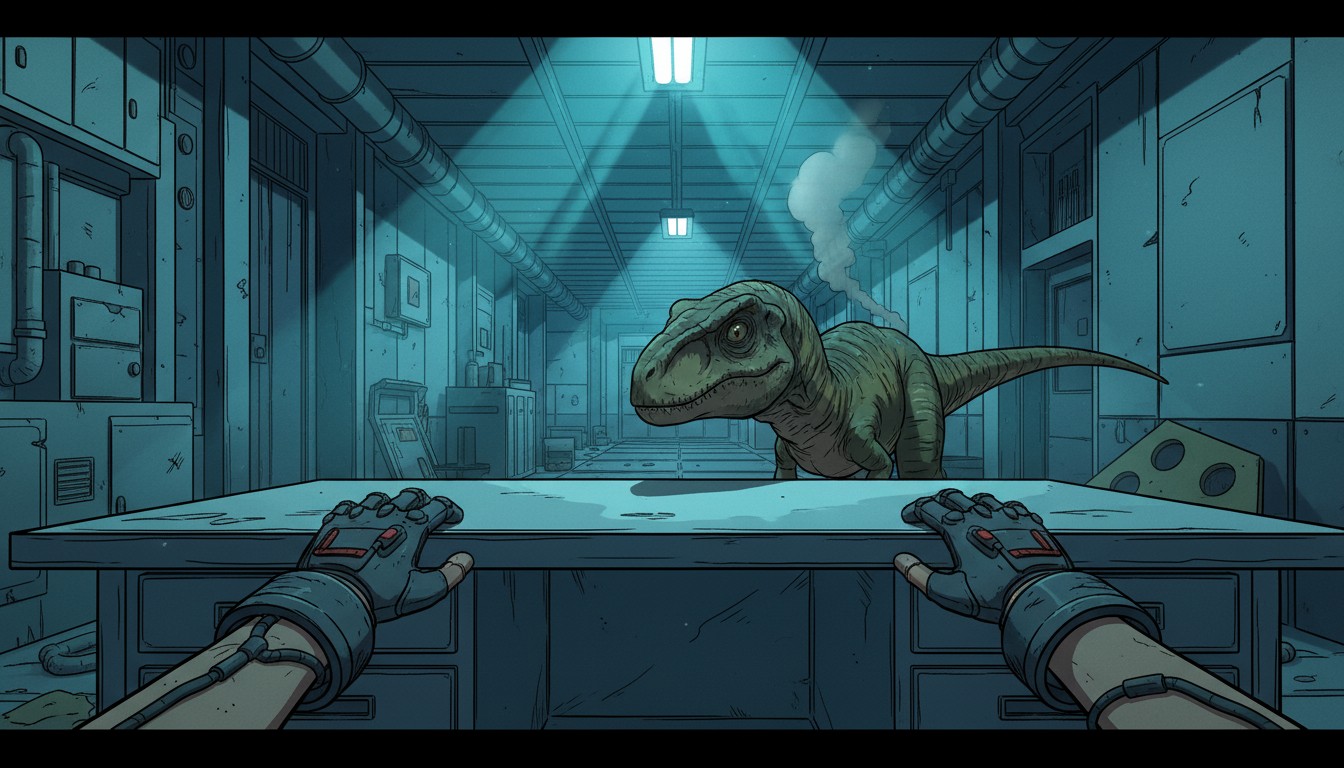
The first time a velociraptor stopped inches from my face and sniffed, I didn’t move. Not because the game told me to freeze — because my actual body locked up. My brain knew it was cel-shaded. My nervous system didn’t care.
That’s Jurassic World Aftermath in one moment. This isn’t a mod retrofitting VR into a flat-screen game. It’s a native VR stealth survival title built from the ground up by Coatsink Software, originally for Oculus Quest in 2020, and it understands something crucial: VR horror works through your ears first.
What You’re Actually Getting
This is an official standalone VR release — not a community mod, not an injection driver, not a hybrid afterthought. You buy it on Quest or PSVR2, put on the headset, and play. No BepInEx. No OpenXR wrangling. No forty-five minutes of forum archaeology before you see a dinosaur.
The setup is refreshingly brainless, which matters because the experience itself is anything but comfortable. You’re Sam, a security specialist who crash-lands on Isla Nublar and gets trapped in a research facility full of velociraptors that hunt by sound. The game uses full motion controls for hiding, climbing, throwing distractions, and — when everything goes wrong — dying instantly. There’s no health bar. Detection means a three-second animation of teeth and game over.
The Cel-Shaded Choice
The art style stops some people cold. This is a comic-book-looking Jurassic Park game, all bold outlines and stylized environments rather than the photorealistic jungle you’d expect. It was a practical decision — cel-shading lets the Quest 2 render larger spaces and more dynamic encounters without choking — but it pays off experientially too.
The style creates just enough abstraction that your brain fills in the gaps. The raptors aren’t “real” but they’re present, and the reduced visual fidelity somehow makes the audio work harder. When you hear claws on tile somewhere behind you, the uncertainty of not being able to see perfectly becomes the point. The game uses positional audio so aggressively that you’ll find yourself physically rotating to track sounds, which is both immersive and strategically necessary.
That said, the look isn’t for everyone. If you want photorealistic dinosaur encounters, this isn’t it. The environments can feel geometrically basic, especially in the PSVR2 version where the 4K resolution and improved lighting make the cel-shaded simplicity more apparent, not less.
How It Actually Plays
The core loop is hide-and-seek against velociraptors. You crouch behind cover, wait for patrol patterns, use boomboxes and loudspeakers to create distractions, and slip past when the timing lines up. The game gives you clear feedback — a blue tint when you’re successfully hidden — but the tension comes from what you can’t control. Raptors investigate noises. They stop and listen. Sometimes they just… stand there, sniffing, while you hold your breath in real life.
The mechanics work well in VR because they’re simple. Grab a locker door. Pull yourself into a desk cavity. Toss a can to draw attention. There’s no complex inventory or crafting system to fight with. The VR interactions feel physical and immediate in a way that flat-screen stealth can’t replicate.
But the loop gets repetitive. You’re evading the same enemy type through similar facility corridors for hours. Part 2 (released as DLC in 2021 and bundled in the Collection) mixes things up with a T-Rex sequence and some Pteranodon encounters, but the bulk of your time is velociraptor hide-and-seek. If that particular tension doesn’t hook you in the first hour, the remaining five won’t change your mind.
Comfort and Performance
Here’s where the caveats get specific. The game runs flawlessly on Quest 2 — genuinely impressive for a standalone headset — and the PSVR2 Collection version hits 4K at a locked 90fps with better lighting and shadows. Performance is never the problem.
Comfort is another story. Aftermath uses smooth locomotion exclusively. No teleport. No comfort-focused movement alternatives. You can enable vignetting and choose between snap or smooth turning, but if smooth locomotion makes you queasy, this game will test you. Reports are mixed — some players prone to motion sickness find the stable framerate and seated-play option manageable, while others report discomfort even with settings maxed.
The game also demands a specific play posture. You’re meant to physically peek around corners, duck under obstacles, and occasionally rotate your body to track audio cues. It doesn’t require a massive playspace, but the “real-turning” recommendation isn’t just flavor text — snap-turning through this experience loses something essential.
Platform Reality
The biggest limitation is availability. This is a Quest/PSVR2 exclusive. No Steam release. No PCVR option. If you don’t own Meta’s ecosystem or Sony’s headset, you can’t play it, period. That’s a significant barrier for a six-to-eight-hour linear campaign with minimal replay value.
Between the two, the PSVR2 Collection is technically superior — 4K, 90fps, better lighting — but the Quest version is arguably the more impressive technical achievement, squeezing this experience into a wireless standalone headset. The haptic feedback on PSVR2 (heartbeat pulsing when stamina is low) is a nice touch but underutilized.
Who This Is For
Play Jurassic World Aftermath if you want a focused, atmospheric stealth experience that respects your time — it’s complete in one or two sessions — and you value sound design and tension over mechanical complexity. This is VR comfort food for Alien: Isolation fans who want that same hide-and-seek dynamic in a different universe.
Skip it if you need teleport locomotion, want deep systems to master, or expect photorealistic visuals. The cel-shaded look and repetitive enemy encounters are genuine dealbreakers for some players, and the platform exclusivity means many PCVR owners simply can’t access it.
The game commits to a specific experience and executes it well. It’s not revolutionary — it doesn’t need to be. It just needs to make you freeze when a dinosaur sniffs the air inches from your face. On that count, it delivers.