
Jupiter & Mars in VR: The Dolphin Sim That Swims in Shallow Waters
Here’s the thing about Jupiter & Mars: I wanted to love it. A dolphin adventure game set in a flooded post-apocalyptic Earth, developed by a studio literally named Tigertron, with proceeds going to actual ocean conservation groups? That sounds like exactly the kind of weird, earnest VR experience I would evangelize to anyone who would listen. But after digging into what this game actually delivers across its PSVR and Meta Quest releases, I have to be honest with you — and with myself. This is a game that looks beautiful in screenshots and trailers, then slowly reveals itself to be about four hours of doing the same three tasks while swimming through increasingly muddy water.
What This VR Option Actually Is
Jupiter & Mars is an official hybrid release that launched simultaneously on flat PS4 and PSVR back in April 2019, with a Meta Quest 2 “Definitive Edition” arriving in August 2022. The VR mode is exactly that — a mode. You can play the entire game flat or in VR, and switching between them is as simple as putting on or taking off the headset. The game was always marketed as a VR experience, but the technical reality is that this is fundamentally a flat adventure game with stereoscopic 3D and head-tracking support bolted on.
On PSVR, you play with a DualShock 4. On Quest, you use Touch controllers. But here’s the kicker: in both cases, you’re basically playing a gamepad game. The VR input never evolves beyond “look where you want to swim” and button presses for actions. There is no hand presence, no motion-controlled swimming, no reaching out to interact with the world. Your hands hold abstracted controllers that map to dolphin abilities. It’s functional, but it’s not transformative.
Tigertron partnered with SeaLegacy and The Ocean Foundation for the release, and you’ll find their informational videos tucked into menus and their messaging threaded through the environmental narrative. It’s not heavy-handed, which I appreciate — you’re not getting lectured, just gently reminded that the flooded ruins you’re swimming through used to be cities.
How It Plays
You control Jupiter, a dolphin with sonar abilities, while Mars — your partner — follows along and handles object interactions when you direct her. Navigation uses either button presses or head-tracking-based steering, depending on which control scheme you select in the pause menu. You cannot combine schemes. You pick one, and you live with it. On Quest, turning with the thumbstick is painfully slow, and the game strongly prefers you just look in the direction you want to go.
The sonar ability is the standout mechanic. Pinging the environment highlights objects of interest, reveals hidden paths, and temporarily lights up dark sections with a Tron-like neon outline effect. It’s genuinely satisfying the first dozen times you do it. You also get a pulse beam for dealing with jellyfish and other hazards, plus unlockable abilities that let you swim deeper or faster as you progress through the Metroidvania-style level design.
Comfort-wise, this is about as gentle as VR gets. It’s seated play. Movement is slow and underwater, which naturally suppresses the vestibular conflict that causes motion sickness. The 360-degree swimming freedom feels good — similar to flying in a relaxed flight sim — and there are no artificial locomotion snap-turns to worry about. If you’re VR-sensitive, this is one of the safer bets in your library.
Performance sits in the moderate-demand category. On PSVR, the original release suffers from the expected blur and texture downgrades that come with first-generation console VR. The Quest 2 Definitive Edition cleans up the image significantly but trades away environmental lighting, ambient effects, and texture quality to run on standalone hardware. Both versions are stable — I found no reports of crashes or game-breaking bugs — but neither version looks as good as the flat PS4 release.
What Works Well
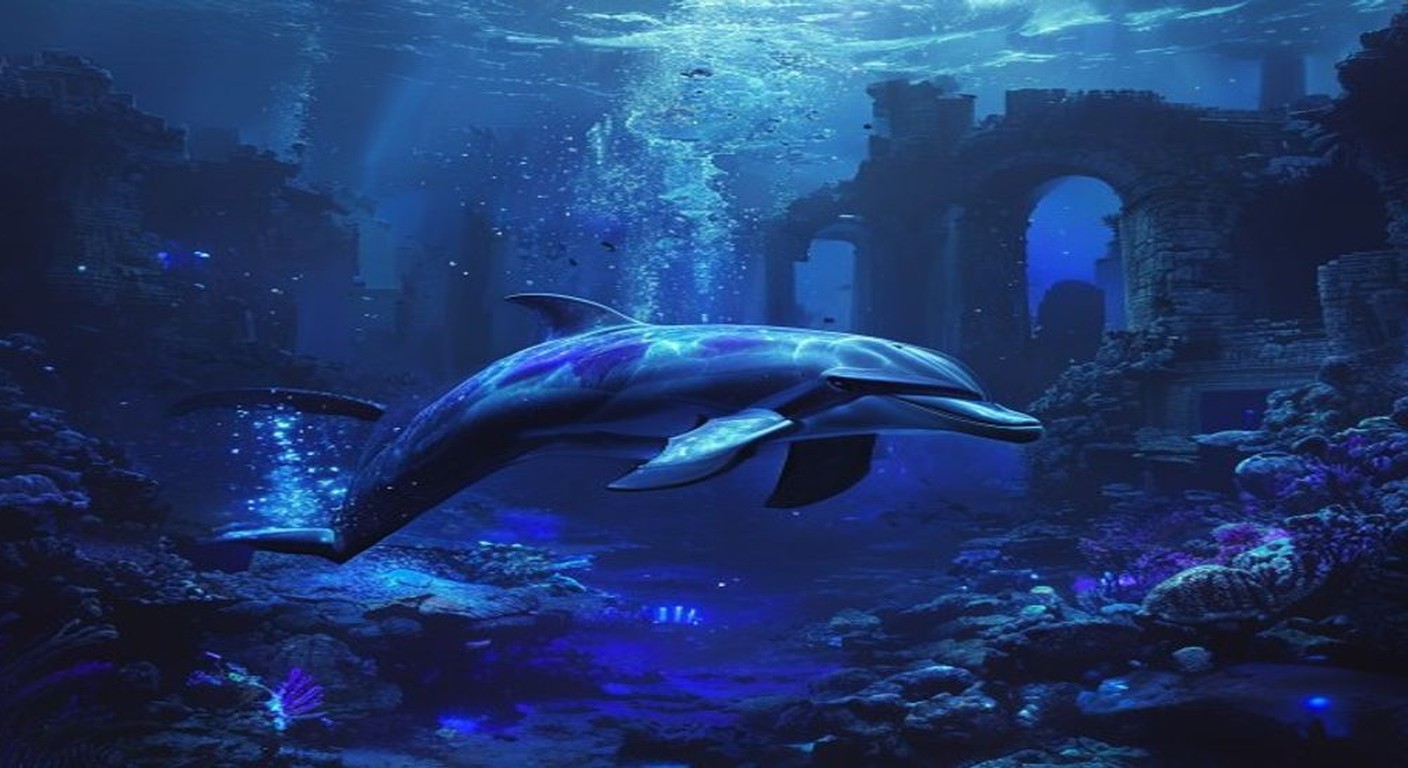
Let me give credit where it’s due: when this game looks good, it looks genuinely striking. Swimming through submerged cities — recognizable landmarks like New York and London reduced to coral-encrusted skeletons — creates moments of real atmospheric power. The skyboxes viewed from underwater are beautiful. The neon-glowing sea creatures and plant life create a visual identity that’s immediately recognizable, even if the inspiration feels borrowed from Rez and Child of Eden.
The soundtrack is the unsung hero here. Orchestral pieces mixed with ambient sci-fi tones create a National Geographic-meets-sci-fi vibe that fits the patient exploration perfectly. It does repeat if you linger in an area too long, but it never approaches the grating territory of the first area’s looping track, which one reviewer accurately compared to a “cheesy Coachella trailer.”
The eco-message is handled with a light touch. Freeing sea creatures trapped in plastic debris, deactivating machines that harm wildlife — it’s present without being preachy. The game wants you to care about the ocean, and it earns that ask through atmosphere rather than lectures.
What Doesn’t Work
Okay, so here’s where I have to be the bearer of bad news. The core gameplay loop is: find a machine, avoid its detection, locate and destroy its power source, move to the next area. That’s it. That’s the game. One reviewer called it “the same strategy every time,” and they weren’t exaggerating. After the second level, the novelty wears off and you’re left with a repetitive checklist of objectives that never evolve in meaningful ways.
The visual fidelity is inconsistent at best. Surface textures get muddy fast, especially when you swim up to inspect them. One reviewer noted mountain ranges near the surface that “would not look out of place in a Test Drive game from the 90s.” In VR, where you can put your face right up against the geometry, these shortcuts become impossible to ignore. The sonar ping effect, cool as it is, risks becoming “detective vision fatigue” — you spend so much of the game looking at neon wireframe outlines that you forget what the actual art looks like underneath.
The controls are a persistent low-grade frustration. On PSVR, the inability to use analog sticks and head tracking simultaneously feels like a subtraction that never needed to happen. On Quest, the slow thumbstick turning makes large open areas confusing to navigate. The game wants you to look where you’re going, which works fine until you need to make a precise maneuver near a hazard and find yourself wrestling with the camera.
Progression relies on Metroidvania-style ability gating — you’ll see areas you can’t access until you unlock a new power, then backtrack through previously visited levels to collect hidden items. If you enjoy that design philosophy, it extends the playtime meaningfully. If you don’t, you can mainline the story in about four hours and be done with it.
Platform Differences
If you have a choice between platforms, the decision comes down to what you value more. The PSVR version on a PS4 Pro delivers better environmental lighting, richer ambient effects, and more natural-looking textures. The tradeoff is blur — that first-generation headset’s resolution downgrade hits hard in a game where reading distant details matters.
The Quest 2 Definitive Edition sharpens the image considerably and adds quality-of-life improvements: better objective navigation via echolocation, speed-boosting currents in some areas, and a handful of new sea creatures. But the standalone hardware demands come at a cost. The VR Grid’s comparison found that the Quest version loses enough visual atmosphere that they preferred the PSVR version despite its resolution handicap — the missing lighting and effects undercut the environmental storytelling that makes the game work.
There is no PCVR version. If you want to play this on a high-end PC headset, you’re out of luck unless you want to try streaming the Quest version, which won’t fix the reduced visual quality.
Who This Is For
Good for: Players who want a low-stress, low-intensity VR experience. If you’re new to VR and worried about motion sickness, this is a gentle entry point. Fans of slow-paced exploration games like Abzû will find familiar DNA here, though Jupiter & Mars never reaches that game’s artistic coherence. Environmental advocates who want their gaming dollars to support ocean conservation will appreciate the SeaLegacy and Ocean Foundation partnerships.
Not for: Anyone seeking dynamic gameplay, challenging puzzles, or a VR-native control scheme. If you’re expecting Ecco the Dolphin’s complexity or Abzû’s emotional arc, you’ll leave disappointed. The game is also too slow and repetitive for players who need regular stimulation — one reviewer dryly noted it commits “one of entertainment’s biggest sins in just being rather dull.”
The Verdict
Tier: C
Game Quality: C The core experience is functional and occasionally beautiful, but the repetitive mission structure, inconsistent visual fidelity, and shallow gameplay systems prevent it from rising above mediocrity. It’s not broken, it’s just boring after the first couple of hours.
VR Implementation Quality: C The official VR support works — stereoscopic 3D is present, head tracking steers your dolphin, and it’s fully playable seated. But there is no hand presence, no motion-controlled interaction, and no design choices that leverage VR as a medium. You’re playing a flat game inside a headset, and in some ways the visual compromises make it worse than the non-VR version.
Overall Tier: C Jupiter & Mars is the definition of a C-tier VR experience: perfectly playable, visually interesting in moments, morally earnest, and fundamentally forgettable. If you find it on sale and you’re in the mood for something slow and pretty, it’ll fill an afternoon. But if you’re choosing between this and virtually any other underwater or exploration-focused VR title, there are better ways to spend your time and your money.
One-line takeaway: A dolphin sim with its heart in the right place and its gameplay stuck in a loop.