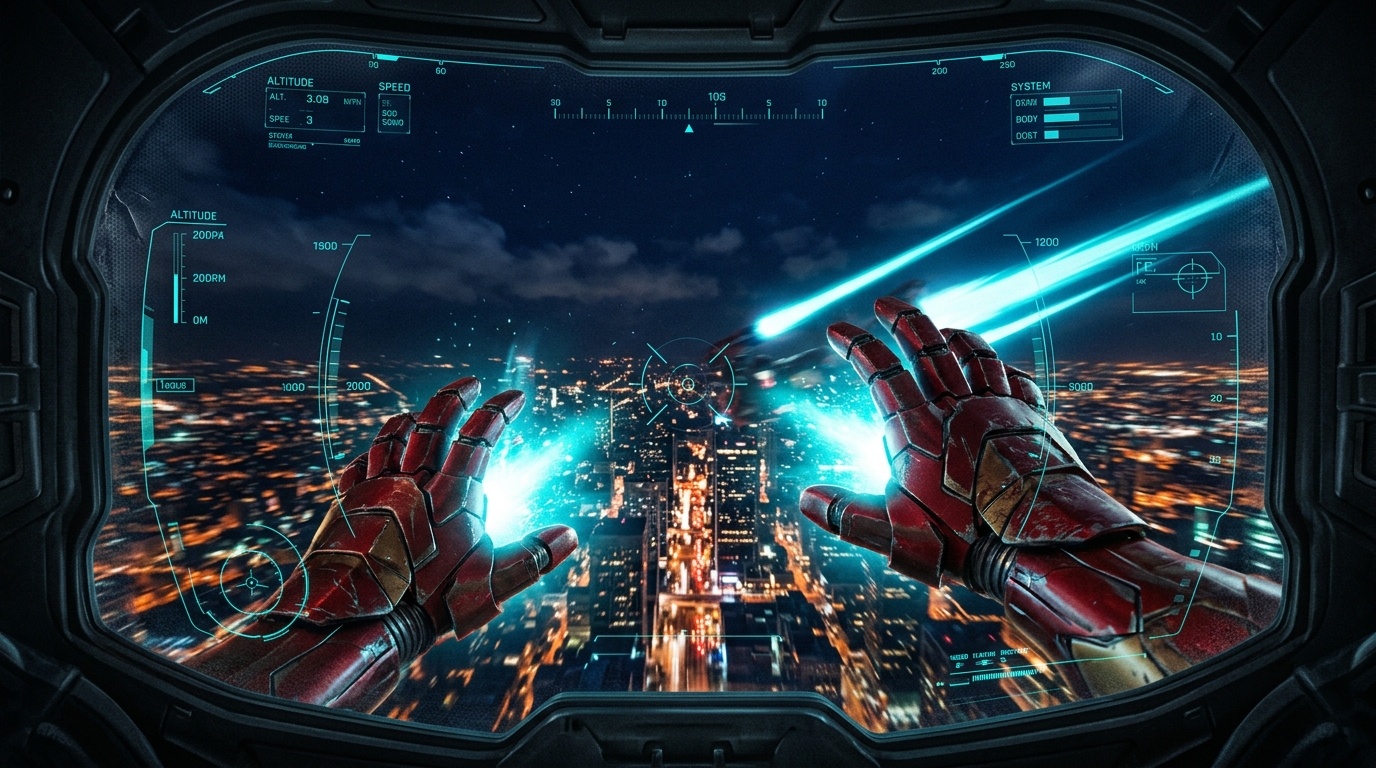
The first time you raise your palms, trigger the repulsors, and feel the virtual thrust push you backward as your body shoots skyward, something clicks. This isn’t a cutscene. You are steering the armor with your own hands, tilting your wrists to bank around Stark Tower, thumbing the boost to blast through a canyon of drones. For about fifteen seconds, Marvel’s Iron Man VR delivers exactly what the premise promises: you are Iron Man, and the suit obeys your body.
That moment is the foundation everything else is built on. Developer Camouflaj — later acquired by Meta — didn’t port a flat game into VR. They built a native VR action campaign from scratch, designed around two motion controllers becoming repulsor thrusters and weapons. The result is one of the few full-length VR games that actually justifies its runtime rather than feeling like an extended tech demo.
What This Actually Is
Iron Man VR is a first-person aerial shooter with a roughly eight-to-ten-hour campaign split across twelve chapters and a prologue. You play as Tony Stark during an original story that pits him against Ghost, a hacker-terrorist seeking revenge for deaths caused by old Stark Industries weapons. Pepper Potts, Nick Fury, and Tony’s AI companions FRIDAY and Gunsmith round out a voice cast that takes the material seriously enough to sell it.
Between missions, Tony’s garage serves as a hub where you can upgrade armor systems, swap out auxiliary weapons like missiles and explosive charges, and launch optional challenge missions. The game also includes flight trials and combat challenges that extend playtime beyond the campaign.
This launched on PSVR in July 2020, then received a substantially reworked Quest version in November 2022. The two versions are the same game in structure, but they are not the same experience in practice. On PSVR, you’re wired to a PlayStation 4, using aging Move controllers with limited tracking and dealing with load times that break momentum. On Quest, you’re wireless, the tracking is modern, the loading is faster, and the whole thing breathes better.
The Flight, and Why It Works
The core mechanic is flight controlled by your hands. Your left palm controls the left thruster, your right palm the right. Point them backward to accelerate forward. Tilt them to turn. Pull one back and push one forward to spin. Hit the grip buttons for a boost dodge. The mapping is physical and intuitive in a way that keyboard or gamepad input simply cannot replicate.
What makes this tolerable for a VR flying game is the Iron Man helmet itself. The heads-up display acts as a natural grounding frame — a cockpit-like reference point that stabilizes your inner ear against the speed. Camouflaj also included standard comfort options: snap or smooth turning, adjustable vignettes, and teleportation alternatives for ground movement. Reviews consistently note that even players typically sensitive to motion sickness found the flight manageable, which is remarkable for a game built around high-speed aerial combat.
The sensation of verticality is strong. Most levels give you plenty of ceiling to climb, and boosting upward through clouds while drones scatter below you captures a specific superhero fantasy that flat games cannot touch. It is the single best reason to play this game.
Where the Armor Cracks
The flight is excellent. The combat is merely okay, and “merely okay” gets tired over eight hours.
Most enemy encounters involve fighting waves of combat drones. You have repulsor blasts from your palms, rocket punches for melee range, a ground pound, and unlockable auxiliary weapons. The controls feel good — aiming with your actual hands is satisfying — but the enemy variety and encounter design don’t evolve enough to justify the campaign length. You fight a lot of similar drones in similar configurations. Boss encounters against larger mechs break up the rhythm, but they’re exceptions, not the rule.
The story is competent without being memorable. Ghost makes for a thematically appropriate villain — Stark’s past sins coming back as repurposed weapons — but the narrative beats follow familiar Marvel beats. The voice acting is solid, the writing is professional, and the character interactions in the garage between missions add flavor. It’s enough to keep you moving through the campaign, but not enough to stick with you afterward.
Some level design also undercuts the freedom. Despite the strong sense of verticality in most areas, certain sections enforce low flight ceilings or tight corridors that clash with the power fantasy. Hitting an invisible ceiling while boosting upward breaks the spell.
Platform Reality
If you have a choice, play the Quest version. The wireless freedom matters enormously for a game about 360-degree aerial combat. On PSVR, the cable is a literal tether that works against everything the game wants you to do. The Move controllers also show their age — the tracking loses precision during fast movements in a way that Quest’s inside-out tracking does not.
The Quest port also benefits from faster loading times, sharper visuals in key areas like the Shanghai level, and tighter overall responsiveness. Camouflaj used the two-year gap to refine the experience based on feedback. This is not a lazy port — it’s the version they always wanted to ship.
That said, the PSVR version is still playable. If it’s your only headset, the core experience remains intact. You will just feel the hardware limitations more acutely.
The Bottom Line
Marvel’s Iron Man VR succeeds at the hardest part: making you feel like the character. The flight mechanics are genuinely excellent, the campaign is substantial by VR standards, and the production values are professional throughout. Its weaknesses — repetitive combat, occasional design constraints, and a story that plays it safe — keep it from being essential. But for anyone who has looked at an Iron Man suit and wondered what it would feel like to lift off, this is the closest VR has come to answering that question. The Quest version is the definitive way to play. If you are highly sensitive to motion sickness, proceed with caution despite the comfort options — at the end of the day, this is still a game about flying very fast while shooting things.