
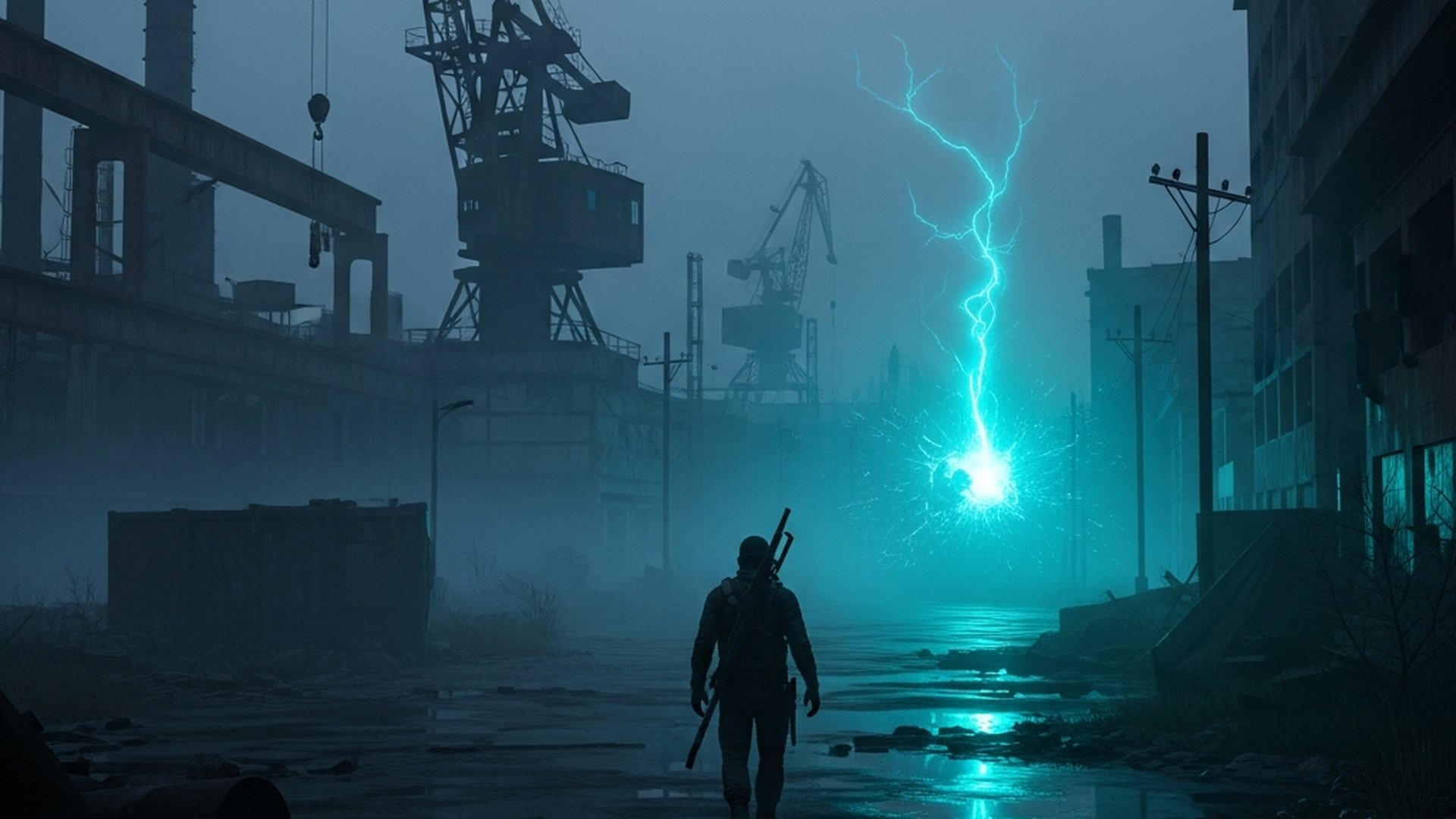
Into the Radius VR
The Pitch
Into the Radius is what happens when someone looks at STALKER and thinks “this should be in VR, properly.” It is not a half-measure adaptation or a tech demo stretched into a game. It is a complete, deliberate survival shooter built from the ground up for virtual reality — and it shows in every interaction.
You play as a scavenger in the Pechorsk Zone, an anomaly-filled exclusion zone where reality has started to fray. You explore, you loot, you survive, you die, you try again. The loop is familiar if you know extraction shooters or survival games, but VR transforms the entire rhythm. Reloading is manual. Gun jams need clearing. Artifacts require careful extraction from unstable anomalies. Every action has weight.
Why It Works
Gun Handling That Actually Matters
Most VR shooters treat gun handling as a novelty. Into the Radius treats it as core gameplay. Magazine insertion requires alignment. Chamber checks are real actions. When a gun jams — and they do — you need to rack the slide or tap-rack-bang your way through it. This is not cosmetic. It forces decisions: do you take the time to reload properly, or do you risk a partial mag in a bad situation?
The arsenal spans Soviet-era hardware — Makarovs, AK variants, shotguns, bolt-action rifles. Each weapon has distinct handling characteristics and durability. Yes, durability. Guns degrade. Dirty weapons jam more. Cleaning kits are consumables you actually use. If you have ever wanted to maintain your virtual AK after a hard day in the Zone, this is your game.
Survival Mechanics With Teeth
This is not a token “eat food occasionally” survival layer. Into the Radius demands resource management across multiple systems:
- Ammo and magazines — You track what you have, in what mags, and loaded condition
- Weapon durability — Guns degrade, need cleaning, and perform worse when neglected
- Health and trauma — Damage is localized, medkits have weight, and bleeding kills
- Stamina and fatigue — Running everywhere is not sustainable
- Artifacts and anomalies — Extraction requires planning and equipment
The result is a game where a good run feels earned, not given. Death loses resources and progress. Extraction is relief, not a given.
Atmosphere Without Jump Scares
Into the Radius understands that tension is more effective than shock. The Zone is quiet — too quiet — until it is not. Anomalies hum and crackle. Distant sounds echo without clear source. The fog reduces visibility to meters, then clears to reveal open ground you do not want to cross.
This is not a horror game in the traditional sense. There are no scripted monster closets. But the atmosphere creates dread through absence and possibility. Sound design does heavy lifting — you hear things before you see them, and sometimes you never see them at all.
Platform Differences
PCVR (Steam, Rift, Index, Vive)
The PCVR version is the reference implementation. Visuals are crisp, lighting is atmospheric, draw distances show the full Zone scale. Index controllers get specific attention for finger tracking, and all major PCVR headsets are well-supported.
Performance is solid on mid-range hardware, though the Zone’s density can stress older systems. Loading times are reasonable, and the game handles room-scale and seated play equally well.
Quest 2 Standalone
The Quest port is impressive — not “impressive for standalone,” actually impressive. The developers pared back visuals without breaking the core experience. Lighting and fog remain effective. Gun handling is intact. The loop works.
Compromises are visible if you look: lower resolution textures, reduced draw distance, simplified particle effects. The atmosphere survives, but the “wait, that is far away” moments of the PCVR version are absent. If your only option is Quest, you are not getting a lesser game — you are getting the same game with visual budget cuts.
Cross-save is not available between platforms. Progress does not transfer.
Comfort and Accessibility
Into the Radius uses smooth locomotion by default, which is non-negotiable for the intended experience. Comfort options exist:
- Snap turn vs smooth turn
- Teleportation available (though it changes game balance)
- Vignette intensity adjustment
- Height adjustment for seated play
- One-handed mode for accessibility
The game can be played seated, and aiming down sights works well from a chair. Standing with full roomscale provides the intended immersion, but seated play is fully viable.
Tolerances for motion sickness matter here. The Zone requires walking — sometimes long distances across open ground. If smooth locomotion causes issues, teleport exists but changes the rhythm substantially. This is not a game to push through comfort barriers; it rewards the patient.
Who Is This For
For:
- STALKER fans mourning the absence of VR adaptation
- Players who want meaningful gun handling, not cosmetic reloading
- Survival enthusiasts who like resource tension
- Anyone who wants a complete, finished VR game with post-launch support
Not for:
- Players seeking fast-paced action gameplay
- Those bothered by slower exploration pacing
- Anyone wanting casual comfort — this is not “beat saber but guns”
- Multiplayer-centric players — this is single-player only
Skill Requirements
The skill ceiling is substantial, but the floor is accessible. New players can learn gun handling through a tutorial zone and low-danger areas. The game does not front-load difficulty, but it does demand attention:
- Gun handling — Learnable, satisfying, punishing if rushed
- Resource planning — Requires some strategy, trial and error teaches well
- Navigation — No in-game map; players learn landmarks or use external guides
- Combat — Enemies can be lethal, but positioning and patience matter more than twitch aim
Hardcore is possible but not required. The difficulty curve is fair. Death stings, but usually feels earned rather than cheap.
Community Consensus
The VR community rates Into the Radius highly. It appears regularly in “best VR games” discussions, often alongside titans like Half-Life: Alyx and Beat Saber. The praise centers on cohesion: the gun handling, survival mechanics, and atmosphere all serve each other. Nothing feels tacked on.
Steam reviews are “Very Positive” (over 90% across thousands of reviews). Quest store ratings are similarly strong. Common threads in community discussion:
- “The most immersive gun handling in VR”
- “STALKER VR we never got”
- “One of the few VR games that feels complete”
- “Takes patience, but rewards it”
Criticism centers on: navigation (no map, easy to get lost), slow pacing (some find it too patient), and difficulty spikes in later zones. These are features for some players, bugs for others.
Technical Notes
- Save system — Permadeath per expedition, but safe zones allow progress checkpoints
- Loot persistence — Items left in stashes stay, corpse recovery is possible
- Modding — Minimal community modding scene; the game is designed as-is
- Updates — Developer support has been strong, with substantial post-launch content
Verdict
Into the Radius is one of the best native VR games available. It earns high B-tier not through spectacle but through execution. Everything serves the core loop: guns feel real, survival has weight, atmosphere creates genuine tension.
The Quest version widens accessibility without breaking the experience. PCVR remains definitive if you have the hardware.
If the premise — slow-burn survival shooter with meticulous gun handling in an atmospheric exclusion zone — sounds appealing, this is essential. If it sounds tedious, it will be. The game is honest about what it offers. It does not try to convert skeptics.
Recommended without caveats for the right player. Know yourself first.
Quick Reference
| Category | Rating |
|---|---|
| Gun Handling | Exceptional |
| Survival Depth | Strong |
| Atmosphere | Excellent |
| Content | Substantial |
| Quest Port | Impressive |
| Value | High |
Overall: B-Tier (82/100)