
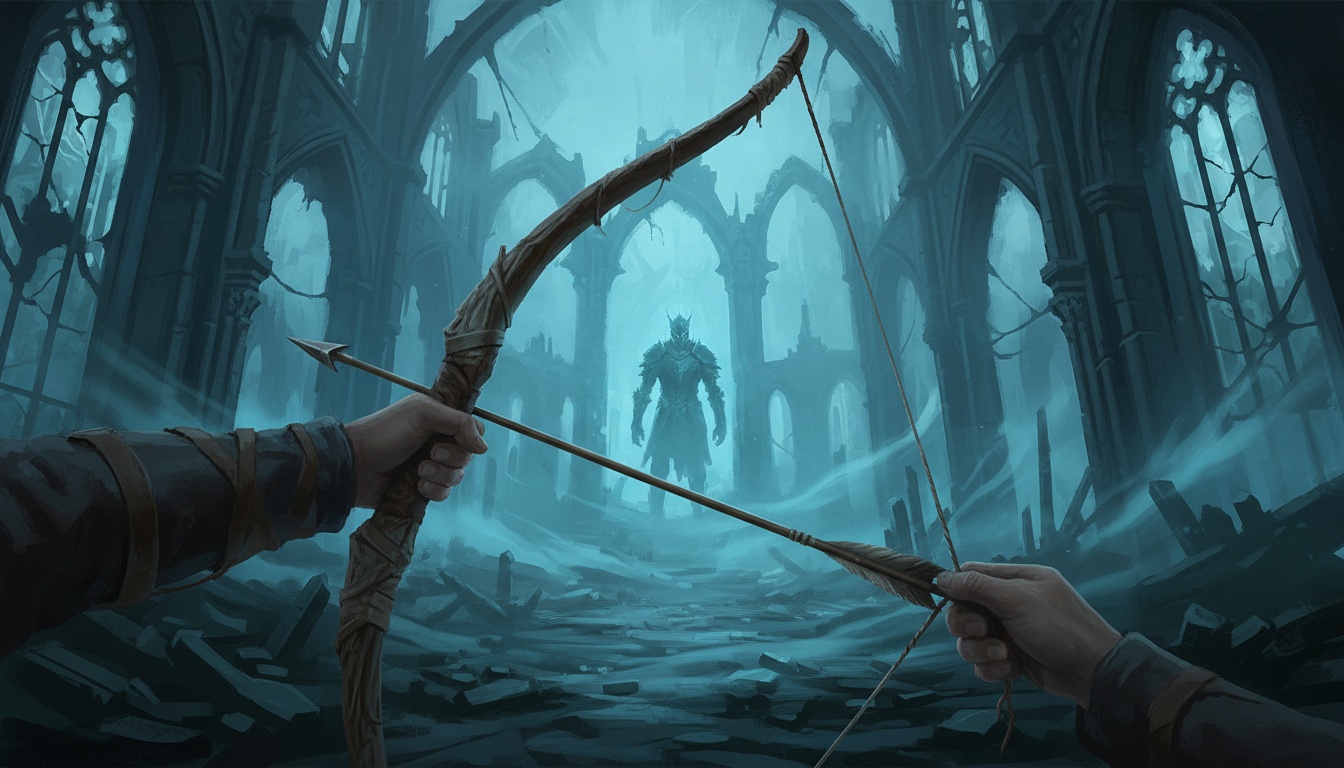
The first time you draw the bow in In Death, you realize most VR archery has been faking it.
Sólfar Studios didn’t build a game with bow combat tacked on. They built the bow first, then wrapped a roguelike around it. You reach over your shoulder, grab an arrow, notch it, pull back against real physical resistance, aim, and loose. The arrow arcs. The enemy crumples. And you immediately reach for another because the feedback loop is that clean.
This is a native PCVR release—no flat version exists, no pancake fallback to compare against. In Death is VR-only, and it wears that decision honestly. Every system here assumes you have two hands, full spatial tracking, and the patience to learn something physical.
You wake in a fractured medieval purgatory, tasked by a distant, judgmental presence to purge the unquiet dead. The structure is pure roguelike: procedurally generated levels, permadeath, persistent unlocks that slowly expand your toolkit. Each run sends you through cathedral courtyards, crumbling battlements, and fog-choked forests where angels and armored knights want you back in the ground.
The genius is that the procedural generation doesn’t feel like random noise. Sólfar clearly built smart tilesets that stitch together with architectural coherence. You learn the vocabulary of a level type—the likely choke points, the enemy spawn patterns, where the treasure shrines tend to hide—without ever memorizing a specific layout. That keeps the tension alive across dozens of runs.
Combat lives and dies by the bow, and here it thrives. The bow physics are tuned with the kind of patience that only comes when a studio knows this is the entire game. Draw weight feels consistent. Aim drift is minimal. The arrow trajectory has enough arc to demand skill without becoming unpredictable. Special arrow types—fire, explosive, teleporting—add tactical variety without cluttering the elegant core. You can also wield a shield in your off-hand, which blocks projectiles and creates a satisfying rhythm of shoot-block-reposition.
Enemy variety is where the game shows its budget. You get archers, knights, shield-bearers, floating cherubs, and a few larger threats. It’s enough to force different approaches, but after a few hours you’ll have seen the full bestiary. The procedural levels stretch further than the enemy roster does.
Progression between runs is handled through a shrine system. Gold dropped by enemies can be spent at altars to unlock permanent upgrades—more health, extra arrows, better shields, new arrow types. It’s a sensible roguelike concession that gives failed runs meaning without undermining the permadeath tension. You never feel safe, but you do feel slightly better equipped each time.
Comfort is worth flagging. In Death uses smooth locomotion with no teleport option, and you’ll snap-turn or physically turn constantly during combat. The pace is deliberate rather than frantic—this isn’t a sprint through corridors—but archery duels in VR demand head movement and spatial awareness that can tax newer users. Experienced VR players will find it moderate and well-handled; newcomers should expect an adjustment period.
Performance on PCVR is solid across mid-range hardware. The art style is painterly and stylized rather than photoreal, which keeps frame rates stable and lets the medieval aesthetic read clearly even in headset. It’s the right call: detailed realism would have demanded more GPU and added little to a game this focused on mechanical purity.
The “one more run” pull is real. A good run in In Death lasts twenty to forty minutes, ending with a death that always feels like your fault—a mistimed shot, a greedy push into unknown territory, an arrow wasted on a distant target while a knight closed the gap. You always know what killed you. You always think you can fix it next time. That is the roguelike contract, signed in VR space with a bow in your hands.
What In Death isn’t: a narrative epic, a multiplayer destination, or a game with endless mechanical depth. The setting is atmospheric but thinly sketched. The voiceovers are moody and forgettable. Once you’ve unlocked the full shrine tree, the long-term motivation comes from leaderboard chasing and personal mastery rather than new systems to uncover.
But within its narrow focus, In Death succeeds completely. This is what happens when a studio builds a VR game instead of porting a flat one—when every design decision asks “does this work better because you’re wearing a headset?” The answer here is yes, consistently, starting with that first bow draw and continuing through every run that follows.
If you own a VR headset and have any patience for roguelikes, this is among the most mechanically satisfying native VR titles available. If archery has ever sounded appealing in virtual space, this is the current standard. And if you’re waiting for a game that justifies the hardware without making you troubleshoot configs, install mods, or accept compromises—In Death is already here.