
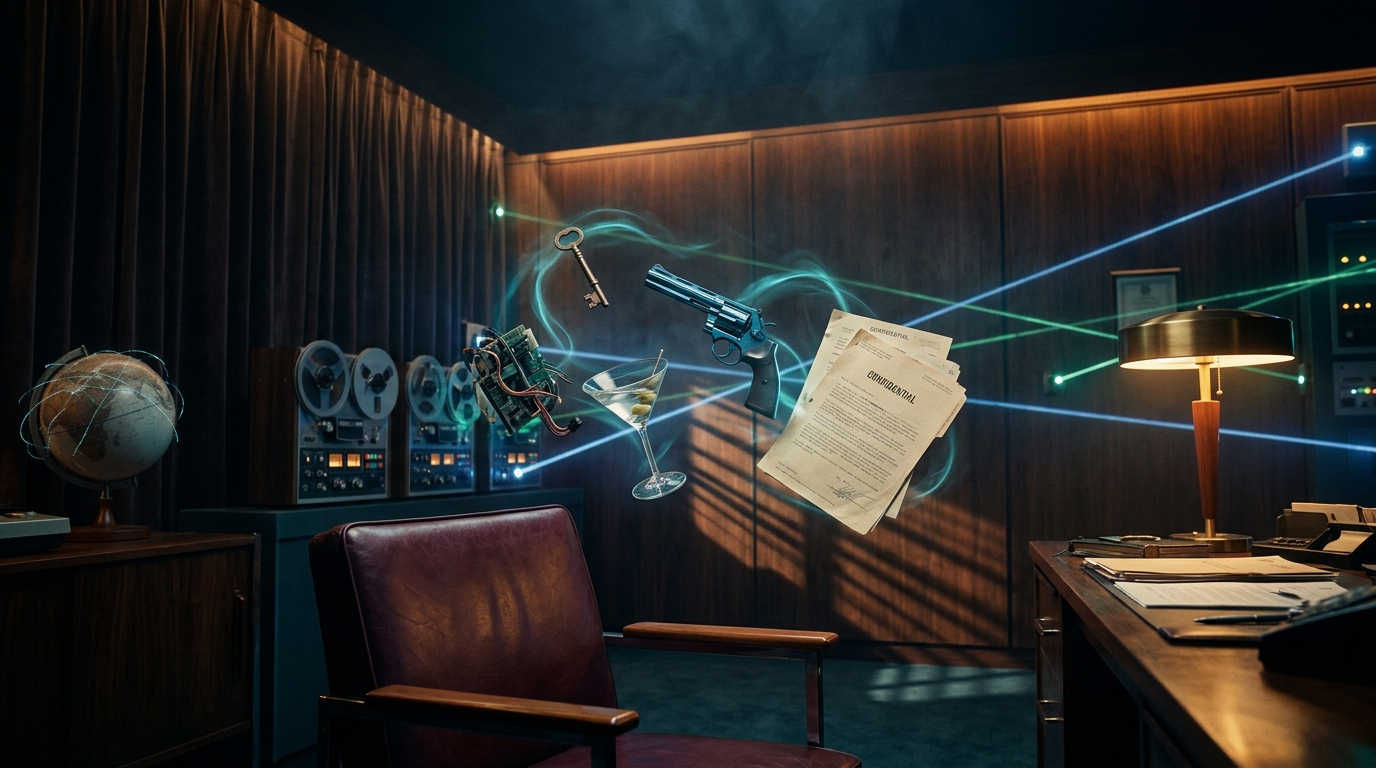
The first time a poison gas canister hisses open three feet from your face, you reach for it. Your real hands flail. Your virtual hands stay planted on the armrests of a leather chair, because in I Expect You to Die, you are a seated secret agent with telekinetic powers, and reaching across the room is exactly what your mind is supposed to do.
This is a spy thriller built from the ground up for VR headsets, and it knows exactly what seated virtual reality can do that standing or room-scale cannot. You are trapped in a series of deadly, self-contained scenarios — a booby-trapped car, a sabotaged airplane, an underwater laboratory — and your only tools are your wits and the ability to grab, rotate, and manipulate objects without standing up. Developer Schell Games designed every puzzle around this constraint, and the result is one of the most confident, comfortable, and cleverly authored experiences in the VR catalog.
Each mission is essentially a high-production escape room compressed into fifteen to thirty minutes of concentrated problem-solving. The fiction casts you as a globe-trotting agent opposing the villainous Dr. Zor, but the real story is the object in front of you: the key that does not fit the lock you expected, the laser that triggers when you pull the wrong lever, the manual you should have read before pressing the red button. Death is frequent, intentional, and usually educational. The game title is not merely a joke — it is a design philosophy. You are expected to die, learn, and iterate.
The telekinetic interaction system is the glue that holds everything together. Rather than forcing you to physically lean or walk around your environment, you simply point at distant objects and pull them toward you with a squeeze of the trigger. Grab a screwdriver from across the room, rotate it in mid-air, align it with a distant screw head, and tighten. The physical logic is intuitive enough that newcomers pick it up within seconds, yet precise enough that complex multi-step puzzles never feel like wrestling with the controls. It is the rare VR mechanic that solves more problems than it creates.
Comfort is arguably the game’s quietest triumph. Every scenario is built for seated play with zero artificial locomotion. There is no smooth movement, no snap turning, no vestibular dissonance whatsoever. If you have ever had a friend or family member try VR for the first time and immediately feel ill, this is the title you hand them. You can play for hours without fatigue, which is fortunate, because the trial-and-error loop of some puzzles can stretch a single mission across multiple attempts.
That loop is where the game shines brightest and where it occasionally frustrates. The puzzle design is logical, fair, and internally consistent — nothing requires moon logic or brute-force guessing. But some missions introduce timed sequences or cascading failure states late in the sequence. Discovering the correct solution only to die because you triggered a hidden trap two steps earlier is part of the intended tension, yet it can feel punishing when a single mistake resets five minutes of careful progress. The game autosaves at the start of each mission, not mid-mission, so failure means starting over. For players who love the pressure, this is gasoline on the fire. For players who prefer to tinker at their own pace, it can edge toward irritation.
Production quality holds up remarkably well for a title originally released in late 2016. The art direction leans into stylized mid-century spy aesthetics — all wood paneling, brushed metal, and dramatic lighting — which ages better than photorealism. Voice acting is campy and committed, with your handler barking encouragement and Dr. Zor monologuing with theatrical glee. The audio design sells the danger: the click of a pressure plate, the whir of a laser grid, the slow filling of a cabin with water. These are not ambient decorations; they are information you need to survive.
The main criticism is length. The core campaign, including free post-launch missions, offers seven scenarios that can be cleared in a few dedicated hours. The game does add hidden collectibles and speed-run challenges to extend replayability, but the meat of the experience is solving each room once, and dedicated puzzle solvers will burn through the content quickly. At its original pricing and given its age, the value proposition depends heavily on how much you treasure quality over quantity. There is no fat here — every mission is hand-crafted — but there is not much gristle either.
Who should play this? Anyone who owns a VR headset and has not yet experienced one of the medium’s foundational puzzle games. It is an ideal introduction for VR newcomers because it teaches motion control fluency without demanding physical stamina or ironclad stomachs. Puzzle enthusiasts will find satisfying, coherent challenges with genuine eureka moments. The only audience that should think twice is players seeking a lengthy campaign or open-ended sandbox; this is a curated, linear experience, and it knows it.
Nearly a decade after its release, I Expect You to Die remains a benchmark for what seated VR can accomplish when a developer designs around the headset instead of bolting support onto an existing game. The sequels expanded the formula, but the original still stands on its own: a tight, clever, and genuinely thrilling spy caper that proves you do not need to stand up to feel like you are in the room where everything is about to explode.