
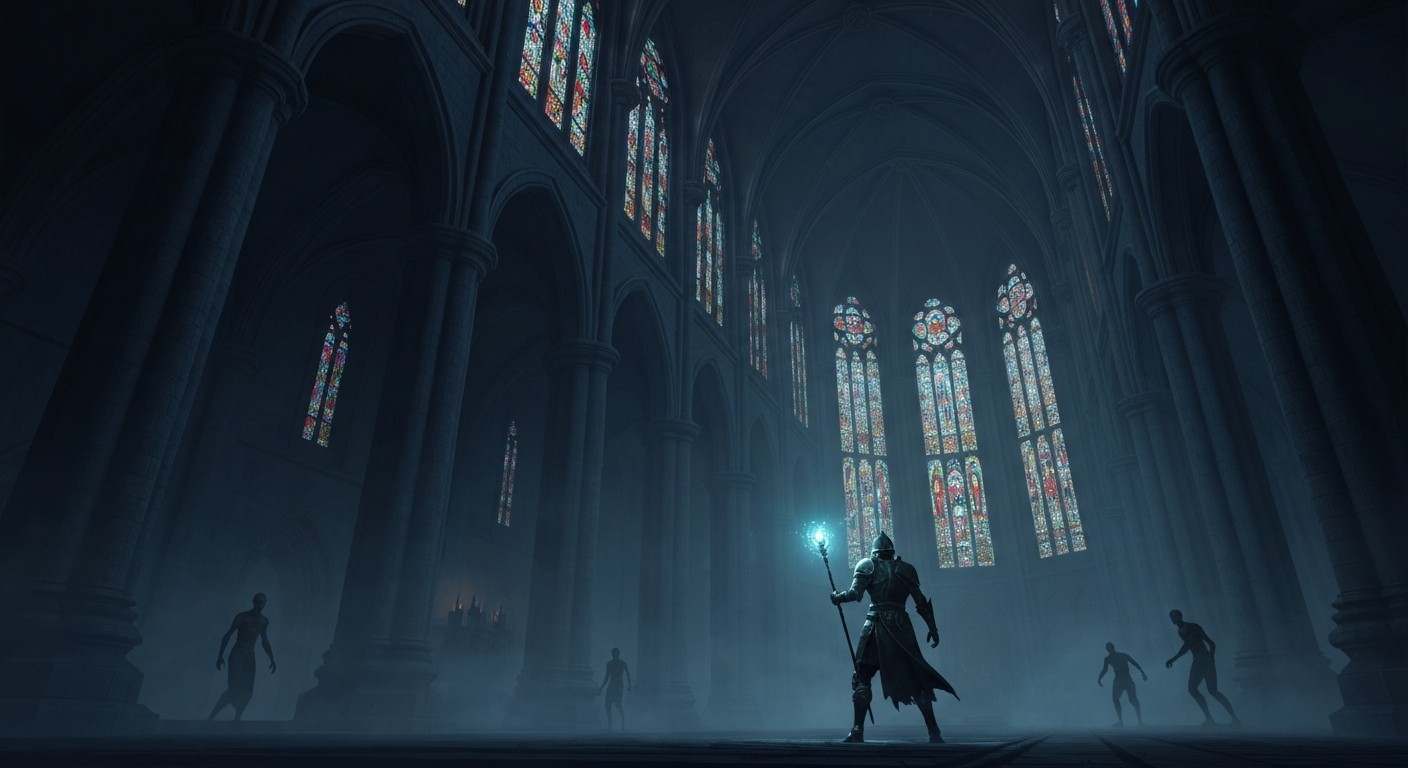
The first time you physically swing a war hammer at a weredragon in a 1997 dungeon crawler, something clicks. Not just about the game — about what VR can do with the right source material. Hexen II was built around four distinct classes, each with their own melee weapons and spell arsenals, and in VR that class identity becomes physical. The Paladin’s hammer feels heavier in your dominant hand than the Assassin’s daggers. The Crusader’s ice magic arcs from your off-hand trigger in a way the original mouse-and-keyboard setup never quite conveyed. It is the same game, but the texture of it changes completely.
What makes Hexen II unusual in the retro-VR space is that it has not one but two native community VR routes, and they serve completely different audiences.
The mature option is GZDoomVR, a PCVR fork of the GZDoom source port that has supported Hexen II for years. It runs through OpenVR, outputs proper stereoscopic 3D, and maps your motion controllers to the game’s four classes with surprising thoughtfulness. Your dominant hand becomes your weapon orientation — swing a mace, aim a spell, or point a ranged artifact. Your off-hand handles movement direction, alternate fire, and inventory management. The grip button toggles a secondary mapping layer for menu access and item use, which sounds complex but becomes natural after a few encounters. Index Controller owners even have a community binding that maps every available button, which tells you how seriously the community takes this port.
GZDoomVR also inherits the entire GZDoom mod ecosystem. You can load HD weapon packs, texture upscales, and quality-of-life tweaks alongside the base game. The laser-sight mod — already bundled — solves the classic retro-shooter problem of aiming in 3D space without a crosshair glued to your face. Performance is a non-issue; the Quake engine runs effortlessly on modern hardware, and even modest PCs hold rock-solid framerates. Comfort is equally straightforward. Hexen II is a relatively slow-paced shooter by modern standards, with deliberate melee timing and methodical exploration. There is no sprinting, no mantling, no snap-turning drama. You walk, you fight, you solve switch puzzles. It is one of the more comfortable classic shooters to adapt to VR.
Then there is the new arrival: VHexen2, an alpha standalone port for Meta Quest headsets that dropped on SideQuest recently. Built on the Hammer of Thyrion source port by a developer called alex.nax, it is the first time Hexen II has been playable natively on a standalone headset without a PC in the loop.
The ambition here is obvious and genuinely exciting. VHexen2 translates the four-class system into physical gestures — actual melee swings for the Paladin and Crusader, controller-based aiming for the Necromancer’s dark projectiles, and gaze-assisted targeting for the Assassin’s ranged options. Body inventory lets you switch weapons by reaching to virtual holsters rather than cycling through a flat UI. In theory, this is the most immersive way to play the game. In practice, it is an alpha release with all the caveats that implies.
The developers are transparent about this: save often, expect bugs, and understand that gesture recognition is still being refined. Some weapon swings do not register cleanly. The inventory system, while conceptually brilliant, can feel finicky when you are being swarmed by chaos serpents in a tight corridor. Performance on Quest 2 is acceptable but not buttery; Quest 3 handles it noticeably better. And because this is a SideQuest sideload, you need the original game files, a PC with ADB installed, and Quest Developer Mode enabled to get it running. It is not a five-minute install.
But here is the thing: even in this rough state, VHexen2 validates what fans suspected. Hexen II works in standalone VR. The hub-based levels, with their verticality and secret nooks, translate beautifully to room-scale exploration. The dark fantasy atmosphere — Raven Software’s crowning achievement with the Quake engine — gains a sense of place in a headset that flatscreen never quite matched. Standing inside the stained-glass catacombs of Thyrion, war hammer in hand, is a genuinely transportive moment.
So who should play which route?
If you have a PCVR setup and want the cleanest, most reliable experience, GZDoomVR is the obvious choice. It is stable, actively maintained, mod-compatible, and mechanically complete. You get full motion controls, excellent performance, and the backing of a mature source-port community. For anyone who has already enjoyed Doom or Heretic in GZDoomVR, Hexen II is a natural next step — slightly slower, more puzzle-oriented, but built on the same rock-solid foundation.
If you are Quest-only and willing to tolerate alpha roughness, VHexen2 is a worthwhile experiment. It is free, the core loop is functional, and the potential is undeniable. Just go in with realistic expectations: this is not a polished product yet. Save before every hub transition. Be patient with the gestures. And understand that you are essentially play-testing a work in progress.
There is a third group worth mentioning: the genuinely curious who have never played Hexen II at all. For them, the GZDoomVR route is the better entry point. The game itself is a product of its era — labyrinthine hub layouts, obtuse switch puzzles, and a combat rhythm that rewards patience over reflexes. It is not Doom with swords. It is a slower, more methodical experience that asks you to think about your class build and inventory loadout. In VR, that deliberateness becomes a strength rather than a pacing problem. You are not rushing through corridors; you are inhabiting them.
What holds this back from an outright A-tier recommendation is the split identity between routes. GZDoomVR is excellent but PCVR-only. VHexen2 is exciting but alpha-rough and Quest-only. There is no single, polished, cross-platform native VR option — yet. If VHexen2 matures into a stable release, or if GZDoomVR gains a standalone port, this becomes one of the essential retro VR shooters. Until then, it sits in the genuinely good-but-fragmented category: two strong halves of what could eventually be a definitive whole.
For now, though? If you have ever wanted to physically hold the Serpent Staff and drain life from a cathedral full of undead, this is your chance. Just pick the route that matches your hardware and your tolerance for setup friction.