
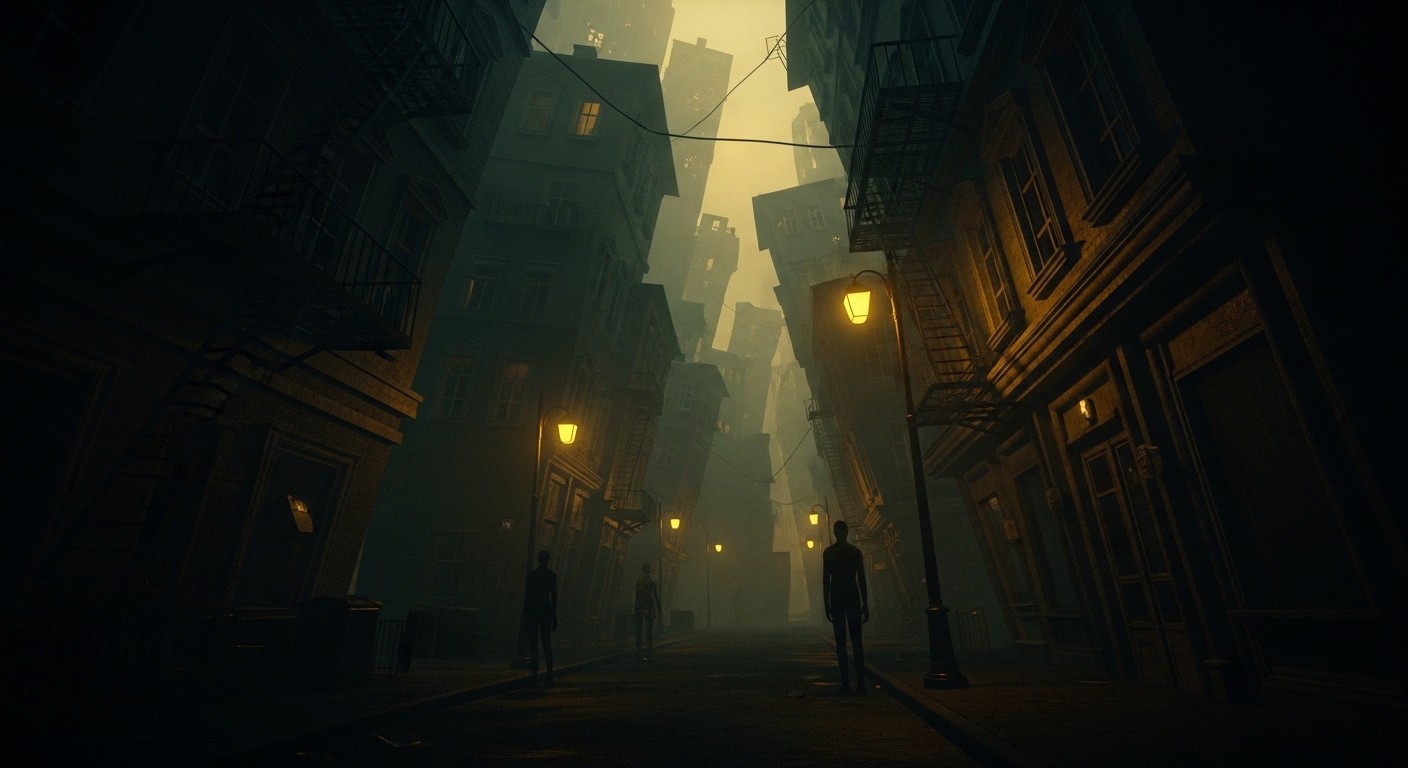
Here They Lie in VR: A Nightmare You’ll Want to Wake Up From
Here They Lie is a first-person psychological horror game developed by Tangentlemen and published by Sony Interactive Entertainment. Released as a PSVR launch title, it was one of the first games to attempt genuinely surreal, narrative-driven horror in virtual reality. The concept is ambitious: you wander through a twisted, nightmarish cityscape where reality fractures and nothing is quite what it seems. The execution, unfortunately, doesn’t match the ambition.
What This VR Option Actually Is
Here They Lie is an official standalone VR game — it was built for PSVR from the ground up and released as a native VR experience on PlayStation 4. There is no flat (non-VR) version. There is no PCVR version. There is no PSVR2 update. It exists exclusively on the original PSVR headset connected to a PS4.
This is important: the game is permanently locked to discontinued hardware. Sony’s original PSVR headset is no longer in production, and the PS5 does not support PSVR software natively through PSVR2. To play Here They Lie in VR today, you need original PSVR hardware connected to a PS4 (or a PS5 with the PSVR adapter, which requires the PlayStation Camera adapter and original PSVR processing unit). This is a significant accessibility barrier.
The game uses the DualShock 4 gamepad for all input. There are no motion controls, no hand presence, and no tracked controllers. You move with the left stick and look with head tracking. The flashlight is mapped to a button. That’s the extent of the interaction.
How It Plays
Controls: Movement is handled entirely through the DualShock 4. You walk through corridors and streets with analog stick locomotion while looking around via head tracking. There is no combat system. There are no motion controls. The game is a walking simulator in the literal sense — you walk, you look, you occasionally sneak past enemies, and you progress through scripted sequences.
Comfort: This is where Here They Lie falls apart. The game features numerous forced camera movements — cutscenes that yank your viewpoint, hallway warping sequences that twist the environment, and scripted camera pans that are genuinely nausea-inducing in VR. Multiple reviewers reported needing to take frequent breaks due to motion sickness. The smooth locomotion combined with forced head movement and environmental distortion effects makes this one of the least comfort-friendly PSVR titles. There are limited comfort options, and the core experience was not designed with VR comfort best practices in mind.
Performance: On original PS4 hardware with PSVR, the game runs at a resolution that was considered low even by PSVR launch standards. The PSVR’s 1080p split display already strains visual fidelity, and Here They Lie does not help itself with its dark, fog-heavy environments. Performance is generally stable but visually muddy. On a PS4 Pro, the experience is somewhat improved but still falls short of what would be considered sharp or clear in VR.
Stability: The game is generally stable with no major crash issues. It’s a linear experience with no complex systems, which limits the number of things that can break. Save points are frequent enough that progress loss is unlikely.
What Works Well
The opening sequence is genuinely unsettling. Wandering through a dimly lit subway station with shadowy figures appearing and vanishing creates real tension — the kind that VR amplifies through spatial presence. For those first thirty minutes or so, Here They Lie delivers on its promise of psychological unease. Being inside the nightmare, checking over your shoulder physically, and not knowing what’s real is effective horror in VR.
The art direction and sound design are ambitious. The surreal cityscapes, distorted architecture, and grotesque creature designs show genuine creative vision. The audio — from growling monsters to ambient drone — creates an oppressive atmosphere that headphones and VR presence enhance significantly.
The concept of a game where you can’t trust your own perception is well-suited to VR. When the world bends and warps around you, being inside it rather than watching it on a screen does add impact that the flat experience cannot replicate.
What Doesn’t Work
The problems pile up quickly after that strong opening:
Comfort failures are the most critical issue. Forced camera movements during cutscenes and the now-infamous hallway-bending sequences are genuinely uncomfortable in VR. This isn’t mild queasiness — it’s the kind of sustained nausea that forces extended breaks and makes the game inaccessible to a large portion of VR users. A horror game that requires you to stop playing because you feel sick, not because you’re scared, has a fundamental design problem.
The enemies are not threatening. Once you realize the monsters don’t react to your flashlight and that death simply respawns you slightly ahead — sometimes even beneficially — the tension evaporates. Stealth sequences become perfunctory walks past props wearing monster masks.
The narrative is overwrought and underdeveloped. The game tries hard to be provocative and surreal but doesn’t seem to know what it’s saying. Notes about sexual content, masked figures gyrating to techno, and heavy-handed symbolism come across as edgy for the sake of edge rather than meaningful horror. The story ultimately amounts to a man confronting guilt over a relationship, told through the most obtuse imagery possible.
The pacing is poor. Legitimately unsettling moments are separated by long stretches of walking through identical corridors with nothing happening. The game is only three to four hours long but still feels padded.
No motion controls or hand presence means the VR implementation is limited to head tracking and stereoscopic 3D. For a game that launched alongside PSVR — when motion controls were the headline feature — this was a notable omission. Interacting with the world through a gamepad in VR undercuts the immersion that VR is supposed to provide.
Platform Situation
Here They Lie is available only on PSVR. There is no PSVR2 version, no PCVR version, and no flat-screen fallback. Sony has not announced any plans to update or re-release the game. The original PSVR is discontinued, and while you can still use it with a PS4 or PS5 (with the appropriate adapter), the hardware is increasingly difficult to find and set up.
This means the game is effectively stranded. Anyone who wants to experience it must source legacy hardware, and there is no path forward for current-generation VR players.
Who This Is For
Good for:
- PSVR hardware owners curious about early VR horror experiments
- Players with strong VR legs who want to experience a genuinely surreal aesthetic
- Horror enthusiasts interested in the historical catalog of PSVR launch titles
Not for:
- Anyone prone to VR motion sickness — this game will be genuinely unpleasant
- Players expecting combat, puzzles, or meaningful interaction
- PSVR2-only owners — there is no compatibility path
- Anyone seeking a polished, modern VR horror experience — games like Resident Evil 7 VR, The Persistence, or even Wandering in VR deliver more refined experiences on the same platform
The Verdict
Tier: D
Game Quality: C Here They Lie has a strong opening and genuine creative ambition in its art direction and sound design. But the narrative is pretentious without being coherent, the pacing drags, the enemies are unthreatening, and the whole experience is only three to four hours of mostly walking. There’s a kernel of a good horror concept here, wrapped in enough padding and forced surrealism that it barely sustains interest.
VR Implementation Quality: D The VR is limited to head tracking and stereoscopic view via a gamepad — no motion controls, no hand presence, no meaningful VR interaction. Worse, the game actively fights against VR comfort with forced camera movements and warping effects that induce nausea. This is not just a game that fails to leverage VR’s strengths; it’s a game whose design choices actively exploit VR’s weaknesses.
Overall Tier: D Here They Lie is a historically interesting PSVR launch title that demonstrates both the potential and the pitfalls of early VR horror. Its strong opening atmosphere cannot sustain an experience that makes players physically ill, offers no meaningful interaction, tells an incoherent story, and is permanently locked to discontinued hardware. There are better ways to spend your time in VR — even on the same platform.