
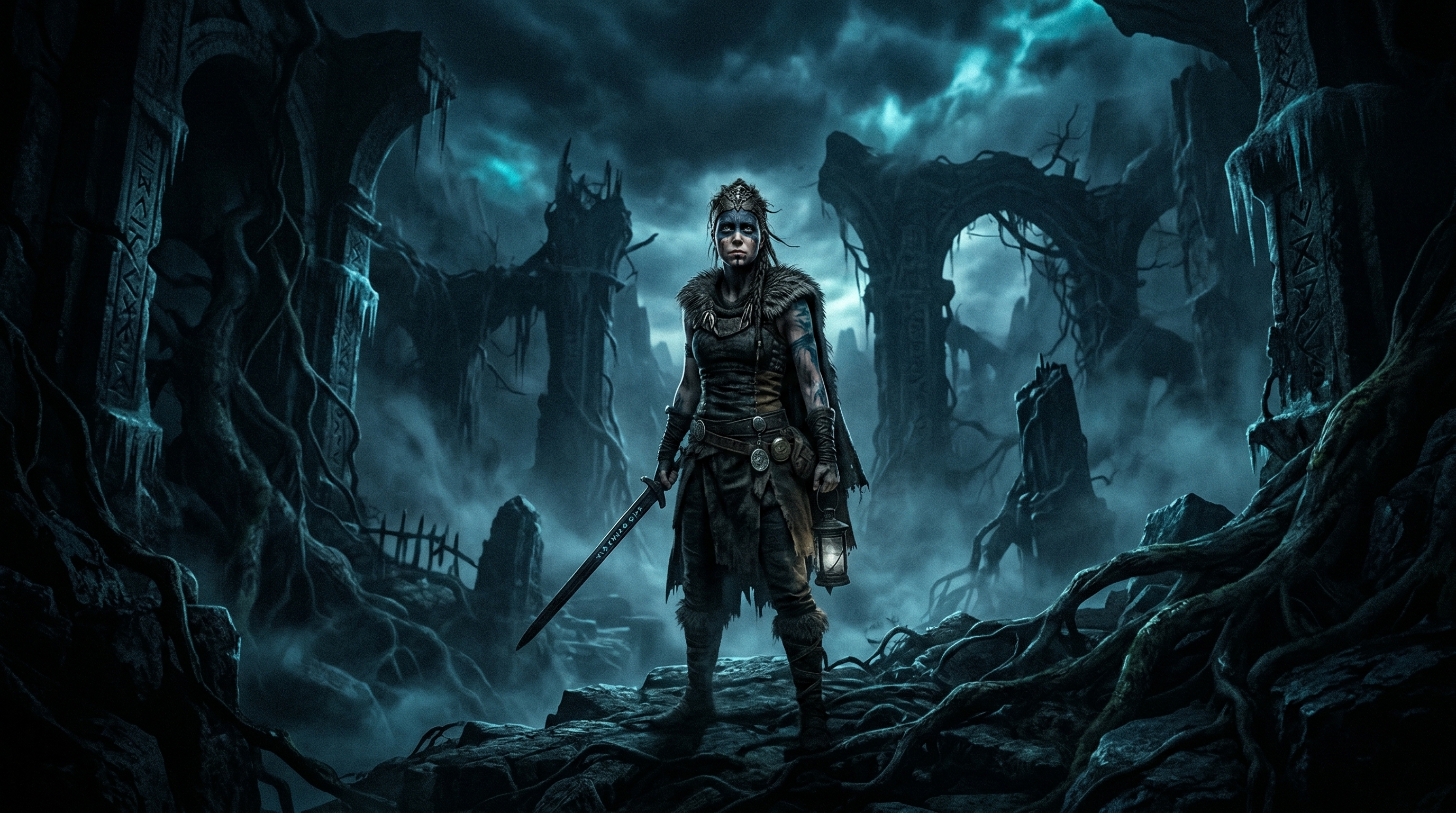
Hellblade: Senua’s Sacrifice in VR: Voices in Your Head, Now in Your Ears
Some games feel like they were destined for VR. Hellblade: Senua’s Sacrifice might not have been built for headsets, but its obsession with sensory distortion, psychological manipulation, and making you feel like you’re losing your grip on reality makes it one of the most compelling official VR conversions available. When the voices whispering in Senua’s head sound like they’re circling your head instead, the game achieves something flat screens simply cannot replicate.
Ninja Theory’s 2017 “independent AAA” action-adventure follows Senua, a Pict warrior descending into Helheim to rescue her dead lover’s soul. It’s a brutal, beautiful, and genuinely uncomfortable journey through psychosis, grief, and Norse mythology. The VR edition—added free for all owners in 2018—takes an already immersive experience and wraps it around your senses. But this is still a third-person game played with a gamepad, and that brings both magic and limitations.
What This VR Option Actually Is
Hellblade’s VR support is an official hybrid update, not a separate product. Ninja Theory added full VR compatibility to the base game in July 2018, making it available free to everyone who already owned the flat version. This is developer-supported, polished integration—not a mod or injection driver.
The implementation provides:
- Full stereoscopic 3D rendering
- Head-tracked camera with multiple view options
- VR-optimized comfort settings
- The complete campaign playable from start to finish
What it does not provide:
- Motion controller support (gamepad or keyboard/mouse only)
- First-person perspective option
- Hand presence or direct interaction
This is fundamentally a third-person action game translated into VR. You control Senua from a trailing camera position while your headset controls where you look. Think of it as playing a console action game where you’re sitting just behind the protagonist, able to crane your neck around the environment at will.
How It Plays
Controls: Gamepad, Not Gestures
The VR edition uses traditional input only. Senua moves with the left stick, camera rotates with the right stick, and combat uses face buttons for light attacks, heavy attacks, dodge, and block. There’s no motion controller support whatsoever—no sword swinging, no gesture-based parrying, no reaching out to interact with the world.
This is the single biggest limitation. Hellblade’s melee combat—light and heavy sword attacks, dodging, blocking, and parrying—works well enough on a gamepad, but you can’t help imagining how visceral it would feel with motion-controlled blades. The “focus” ability, which slows time during combat, looks spectacular in VR, but you’re still pressing buttons to trigger it rather than raising a hand to your temple or some other diegetic gesture.
That said, the gamepad controls are responsive and the combat system is deliberately streamlined. This isn’t Dark Souls complexity; it’s rhythmic, manageable melee with clear timing windows. For what it is, it works.
Comfort: Manageable with Options
Hellblade is a third-person game with a fixed camera following Senua, which eliminates many VR comfort concerns by default. You’re not teleporting or smoothly locomoting through first-person space—you’re watching a character move through environments while you observe from a stable floating position.
Ninja Theory included robust comfort options:
- Snap turning with adjustable angles
- Camera snapping during combat to keep enemies in view
- Smooth rotation for experienced users
- Head-based steering that lets you turn Senua by looking in a direction
The game also employs forced letterboxing during cutscenes—shrinking the view to a cinema-style frame when the camera moves dramatically. This prevents discomfort during the game’s many cinematic sequences, though some users find it immersion-breaking and wish they could disable it.
Combat intensity is moderate. Enemies attack from off-screen, requiring you to spin your head to track threats. One of the Furies (the voices) literally warns you when enemies attack from behind—“Behind you!”—and physically turning to spot the threat feels natural and effective. This is VR-enhanced gameplay, not just VR visualization.
Performance: Demanding but Stable
Hellblade is a visually ambitious game. Even in its original flat form, it pushed hardware with dense environments, complex lighting, and detailed character models. In VR, rendering that same visual fidelity twice (once per eye) at 90fps demands serious GPU power.
The game scales reasonably well, but expect to make compromises on high-end visual settings unless you’re running top-tier hardware. Stability is generally good—this is polished, developer-supported code, not a fragile mod. Occasional stuttering can occur in dense areas, but crashes are rare.
What Works Well
The Audio Transformation
Hellblade’s binaural audio design was already groundbreaking on flat screens. In VR, it becomes genuinely unsettling in the best way. The Furies whispering, mocking, and encouraging Senua move around your head in 3D space. When a voice giggles from your left ear or screams from behind you, the instinct to turn and look is irresistible. The spatial audio implementation is arguably the best reason to play in VR—you’re not just hearing Senua’s psychosis, you’re inhabiting it.
Scale and Presence
Being able to physically crane your neck to examine the massive environments—decaying Norse landscapes, towering structures, rotting flesh-piles of Helheim—adds a sense of scale that’s impossible on a monitor. The “Tabletop” and “Giant” experimental camera modes let you view Senua as a miniature figure or from ground-level at her feet, but even the standard third-person camera benefits enormously from head-tracked freedom.
Combat Awareness
The ability to look around while fighting genuinely improves the combat. Multiple enemies frequently attack from off-screen angles, and being able to track them by turning your head—rather than fighting the camera—makes the encounters feel fairer and more tactical. The audio warnings combined with physical head-turning create a satisfying loop of perception and response.
Complete Content
Unlike many VR conversions that truncate campaigns or disable features, Hellblade’s VR edition includes the full game. All puzzles, all combat encounters, all narrative sequences, all lore collectibles. You can earn every achievement, unlock every secret, and experience the complete story from opening to credits.
Free Upgrade
Ninja Theory gave this to existing owners at no cost. That’s consumer-friendly support that deserves acknowledgment.
What Doesn’t Work
No Motion Controls
This cannot be overstated: you will be pressing buttons to swing a sword. For a game about visceral combat and physical struggle, the absence of motion controller support feels like a missed opportunity. Hellblade’s swordplay is deliberately simple—light attack, heavy attack, block, dodge—but even simple gestures would have added physicality that button presses cannot replicate.
Third-Person Limitations
You are watching Senua, not being Senua. This creates emotional distance that first-person VR experiences avoid. The game’s many close-ups and intimate moments—Senua’s anguished facial expressions, her interactions with her lover’s severed head—are powerful, but you’re observing them rather than embodying them.
Cutscene Letterboxing
The forced cinematic bars during camera-movement-heavy sequences are understandable from a comfort perspective, but they break immersion. You go from full VR presence to watching a movie-in-a-window, and the transition is jarring. The inability to disable this feature frustrates experienced VR users with strong stomachs.
Setup Simplicity, Platform Limitations
While the “setup burden” is minimal (launch the game, enable VR mode), the VR edition is PC-only. Console players on PlayStation and Xbox have no VR option. Additionally, the game targets the original HTC Vive and Oculus Rift era—there’s no native support for newer features like finger tracking, inside-out boundary systems, or advanced haptics.
Who This Is For
Good for:
- Players who want to experience Hellblade’s story with enhanced audiovisual immersion
- VR users comfortable with third-person perspectives and gamepad controls
- Horror and atmospheric game fans who value presence over physical interaction
- Players who found the flat version compelling but wanted deeper sensory engagement
- Those seeking a complete, narrative-driven VR experience without technical tinkering
Not for:
- Players expecting motion-controlled sword combat
- Users seeking first-person immersion or embodiment
- Those prone to discomfort from intense visual sequences
- Players who haven’t played the flat version and want the “definitive” first experience
- Users with lower-end hardware expecting to maintain maximum visual quality
The Verdict
Tier: B
Game Quality: A Hellblade: Senua’s Sacrifice is an exceptional piece of interactive storytelling. Its depiction of psychosis is nuanced, empathetic, and grounded in actual research with neuroscientists and mental health professionals. The combat is serviceable, the puzzles are atmospheric, and the narrative packs genuine emotional weight. As a flat game, it sits comfortably among the generation’s most memorable titles.
VR Implementation Quality: B The VR conversion is polished and thoughtful, with strong comfort options and genuinely transformative audio. The absence of motion controls and the third-person camera perspective create unavoidable limitations, but what’s here works well. The binaural audio alone justifies the VR mode for many players.
Overall Tier: B Hellblade in VR is a strong recommendation with caveats. If you already own the game, the free VR upgrade is an easy yes—the enhanced audio and scale add meaningful value. If you’re buying specifically for VR, understand that this is a seated, gamepad-controlled, third-person experience. The immersion is real, but it’s observational immersion, not embodied immersion. For narrative-driven atmospheric games, that’s often enough. For action-combat enthusiasts seeking physical swordplay, it isn’t.
The voices in Senua’s head were always the star of the show. In VR, they finally get to whisper directly into yours.
Sources Consulted:
- UploadVR review and gameplay analysis (2018)
- Wikipedia entry for Hellblade: Senua’s Sacrifice (VR support details)
- Ninja Theory official announcements regarding VR update
- Community reports on Steam and VR subreddits
- Training data on binaural audio implementation and psychosis representation
Note: This article was compiled through research synthesis. For the most current compatibility information, consult community resources and recent user reports.