
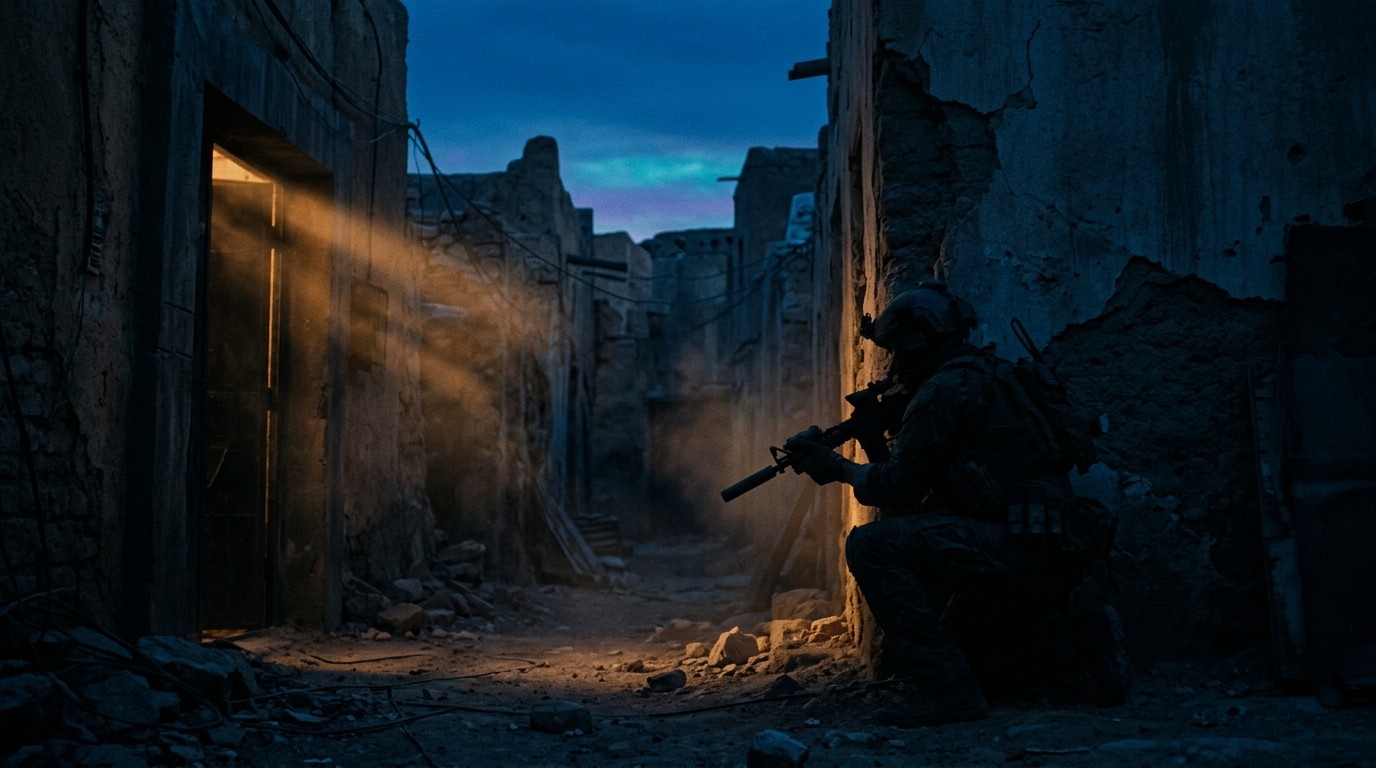
The AK-47 kicks harder in VR than I expected. In flat Counter-Strike 1.6, the CV-47 is a known quantity — a diagonal line of pixels, a sound cue, a rhythm of counter-strafe and spray. In CSVR, it’s a two-handed object that recoils through your wrists, and your instinct to flick to a headshot becomes an actual physical motion in a 12-by-12 play space. The first hour is humbling. The second hour is something I didn’t think I’d ever see: Counter-Strike, the most mouse-and-keyboard shooter ever made, making sense in a Quest 3.
What the VR Option Actually Is
There is no official VR support for Counter-Strike, and until early 2026 there was no real way to play it in a headset at all. The only viable path is CSVR, a standalone VR port built by Team Beef Studios — the same group behind Lambda1VR and the Quest ports of Doom, Quake, and Prey. It launched on SideQuest on January 11, 2026, and it’s built on the Xash3D-FWGS engine reimplementation of GoldSrc.
This is not a wrapper or a screen-in-headset solution. CSVR gives you 6DOF controller tracking, room-scale movement, two-handed gun handling, smooth locomotion, in-headset server hosting, bot matches, online PvP, team chat, and crossplay with the Android Xash CS 1.6 client. It requires a $10 copy of Counter-Strike 1.6 on Steam to supply the valve and cstrike game folders, and installation is a SideQuest sideload plus a file copy. A PC is only needed for setup.
It also supports bHaptics gear if you own a vest or arm bands, which is the kind of detail that tells you this is a passion project rather than a proof of concept.
How It Actually Plays
The surprise is how much of CS 1.6 survives the transition. de_dust2 is still de_dust2. The buy menu, the round timer, the economy, the bomb sites — all intact. What changes is the aiming. Mouse flick aim is replaced by physical arm aiming, and the skill ceiling resets completely. A decade of CS muscle memory doesn’t transfer; instead you’re learning to brace a virtual rifle, snap your wrist to track a target, and manage recoil as a physical rhythm. It turns the game into a different kind of contest — less about pixel-perfect crosshair placement, more about body positioning, stance, and steady hands under pressure.
Movement is smooth and fast. Too fast, sometimes. Counter-Strike was designed around WASD strafing and bunny-hopping, and that DNA doesn’t go away in VR. You can still move quickly, but your vestibular system now has to track it. This is not a game for VR beginners or anyone prone to motion sickness. I had to take breaks after competitive matches, and even standing still in a firefight while rotating my view created a moment of dissonance. The comfort profile is intense, full stop.
That said, the gunplay itself is satisfying. Aiming down sights with two hands feels natural once you stop treating the controllers like a mouse. Reloading is a button press, not a manual gesture, which keeps the pace intact. Melee is a wrist flick. Grenades arc roughly where you’d expect. Bot matches are the best way to acclimate; jumping straight into online PvP against players who’ve already adjusted is a fast way to feel old and slow.
Performance is efficient. CS 1.6 is a lightweight GoldSrc game, and even on a Quest 2 the mod holds frame rate in complex map areas. The networking, given that you can host a server from the headset, is more stable than it has any right to be. Team chat works. Crossplay with the Android Xash client works. It’s a real multiplayer Counter-Strike loop in standalone VR, which still feels slightly impossible.
What’s Good and What Isn’t
The best thing about CSVR is that it doesn’t treat the source material like a museum piece. Team Beef rebuilt it as a shooter that belongs in a headset. The 6DOF aiming, the room-scale ducking behind cover, the physical snap-up of an AWP — these aren’t gimmicks; they reframe the game. Playing office or Italy in room scale changes how you use cover in a way that flat CS never could. The maps were always three-dimensional spaces; VR finally lets you occupy them that way.
The biggest limitation is the comfort barrier. A fast tactical FPS with smooth locomotion is one of the most intense things you can do in VR, and CSVR doesn’t soften the edges. There are no teleport options, no comfort vignettes, no concessions to sensitive stomachs. You either have the VR legs or you don’t. I do, mostly, and I still had to pace myself.
The other limitation is the skill reset. If you’re coming in expecting to dominate because you were Global Elite in 2014, prepare to be out-aimed by someone with better wrist discipline and no mouse latency to rely on. That’s not a flaw of the mod — it’s the honest reality of transposing a precision shooter into physical space. But it means the audience skews toward people who want to learn a new version of an old game, not people who want their old game to work exactly the same way.
Setup is moderate friction by Quest mod standards. SideQuest is familiar territory for anyone who sideloads, and the file-copy requirement is clearly documented. But it’s still sideloading, still file management, still a separate Discord for support. This is not a store app you install in one tap.
Who Should Bother
CSVR is for Counter-Strike veterans who own a Quest or Pico and want to see what the game feels like when aim becomes physical, not digital. It’s for players who already have VR legs and are comfortable in fast shooters like Pavlov, Ghosts of Tabor, or Contractors. It’s not a replacement for flat CS 1.6 — the competitive balance and precision are different — but it’s a genuine alternative that captures enough of the original’s tension to be worth the time.
For anyone who loves the idea of Counter-Strike in VR but gets queasy in smooth-locomotion shooters, this is not the mod that changes that. The implementation is strong enough that it’s worth considering whether you want to build up tolerance for it. But go in honest about the comfort cost.
Counter-Strike in VR shouldn’t work. CSVR proves it can, with real multiplayer, real maps, and real gun handling. It just asks you to relearn how to aim, and maybe take an aspirin first.