
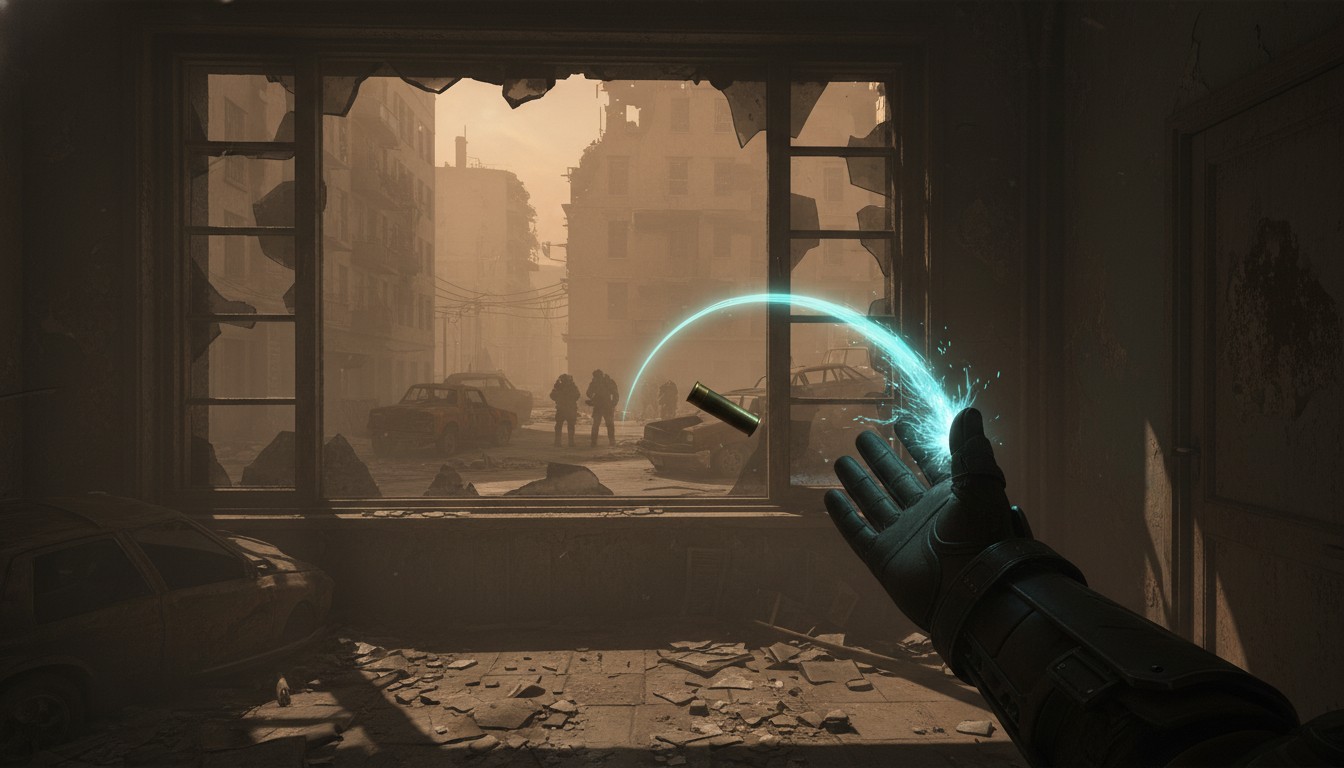
There is a moment in Half-Life: Alyx when the tutorial finally dissolves and the game simply becomes how you move through the world. You are crouched behind a rusted sedan, shotgun empty, and a Combine soldier is closing the distance. You point at a box of shells across the street, flick your wrist, and the box arcs through the air and slaps into your waiting palm. You breach the shotgun, feed shells in one at a time with your actual hands, and lean out just far enough to fire around the bumper. That is not a scripted sequence. That is the baseline. And it is why Alyx, years after release, remains the standard against which every VR campaign is measured.
This is not a port. Valve built Half-Life: Alyx exclusively for VR from the ground up on the Source 2 engine, and there is no flatscreen version. Released in March 2020 as a prequel to Half-Life 2, it exists only in headsets. Every system — combat, exploration, puzzle-solving, inventory — assumes you have two tracked hands and a head. The result is a game that would make no sense outside of VR.
The Gravity Gloves, or “Russells,” are the clearest expression of that design philosophy. Point at an object, flick your wrist, and it flies to your hand. It solves the eternal VR annoyance of bending to pick up loot without breaking the fiction. The mechanic is functional first — you need ammo, resin, and health items constantly — and satisfying second. Once it becomes muscle memory, you stop thinking about interface and start thinking about spatial geometry: what can I grab from here without exposing myself?
Combat demands physicality. Cover is real cover because you physically duck and lean. Aiming is steady because you brace your actual arms. Reloading is manual and weapon-specific: the pistol uses magazines, the shotgun loads shells individually, and each action takes real time. Under pressure, you will fumble a reload. That friction is intentional; it makes every encounter feel consequential.
The Rubikon physics engine gives environmental objects convincing weight and momentum. Almost everything can be picked up, thrown, stacked, or shattered. Drawers slide open. Bottles break. Explosive barrels can be maneuvered with two hands. This creates a playground quality to the world that rewards idle curiosity — which the level design then folds back into progression, hiding essential items in logical but not obvious places.
Locomotion is comprehensive. The default Blink option teleports you with a screen fade, the safest choice for motion sensitivity. Shift offers a faster teleport with less fade. Continuous smooth locomotion is available for players who want free movement, with orientation tied to either head or hand direction. Turning can be snap or smooth. Comfort tools include vignettes that narrow the field of view during movement, and the game supports seated play. Valve clearly designed around accessibility without treating it as an afterthought.
The campaign runs roughly eight to fifteen hours, depending on thoroughness, and the pacing alternates between quiet atmospheric exploration and intense combat beats. The environmental storytelling is among the best in the series, conveying narrative through graffiti, abandoned apartments, and audio logs rather than cutscenes. For players who want more, the Steam Workshop hosts over a thousand community mods, including full campaigns, though those vary widely in polish.
The caveats are hardware and availability. Minimum specifications are modest on paper, but for stable 90fps at comfortable settings you will want hardware well above the floor. The game employs dynamic resolution scaling to maintain framerate, which means visual fidelity can dip in heavy scenes. Some users experienced crashes near launch, typically resolved by lowering SteamVR render resolution. Valve has not shipped significant post-launch updates, though the build has remained stable. The larger issue is that there is simply no way to play without VR hardware. If you do not own a headset and a gaming PC, this game is inaccessible.
If you own a PCVR headset and your system is mid-range or better, ownership should be automatic. It is the closest thing the platform has to a system seller, not because of marketing but because the execution is so coherent across every axis: controls, comfort, physics, pacing, and sound design. If you are sensitive to motion sickness, the default teleportation settings are genuinely manageable. If you are running minimum hardware, expect to compromise on sharpness. If you do not have VR hardware, this is not an option at all.
Half-Life: Alyx is the benchmark. That is praise, but it is also an indictment of the years that have followed. Few VR campaigns have matched its consistency. It is not perfect — it is demanding, it is gated behind expensive hardware, and its mod community produces mixed results. But within the boundaries of what it attempts, it is as good as PCVR gets.